



Array ( [0] => 8 [1] => 10155 )

Podcast K44

Cronaca

  • Casello A14 di Riccione chiuso per autocisterna in fiamme

    Casello A14 di Riccione chiuso per autocisterna in fiamme

    Un'autocisterna carica di carburante si è ribaltata e ha preso fuoco nei pressi del casello A14 di Riccione nel primo pomeriggio del 18 giugno 2026, causando due feriti ma nessuna vittima accertata. Vigili del Fuoco da Rimini, Forlì e Pesaro sono intervenuti per spegnere l'incendio e gestire il traffico bloccato …

Transpotalk

Normativa

Mare

  • Noli container ai massimi da settembre 2024

    Noli container ai massimi da settembre 2024

    Il World Container Index di Drewry sui noli medi spot del trasporto marittimo di container sale del 5% nell’ultima settimana completa di giugno 2026, spinto dal transpacifico in piena tensione. Asia-Europa resta stabile ma con capacità limitata, mentre la tregua Usa-Iran allenta i rischi sullo Stretto di Hormuz senza eliminarli …

Autotrasporto

  • Schmitz Cargobull aggiorna il semirimorchio per container

    Schmitz Cargobull aggiorna il semirimorchio per container

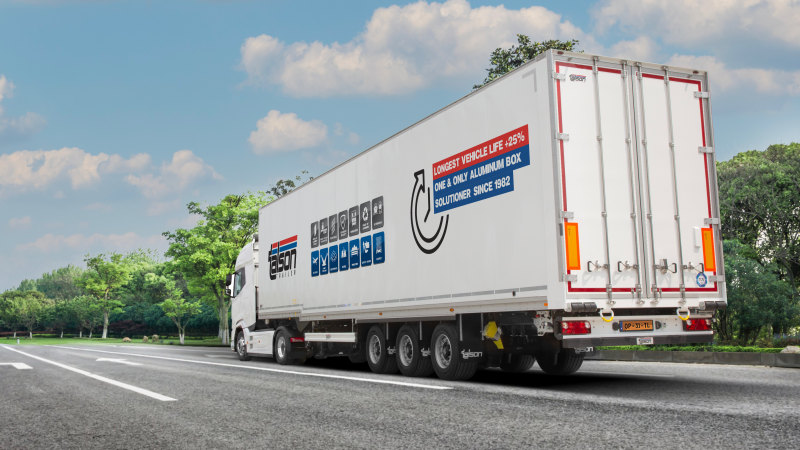
    Schmitz Cargobull rinnova il semirimorchio per container S.CF Allround 20-45 e lo presenta nel quadro dell'anteprima Iaa 2026 a Vreden, insieme a nuovi semirimorchi per il freddo, la distribuzione urbana e una strategia di riduzione del costo totale di esercizio.

    Volatile demand and limited capacity at the heart of European road haulage

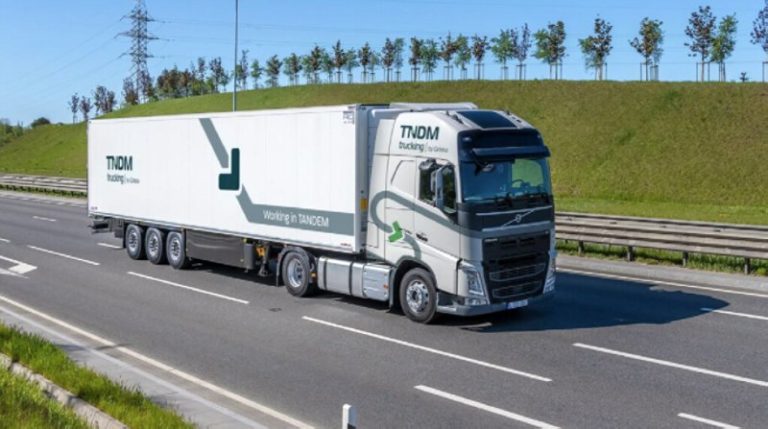
    The European road freight market is going through a more complex phase than the traditional cycles observed in the past, according to an analysis released in December 2025 by Lithuanian haulage giant Girteka. By the end of 2025, the cooling seen in autumn did not translate into either a real contraction or a clear recovery, but rather into a condition of ongoing volatility that has now become the sector’s new operating baseline. Transport demand remains uneven and highly sensitive to short-term changes, while available capacity in Europe is structurally insufficient to manage sudden swings in volumes.

    Manufacturing activity in the euro area continues to hover around the threshold between expansion and contraction, with indicators reflecting widespread fragility. In this context, a paradox has emerged: overall weak demand coexists with a market that no longer has an adequate surplus of industrial vehicles. The traditional reserve of trucks ready to absorb traffic peaks has largely been depleted, making the system less elastic and more exposed to sudden tensions.

    Analysts explain that this reduction in capacity cannot be traced back to a single event, but is the result of a process that began in the post-pandemic period and accelerated during the slowdown of 2023–2024. In those years, insolvencies in the European transport and storage sector rose by around 180% compared with historical levels, forcing many small and medium-sized carriers out of the market. Many of the operators that survived downsized their fleets or postponed investments, contributing to a structural contraction in supply.

    Unlike demand, capacity takes a long time to rebuild. Operators remain cautious about purchasing new vehicles because of rising compliance costs and regulatory uncertainty. Tolls, reporting obligations and cross-border rules are constantly evolving, making long-term investment planning more complex. According to Tomas Šilinikas, pricing director at Girteka, even when demand cools the market no longer has enough vehicles to absorb fluctuations, which is why spot rates do not collapse in the way seen in the past.

    The picture is further compounded by the driver shortage, which in 2024 reached 426,000 unfilled positions across Europe. An ageing workforce and limited inflows of new drivers further compress capacity elasticity. As a result, even if more vehicles were available, there would not be enough human resources to put them into operation, with direct effects on the continuity of transport networks.

    According to Girteka, current volatility therefore does not appear to be a cyclical phenomenon set to fade with an economic recovery. Several factors combine to make it structural. Macroeconomic indicators point to modest growth, driven mainly by domestic consumption rather than exports, resulting in logistics flows that are highly sensitive to shifts in confidence. Energy costs, while more stable than during the 2022 crisis, remain exposed to geopolitical tensions and continue to have a rapid impact on cost structures.

    Regulatory pressure represents a further element of instability. CO₂-based toll increases introduced in Germany marked a turning point, while in the Netherlands the eurovignette is set to be replaced by a distance-based charging system by mid-2026. Other member states could follow the same path. In several European markets, emissions- and distance-related tolls account on average for around 14% of total transport costs, with peaks of about 23% on specific routes, and further increases are expected as kilometre-based systems are expanded.

    Added to these factors are the effects of climate change. Heatwaves affecting agricultural flows, floods damaging infrastructure and increasingly frequent extreme events introduce elements of operational unpredictability that require rapid adaptation across the entire logistics chain.

    In this scenario, operators are revising their strategies with a focus on network resilience. The response goes beyond faster reactions and involves designing systems capable of absorbing shocks without interrupting service. Girteka says that long-term contracts play a central role. With spot rates weakening in the final part of 2025, the gap with contractual prices has narrowed, strengthening interest in stable agreements that guarantee access to capacity in a structurally tight market.

    At the same time, the digitalisation of processes is advancing. Predictive analytics, real-time visibility and scenario simulations make it possible to identify bottlenecks, redirect flows and optimise asset deployment on a regional scale. Data management is becoming as central as the management of physical assets, with a direct impact on operational reliability.

    Pricing models are also evolving. Flexible clauses for fuel and tolls, dynamic adjustment mechanisms and shorter tender cycles allow risk to be shared between carriers and shippers, while preserving the stability of long-term relationships. From the shippers’ perspective, attention is gradually shifting from cost containment alone to risk management. More robust supply chains are built on collaboration, forecast sharing, transparent volume commitments and joint planning linked to seasonality and regulatory changes.

    Girteka’s analysis concludes with an outlook for 2026 pointing to slow stabilisation, with modest European economic growth driven mainly by household consumption. At the same time, operational complexity is set to increase. Regulatory costs, environmental reporting obligations and ESG requirements will increasingly influence capacity availability and price formation. Logistics networks designed solely around cost optimisation are more exposed to sudden shocks, while those oriented towards operational continuity show a greater ability to adapt.


    © TrasportoEuropa - Riproduzione riservata - Foto di repertorio
    Segnalazioni, informazioni, comunicati, nonché rettifiche o precisazioni sugli articoli pubblicati vanno inviate a: redazione@trasportoeuropa.it


      Puoi commentare questo articolo nella pagina Facebook di TrasportoEuropa

      bottone newsletter piccolo Vuoi rimanere aggiornato sulle ultime novità sul trasporto e la logistica e non perderti neanche una notizia di TrasportoEuropa? Iscriviti alla nostra Newsletter con l'elenco ed i link di tutti gli articoli pubblicati nei giorni precedenti l'invio. Gratuita e NO SPAM!


    CONTENUTI SPONSORIZZATI


Videocast K44

Aereo

  • Lufthansa Cargo avvia il nuovo hub merci a Francoforte

    Lufthansa Cargo avvia il nuovo hub merci a Francoforte

    Lufthansa Cargo avvia la prima fase del progetto LCCevo nell’aeroporto di Francoforte da 600 milioni di euro, che entro il 2030 trasformerà il Lufthansa Cargo Center nello scalo aereo merci più moderno d'Europa. In parallelo la compagnia lancia nuovi servizi digitali su WeChat per il mercato cinese.

Persone

Schmitz Cargobull aggiorna il semirimorchio per container

TECNICA

Schmitz Cargobull aggiorna il semirimorchio per container
Renault Trucks estende l’autonomia dei suoi camion elettrici

TECNICA

Renault Trucks estende l’autonomia dei suoi camion elettrici
Alleanza Octopus-Catl su scambio batterie per camion elettrici

TECNICA

Alleanza Octopus-Catl su scambio batterie per camion elettrici
Il camion europeo si prepara alla crescita della Difesa

TECNICA

Il camion europeo si prepara alla crescita della Difesa
Still aggiorna quattro gamme di sollevatori e transpallet

TECNICA

Still aggiorna quattro gamme di sollevatori e transpallet
previous arrow
next arrow
La crisi dei chip e delle memorie colpisce la logistica

LOGISTICA

La crisi dei chip e delle memorie colpisce la logistica
La Cassazione conferma la qualifica di spedizioniere-vettore

LOGISTICA

La Cassazione conferma la qualifica di spedizioniere-vettore
L’interporto di Trieste chiude il 2025 con utili record

LOGISTICA

L’interporto di Trieste chiude il 2025 con utili record
El Niño 2026 minaccia anche la logistica

LOGISTICA

El Niño 2026 minaccia anche la logistica
Liguria ospite d’onore al China International Supply Chain Expo 2026

LOGISTICA

Liguria ospite d’onore al China International Supply Chain Expo 2026
previous arrow
next arrow
Gasolio agricolo sui camion, cinque arresti in Puglia

ENERGIE

Gasolio agricolo sui camion, cinque arresti in Puglia
Il Gnl cresce in Italia ma rallenta nell’autotrasporto

ENERGIE

Il Gnl cresce in Italia ma rallenta nell’autotrasporto
Fiap avverte che una causa sul cartello carburante è prematura

ENERGIE

Fiap avverte che una causa sul cartello carburante è prematura
Bruxelles approva il regime italiano da 23 miliardi per le rinnovabili

ENERGIE

Bruxelles approva il regime italiano da 23 miliardi per le rinnovabili
Operazione Red Gold contro frode nei carburanti in Abruzzo

ENERGIE

Operazione Red Gold contro frode nei carburanti in Abruzzo
previous arrow
next arrow
La logistica è tra le attività più colpite dai ciberattacchi nel 2025

SERVIZI

La logistica è tra le attività più colpite dai ciberattacchi nel 2025
Il rischio Dogana non è più solo amministrativo

SERVIZI

Il rischio Dogana non è più solo amministrativo
Sicurezza certificata da Tapa nella borsa carichi Trans.eu

SERVIZI

Sicurezza certificata da Tapa nella borsa carichi Trans.eu
Due attentati a Sicily by Car con fuoco e kalashnikov

SERVIZI

Due attentati a Sicily by Car con fuoco e kalashnikov
L’innovazione di Geotab punta su sicurezza e Pmi

SERVIZI

L’innovazione di Geotab punta su sicurezza e Pmi
Gaston Schul cresce nelle spedizioni genovesi con Parodi Forwarding

SERVIZI

Gaston Schul cresce nelle spedizioni genovesi con Parodi Forwarding
L’Italia è molto esposta nel cibercrimine nel trasporto e logistica

SERVIZI

L’Italia è molto esposta nel cibercrimine nel trasporto e logistica
Carta DKV per ricaricare il camion elettrico

SERVIZI

Carta DKV per ricaricare il camion elettrico
Video | Dkv al Transpotec oltre la carta carburante

SERVIZI

Video | Dkv al Transpotec oltre la carta carburante
Zucchetti presenta una logistica digitale integrata software e robot

SERVIZI

Zucchetti presenta una logistica digitale integrata software e robot
Golia360 punta sulla digitalizzazione per gli autisti

SERVIZI

Golia360 punta sulla digitalizzazione per gli autisti
Come la logistica può guadagnare dalle multe Antitrust

SERVIZI

Come la logistica può guadagnare dalle multe Antitrust
Tra Genova e Barcellona l’asse della formazione per la logistica

SERVIZI

Tra Genova e Barcellona l’asse della formazione per la logistica
Transporeon introduce la ricerca con l’intelligenza artificiale

SERVIZI

Transporeon introduce la ricerca con l’intelligenza artificiale
Nasce Synlog Alliance consorzio dati per la logistica

SERVIZI

Nasce Synlog Alliance consorzio dati per la logistica
previous arrow
next arrow