






- Transporting empty containers is not a marginal effect of the recovery in traffic, but a structural component of the system: UNCTAD (United Nations Conference on Trade and Development) estimates that, under normal conditions, about 20% of maritime containers travel empty, and widening imbalances between Asia, Europe and North America have multiplied the scale of the phenomenon.
- Repositioning empty containers now accounts for 30% of the sector’s global workload measured in TEU-miles, compared with 24% before the pandemic. Since the first quarter of 2019, empty containers transported have increased by 65%, while full containers have risen by only 17%, with overall demand up by 40%.
- Blank sailings are amplifying the imbalance: on the four main East-West routes, carriers are consistently withdrawing between 10% and 14% of scheduled capacity. On the Asia-US East Coast route, cancelled capacity has increased by 215% compared with 2019, against a 46% rise in scheduled capacity.
On 13 August 2026, Maersk presented its second-quarter results, showing revenue of $15.8bn, about €13.7bn, up 20% on the same period in 2025, with its operating margin back at 10% and an upward revision to its full-year guidance. In its explanation to the markets, however, the Danish group linked the resilience of freight rates not only to demand, but to the combination of expected market growth of around 4% and a growing imbalance between headhaul volumes and return volumes, often involving empty containers, which is reducing the capacity actually available: "Strong and widespread demand from the Far East since 2024 has made trade flows much more imbalanced," chief executive Vincent Clerc said. Empty containers are precisely where carriers’ accounts and the physical work of terminals diverge. A market growing by 4% in full cargo does not generate an equivalent increase in handling: in its results conference, Maersk put effective handling demand for terminals at between 7% and 8%, almost twice as much, because of higher empty-container movements.
Confirmation of the scale of the phenomenon comes from Danish consultancy Sea-Intelligence, which has recalculated the weight of empty containers in the total work carried out by the global fleet. Measured in TEU-miles, the repositioning of empty containers now absorbs 30% of total container shipping activity, compared with 24% before the pandemic. Since the first quarter of 2019, empty containers transported have risen by 65% and full containers by 17%, against total demand growth of 40%: in practical terms, Sea-Intelligence analysts explain, shipping lines are now moving twice as many empties as before the pandemic once voyage length is taken into account. Expressed as a ratio, the same imbalance is even clearer: for every ten miles travelled by a full container, 4.1 miles are now needed by an empty one, compared with 3.1 in 2019. According to the analysts, the cause lies in widening trade imbalances between macro-regions: where flows are asymmetric, carriers have to return equipment to where it is needed, absorbing the cost and capacity.
This imbalance is not a recent phenomenon; indeed, it has a well-established structural basis. UNCTAD estimates that, under normal conditions, about 20% of maritime containers are repositioned empty, precisely because of asymmetric trade flows. The difference compared with the past is therefore not the existence of the phenomenon, but its scale and the speed at which it has grown. More recently, a strong push has come from Chinese exports of components for electrification, data centres and electric vehicles. A concrete European example can be found at the Port of Rotterdam, the continent’s main gateway for imports from Asia. In the first half of 2026, the number of empty containers at the Dutch port rose by 60% compared with 2020. For a European port, this accumulation is the arithmetic consequence of imports from Asia exceeding exports to the east, while for the Asian exporter the problem is a shortage of equipment.
A second variable is slowing the container cycle, acting on the number of opportunities available to move boxes: in the first half of 2026, shipping lines consistently reduced between 10% and 14% of scheduled capacity on the four main East-West routes through blank sailings, a practice that Sea-Intelligence describes as a structural change in carrier behaviour rather than a temporary adjustment. The comparison with 2019 shows how much more withdrawn capacity has grown than deployed capacity: on the Asia-US East Coast route, scheduled capacity rose by 46% while cancelled capacity increased by 215%; on the Asia-Mediterranean corridor, the ratio was 56% versus 159%; on Asia-North Europe, 20% versus 83%; and on Asia-US West Coast, 16% versus 62%. Every blank sailing is also a lost opportunity to return empty containers to where they are needed, adding to the need to lengthen routes because of geopolitical tensions. C.H. Robinson reports that equipment availability is becoming less predictable, especially in some regions, because containers remain tied up in extended voyages or are repositioned outside normal flows, with localised shortages particularly in South Asia and parts of Africa.
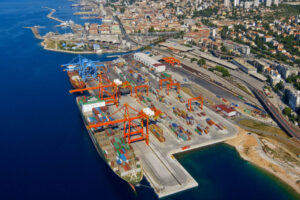
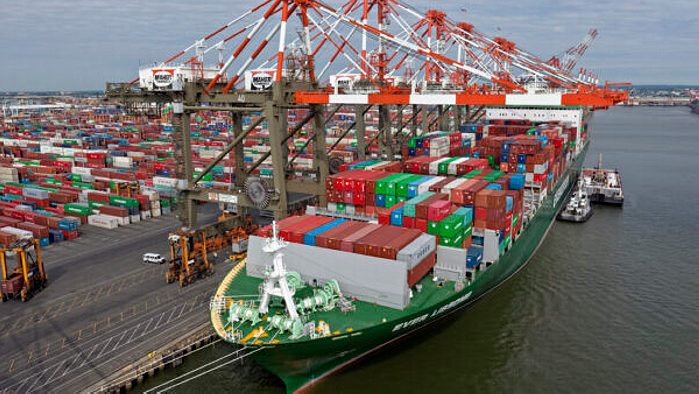
The phenomenon does not end at port quays, because empty containers occupy slots, require gate appointments, inland transfers and yard rehandling. These are actions that generate less value than a full container, and in a terminal already close to saturation, an increase of just a few percentage points can erode productivity and punctuality. In addition, the cost of repositioning rarely appears as a separate surcharge, while in most cases it is built into the headhaul rate on high-volume routes. That means it is paid by the shipper moving goods in the remunerative direction. In peripheral markets, the penalty is even greater: when empty containers are scarce, UNCTAD notes, the importer bears not only the freight cost of the full container but also the cost of keeping the empty unit tied up, while South America and West Africa face longer routes, limited return flows and weaker bargaining power at the same time.
In ports and terminals, a surplus of empty containers affects capacity, because planning yards, gates and rail links solely on the basis of full-container volumes underestimates the real workload when the share of empty moves increases. Returning to Maersk’s analysis, the gap between market growth and the effective load on terminals appears to be the most immediate measure of this. For shippers and freight forwarders, procurement strategy must therefore include not only the ocean freight rate but also the real availability of equipment, container collection times, return conditions and detention and demurrage items.
Mara Gambetta