







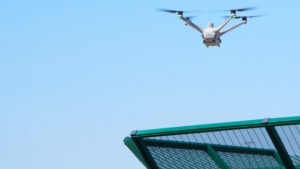
Since the end of July 2026, two drones have been flying over the 185 kilometres of Italian motorway network managed by Milano Serravalle-Milano Tangenziali, which includes the A7 Milan-Genoa motorway and the ring roads serving the Lombardy capital. They are at the centre of a six-month trial for real-time traffic monitoring and are not used to detect offences. The two Dji Matrice 4DT drones operate at the Milano Ovest toll barrier on the A7, where traffic is heaviest, and on the Bereguardo-Pavia motorway link, a section with less extensive fixed-camera coverage. In both areas, “nests” have been installed, using Dji Dock 3 stations where the aircraft can remain stationed, recharge and take off autonomously. The drones are piloted remotely by Enav-certified staff from the control centre and are equipped with hybrid zoom systems and infrared cameras. This equipment allows them to detect accidents and congestion up to 13 km away, including at night, while flying at a maximum altitude of 120 metres. When an intervention request is received, they can take off in around 100 seconds and operate continuously for 16 hours a day, seven days a week, in Bvlos mode, meaning remote piloting beyond the operator’s direct line of sight.
The trial includes **two types of mission: planned flights for periodic monitoring of the network, and on-demand flights activated in response to accidents, queues, fires or obstacles on the carriageway. The motorway company estimates that the use of drones could increase monitoring capacity by up to 50% compared with traditional tools, on a network that recorded around 41 million transits in 2025 and where the traffic control centre has managed around 18,000 events over the past 12 months.
The initiative has, however, opened a debate on privacy and transparency. A drone flying over a motorway does not record only the road surface, but also number plates, passengers’ faces and driving behaviour, and the concessionaire’s statement does not specify who owns these data, how long they are stored or who can access them. The ambiguity carries particular weight because the trial is part of a broader digitalisation programme that will soon integrate a predictive platform able to cross-reference data on traffic conditions and infrastructure anomalies automatically. There is also an economic dimension: a Bvlos system with a drone control centre operating 16 hours a day and certified pilots involves additional costs.
This is not Milano Serravalle’s first drone trial. In July 2022, the company conducted an initial test on a critical section of the A7, near the construction site for the refurbishment of the bridge over the Po river, using two types of drones with different optical systems and a streaming link to the radio control centre. The current phase represents its operational evolution, on a wider scale. At the end of the six-month trial, the service is expected to move into full operation from the first quarter of 2027, with the addition of two more drones.
Marco Colloredo, Operations, Operations Management, Innovation and Strategy director at Milano Serravalle Milano Tangenziali, explained the practical value of the system with a concrete example: in the event of an accident involving a road tanker, the drone would immediately identify the area affected and the safety distance to be maintained, allowing the operations centre to activate maintenance and rescue teams more quickly. Colloredo added that integration with the traffic control centre’s management system increases response capacity, while integration with the new digital platform for traffic management, due to be released in autumn 2026, will allow further data on traffic and infrastructure anomalies to be collected automatically, improving the system’s analytical capacity and predictive capability. The launch of the trial was timed to coincide with the summer holiday departure weekends, when traffic towards holiday destinations is heaviest.
P.R.