






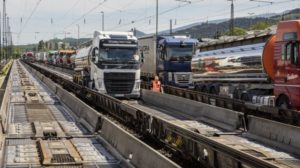
Six European rail and intermodal associations contest the structure of the new Directive on the weights and dimensions of industrial vehicles, endorsed as a general approach by the European Council on 4 December 2025, arguing that it favours road haulage without ensuring a genuine reduction in the environmental footprint of logistics. According to the joint declaration, the “Screening Freight Transport” package, presented by the Commission in summer 2023, promised “greater economic benefits with lower environmental impact”, yet the balance between these two objectives has been compromised in the current version of the Directive on weights and dimensions.
In the note signed by Cer (Community of European Railway and Infrastructure Companies), Erfa (European Rail Freight Association), Rff (Rail Freight Forward), Uip (International Union of Wagon Keepers), Uirr (the European association for intermodal freight transport) and Unife (European Rail Supply Industry Association), the associations highlight that road haulage stands to gain significant economic advantages from the new rules, while the environmental benefits envisaged in the original package risk being postponed and weakened. Their core criticism is that the Directive, in its current form, further widens the competitiveness gap between road and rail, prolonging an imbalance that has penalised rail and intermodal freight for years.
According to Cer, which represents railway undertakings, infrastructure managers and wagon leasing companies across Europe, the proposal on revising weights and dimensions had been conceived to proceed “in parallel” with the revision of the Directive on combined transport. Only a consistent strengthening of the framework for combined transport would make all land-based modes more efficient, support a more sustainable European logistics system and contribute to the goals of the “Clean Industrial Deal” by promoting rail freight and intermodal solutions. In this context, the Commission’s decision, set out in the 2026 Work Programme, to withdraw the proposal revising the Directive on combined transport is described as a negative signal that must be factored into the assessment of the Directive on lorry weights and dimensions.
Erfa, representing private and independent rail freight undertakings operating within the Single European Railway Area, focuses particularly on the competitive dimension. In a freight market highly sensitive to cost, any facilitation of cross-border operations for lorries belonging to the so-called European Modular Systems (Ems) makes rail freight and intermodal solutions less attractive. According to the association, this contradicts the European Union’s stated aim of strengthening the internal market by rebalancing transport modes, promoting high-capacity options such as rail, improving energy efficiency and reducing emissions, road accidents and congestion.
Rail Freight Forward, the coalition of rail freight companies committed to reducing the environmental impact of freight transport in Europe, stresses the risk of reverse modal shift: making point-to-point road transport more economically attractive, especially over long distances, makes it harder to shift freight volumes from road to rail. The cross-border spread of longer and heavier lorries, the associations add, also accelerates the deterioration of road infrastructure, generating more roadworks, more congestion due to construction and higher maintenance costs for states.
Uip, which represents wagon keepers and companies responsible for maintenance, covering a fleet of more than 255,000 wagons delivering half of Europe’s rail freight tonne-kilometres, draws attention to the infrastructural and technical consequences for intermodality. Allowing cross-border circulation of longer and heavier road vehicles raises compatibility issues for many intermodal terminals and a large proportion of freight wagons currently in service. The dimensions and masses of Ems road combinations are not compatible with the loading capacity or geometries of numerous existing intermodal structures and handling equipment, risking an obstacle to the development of genuinely multimodal and interoperable logistics chains based on combined transport.
Uirr, bringing together intermodal operators, transshipment terminal managers, national associations and technology providers, underlines how the Directive, unless properly amended, could weaken the combined transport ecosystem precisely when the European Union claims to be promoting zero-emission logistics. For Uirr, building resilient multimodal supply chains requires regulatory incentives that do not lean towards all-road transport but support efficient integration between rail, road and, where relevant, inland waterways.
Unife, representing more than 115 European companies supplying rail systems, rolling stock and subsystems, as well as national industry associations, interprets the Directive from an industrial and technological standpoint. According to the association, a regulatory framework that strengthens the role of rail and intermodality stimulates investment in new trains, freight wagons, digital technologies and interoperability solutions. Conversely, a framework that privileges road haulage may delay investment decisions in innovative rail solutions and reduce predictability for Europe’s rail supply industry.
Ahead of the interinstitutional negotiations between the Commission, Council and European Parliament, all the signatory associations – Cer, Erfa, Rff, Uip, Uirr and Unife – call on EU legislators to maintain a long-term vision for the configuration of Europe’s logistics system. The stated objective is an interoperable ecosystem able to contribute consistently to shared goals in transport, energy, climate, environment and social matters, avoiding regulatory choices that solve short-term issues for road haulage but generate higher external costs in the medium and long term.
To safeguard this objective, the associations outline specific conditions that, in their view, must be integrated into the Directive on weights and dimensions. First, any incentives in the Directive – including possible exemptions from standard masses and lengths for industrial vehicles – should be reserved for zero-emission vehicles and those involved in intermodal transport chains, ensuring that any competitive advantage is tied to choices genuinely aligned with climate objectives. Second, the regulatory framework must ensure technical and operational compatibility between different transport modes, preventing developments in the road fleet from complicating integration with existing rail terminals and infrastructure.
A third key point concerns the need for ex-ante national assessments. The associations argue that Member States should be required to conduct public evaluations before authorising Ems lorries, assessing potential impacts on road safety, infrastructure wear and maintenance, modal cooperation, environmental performance and modal split. The results of the 2024 “Study on Weights and Dimensions”, carried out by D-fne on behalf of Cer, Erfa, Uic, Uip and Uirr, are cited in support of this request: the study, they say, shows how unbalanced regulatory scenarios could trigger a reverse modal shift from rail to road, raising transport externalities, emissions and safety risks, along with greater congestion and higher road maintenance expenditure.
Antonio Illariuzzi