




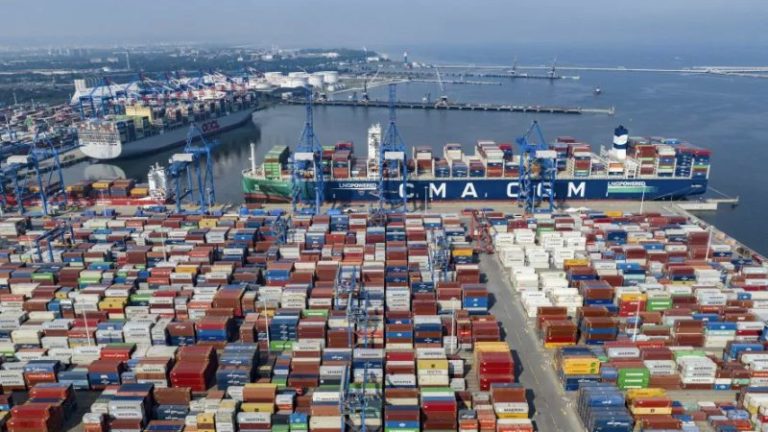
Hundreds of hauliers staged a strike at the Baltic Hub container terminal in Gdańsk, Poland, beginning on 7 January 2026 and ending after almost 48 hours of negotiations. After driving in convoy to the nearby city of Gdynia under police escort, the heavy goods vehicles returned to Gdańsk and blocked access to the terminal. Although the protest had been widely announced by carriers, the authorities did not expect such a large turnout or a complete shutdown of terminal operations.
As early as December 2025, haulage associations had sent a lengthy open letter to Baltic Hub management, complaining of systemic problems such as opaque procedures and regulations, inaccessible slots, long waiting times for container pick-up and delivery, and drivers effectively forced into repeated breaches of driving and working time rules, stuck for hours on end in their cabs without access to toilets or rest facilities. According to the hauliers themselves, these conditions, which persisted throughout 2025, contributed not only to higher operating costs and increased prices for consumers, but also to a deterioration in supply chain quality and in the service provided to customers.
“The terminal’s current operating methods significantly hinder the efficient work of both hauliers and freight forwarders,” the letter states. “The lack of a collaborative approach in operational dialogue translates into a deterioration in the quality of the entire logistics process and causes a substantial reduction in the profitability of haulage operations. The new booking system was supposed to improve operational processes, but the effect has been the opposite. The lack of coordination of activities leads to increased congestion, difficulties in route planning and numerous delays in carrying out assignments.”
The text goes on to say that “Baltic Hub displays a monopolistic attitude and a limited willingness to cooperate, forcing drivers into breaches of working time regulations in the name of ‘cost optimisation’, the consequences of which fall on hauliers and freight forwarders. The lack of transparency in operations, the frequent blocking of areas and slots, the restriction of options for returning empty containers and difficulties in accessing operational resources lead to a deterioration in service quality for the end customer, an increase in costs and a reduction in the profitability of our shared activities.”
In the letter, the associations also announced a work-to-rule action, which began on 20 December and culminated on 7 January in a full stoppage. Despite palpable tension, the parties sat down to negotiate new terms of cooperation as early as Wednesday morning, but the large number of vehicles involved forced the terminal to block all entry slots until the evening of the following day. The announcement of an agreement was published on the Baltic Hub website on Thursday 8 January, and a regular flow of vehicles was restored from Friday morning.
“The meeting took place in a constructive dialogue atmosphere and led to a joint agreement,” the statement reads. “Both parties expressed their willingness to continue negotiations and to seek solutions that are beneficial for the entire logistics chain. The agreement covers key areas relating to the improvement of operational processes, the optimisation of terminal capacity management, the implementation of systemic solutions and the guarantee of transparent rules in emergency situations. The terms for ending the current protest were also agreed, allowing roads to be cleared and full access to port infrastructure to be restored.” Despite this declaration of intent, signed by the terminal management and the Port Authority of Gdańsk, the road ahead remains challenging and hauliers will continue to monitor the efficiency and operability of access to the facility.
What happened at the Baltic Hub terminal is not an isolated episode, but rather reflects a structural issue now affecting many European container terminals. At numerous ports and inland hubs, operational management is becoming increasingly complex, with direct consequences for hauliers, road carriers and the entire logistics chain. The main problems concern access to facilities and long waiting times at gates, often caused by high volumes of containers in storage. High saturation levels maximise terminal margins but drastically slow down operations, forcing trucks to remain idle for hours, if not entire days.
This phenomenon generates significant costs for carriers, linked to fuel consumption, drivers’ working hours, overtime and contractual penalties, as well as a negative impact on the reliability of deliveries to customers and logistics operators. In effect, in an attempt to increase productivity, terminals end up shifting operational risk onto hauliers, who are forced to absorb inefficiencies and delays without adequate financial compensation.
Marco Martinelli