







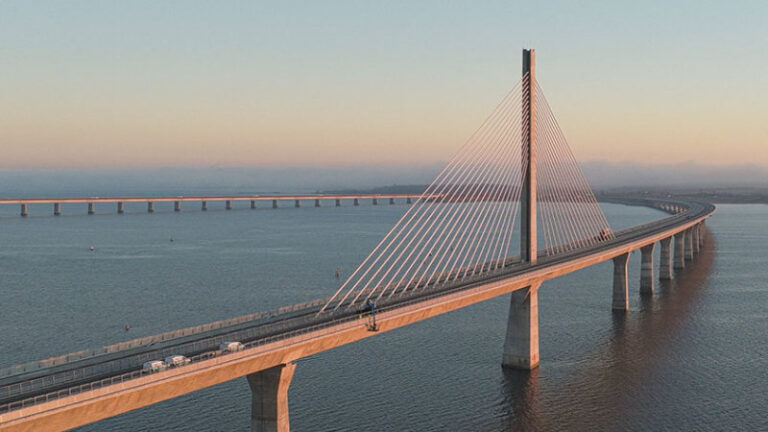
A first, important piece in the upgrading of rail and road links between Germany and Denmark has fallen into place along the Scandinavian-Mediterranean corridor, between the Danish region of Zealand and the island of Falster:the new Storstrøm bridge, officially named Queen Margrethe II’s Bridge, after Queen Margrethe II of Denmark. Because of its construction features, the technical solutions adopted and the benefits it brings to transport, the new infrastructure can already be considered one of the most important projects built in Europe. But its significance is even greater because the new road-rail bridge should be seen as the natural continuation of the Fehmarn Belt, now at an advanced stage of construction: the underwater crossing, the longest of its kind in the world, will include a four-lane motorway and a double-track railway, at a cost of more than €5bn. Stretching 18 kilometres between Germany and Denmark, the Fehmarn Belt, described as the project of the century, will connect the German island of Fehmarn with the Danish island of Lolland.
The new Storstrøm bridgeis therefore part of the programme to radically upgrade the rail network between the two countries, which until now has consisted of lines of almost exclusively regional importance and must be adapted ahead of a cross-border connection of this scale. It is therefore no surprise that the project has had two inauguration events: the first on 23 March 2026, with its formal opening to traffic, and the second, more ceremonial and official, on 6 June 2026, when Queen Margrethe symbolically crossed the old existing structure for the last time. That bridge is being decommissioned and replaced by the new modern infrastructure.
The new bridge also has an Italian dimension, as it was designed and built by the Sbjv consortium(Storstrøm Bridge Joint Venture), led by Itinera of Gruppo Astm, in collaboration with Grandi Lavori Fincosit and Condotte. The new structure, with a total length of 3,832 metres, consists of a central cable-stayed bridge with two 320-metre spans and two access viaducts made up of 44 spans of 80 metres each. Its distinctive feature is a configuration that combines the motorway link with the double-track railway line, which is due to enter service in 2027.
The Storstrøm bridge is undoubtedly the most important project within the upgrading of the entire Danish rail networkalong the 80 kilometres between Ringsted and Nykøbing Falster, the main route in the Zealand region, which stretches between Copenhagen and Germany. This railway section was originally single track, as it served local needs. The investments have included doubling and upgrading the line, removing all road conflicts and adapting it to the interoperable European Ertms-Etcs signalling system, in line with standards for fast, high-capacity lines. Similar works are also under way on the line between Nykøbing Falster and the port terminal at Rødby, overlooking the Fehmarn Strait.
This picture clearly highlights the commitment made by the Danish authorities, which is unsurprising, as the Fehmarn Belt underwater crossingwas strongly backed by Copenhagen, while Germany has always shown rather lukewarm interest in the project and appears to have accepted it largely because it is part of an EU framework. After all, Denmark stands to gain the most from the continental integration supported by this major project.
Piermario Curti Sacchi