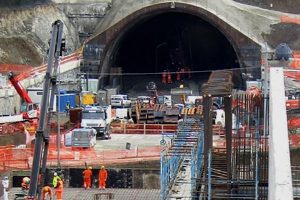








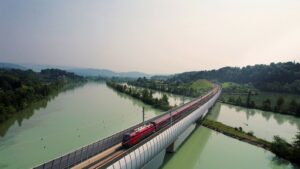
More than one million tonnes of goods were carried in the first 100 days after Austria’s new Koralm Railway opened to traffic. This was how, on 13 February 2026, a statement from the Austrian group ÖBB Rail Cargo announced a successful start for the new route running beneath the Koralpe: in the three months from 1 November 2025, around 1,050 freight trains with more than 21,000 wagons used the Austrian rail link that connects Graz with Klagenfurt on a new 125-kilometre high-capacity alignment, including the 32.9-kilometre base tunnel.
The Koralm Railway brings significant improvements for freight transport: shorter journey times, greater efficiency and higher capacity on the southern axis. The new route, with a maximum gradient of no more than 10 per mille, also enables heavier loads to be carried with lower traction costs. Together with the existing line over the Neumarkt pass, ÖBB’s southern axis now has four tracks. This translates into 30% more capacity for the southern corridor, which via Villach can reach the Tarvisio crossing between Austria and Italy and continue on the modern Pontebbana railway towards the Adriatic ports and beyond.
Without detracting from what was stated in the ÖBB Rail Cargo release, it should be noted that during the first 40 days after the new Koralm Railway opened, traffic was limited to freight trains only for final testing of the line, which was prudently excluded from passenger services. The final balance for the first 100 days of operation, marked by a strong boost for freight, should therefore come as no surprise.
Is this trend set to continue, or will the coexistence of freight and passenger trains put the line’s capacity under severe strain? A direct check through the Austrian Federal Railways booking system helps answer this question. Fast Railjet passenger services are seeing a marked increase in bookings, which in some periods, such as at weekends, are almost always sold out. This is a direct consequence of the opening of the new fast route, which enables connections that were previously far less convenient and is therefore stimulating what is effectively new demand, apparently growing rapidly.
All this is happening while, on the Italian side, investment and attention from RFI are not comparable with the commitment shown by the Austrian railways. Only the new Pontebbana railway from Tarvisio to Udine, radically upgraded between the end of the 20th century and the early 2000s with an alignment largely built as a variant, can be considered adequate, while from Udine to Venice no real enhancement plan has ever taken off. The infrastructure situation is relatively more favourable only for connections with Trieste.
Overall, however, this is a network where the coexistence of passenger services and freight traffic has to contend with infrastructure that lacks high-capacity corridors. The Udine-Cervignano line is single track, even though in theory it could be regarded as the most direct and functional route serving the Cervignano marshalling yard, a facility that has never really taken off but is now seeking a possible relaunch together with the adjacent interporto. From there, however, traffic would end up feeding into the key Venice-Trieste line, with its limited residual capacity.
Alternatively, a Udine-Casarsa-Portogruaro route could be envisaged, using the ongoing electrification of the section between the latter two locations, but only on condition that this line is prioritised for freight traffic, as it is single track and therefore has limited capacity. Between Portogruaro and Treviso, a direct link of just over 50 kilometres was reopened to service, electrified and upgraded in the early 2000s, but here too the presence of a single track creates an unavoidable conflict between different types of service.
To avoid the congested Venice-Trieste line, there is also an “upper” route via Udine-Pordenone-Conegliano-Treviso. From Treviso, traffic can reach Venice-Mestre in one direction or use the direct Treviso-Vicenza link and from there join the main Po Valley rail corridor, albeit with a longer journey. As can be seen, there is no shortage of alternatives for freight transport along the eastern rail corridor, but there is no single optimal solution offering a high-capacity route that could serve as the best access corridor to the Tarvisio crossing and therefore to the central and eastern European network.
Piermario Curti Sacchi