



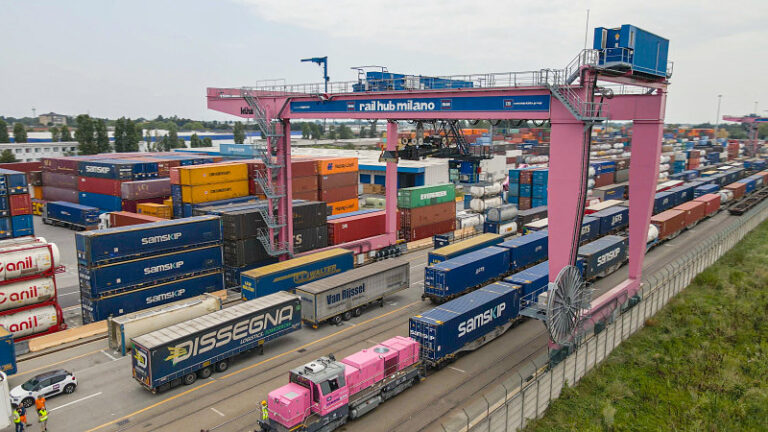
- The Contship group provides land-based intermodal solutions through five integrated companies: Hannibal, the commercial MTO; Oceanogate, which provides national rail traction; Rail Hub Milano, which handles inland terminal and handling operations; Sts, which manages customs procedures; and driveMybox, which provides road transport, with around 100 directly owned vehicles and 350 coordinated vehicles.
- Rail transport of unaccompanied semi-trailers is expanding rapidly. Since 2021, the group has operated services to Rotterdam, currently serving three terminals, with a fourth due to be added shortly. This presence enables the handling of significant volumes to the United Kingdom and Scandinavia through onward ro-ro connections. Direct connections to Germany are expected to be launched by 2026, a market seen as offering strong potential for modal shift. On the national corridor, the Marcianise-Melzo rail link carries tanks, containers and swap bodies.
- The group is also among the founding members of the Synlog Alliance data consortium, whose purpose is to share information among supply chain operators and increase operational efficiency through artificial intelligence. Internally, Contship is developing algorithms for train balancing and flow optimisation. In line with its corporate sustainability strategy, Moves That Matter, the group has launched practical trials using low-emission fuels in road transport.
When Angelo Ravano founded Contship in 1969, a name formed from the words container and shipping, he focused on the growing maritime container transport sector, which was taking its first steps in Europe. Just two years later, he built Italy’s first private port terminal in La Spezia. The group grew with a maritime focus and, in 1993, Ravano laid the foundations for Italy’s largest transhipment hub and one of the biggest in the Mediterranean, Gioia Tauro, which opened in 1995. After his death in 1994, his work was carried forward by Cecilia Eckelmann Battistello, who in the following decades developed the business with an eye also on land transport, adding her own distinctive touch through the group’s characteristic pink livery for trucks and trains.
Today, the group presents itself to the market with a range of integrated services covering containers from unloading at the quay through to the final consignee, using a model built around direct control of assets along the logistics chain. “Having this direct control allows us to be competitive and to create value at the connection points between the various modes of transport,” Cristiano Pieragnolo, Chief Commercial Officer of Contship, tells TrasportoEuropa in this interview, which looks in greater depth at the company’s land-based operations.
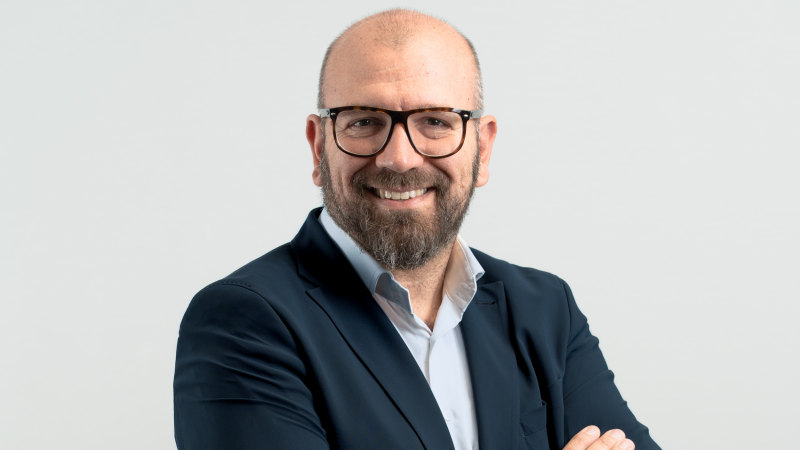
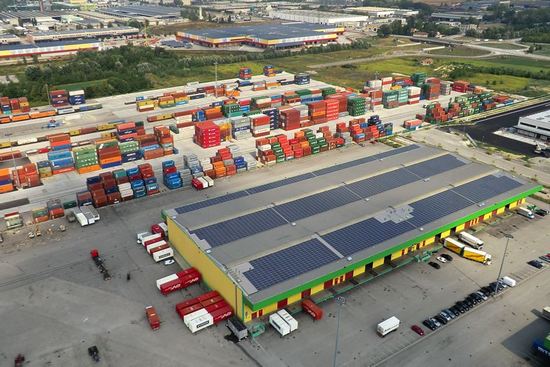
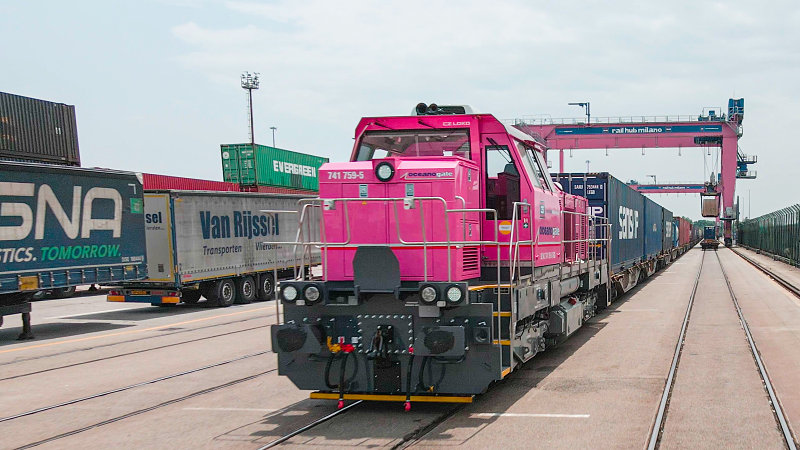
Pieragnolo outlines Contship’s structure, which is built around four companies with distinct yet complementary roles. Hannibal is the operator that designs, develops and markets intermodal solutions as an MTO. Oceanogate is the group company that provides rail traction and operates exclusively on the national network, offering its services both to direct customers and to other MTOs, integrating them with the terminal services of Rail Hub Milano, which manages the Melzo terminal and third-party handling activities.
The offer is completed by driveMybox, created from GoTrans, which was acquired in 2023, and which serves the first and last mile by road with a fleet of around 100 owned industrial vehicles and a total of around 350 coordinated vehicles. As part of the group’s integrated model, customs activities are a key element and a value-added service. Through Sts and Rhm, Contship directly oversees customs clearance processes and activities linked to the documentary and regulatory management of goods. This makes it possible to optimise handling times and ensure greater integration between operations at maritime terminals and intermodal and land transport. “With this structure, Contship offers an end-to-end service, from the port to the final customer’s warehouse, or from point A to point B on the continent, with its focus on northern Europe,” Pieragnolo says.
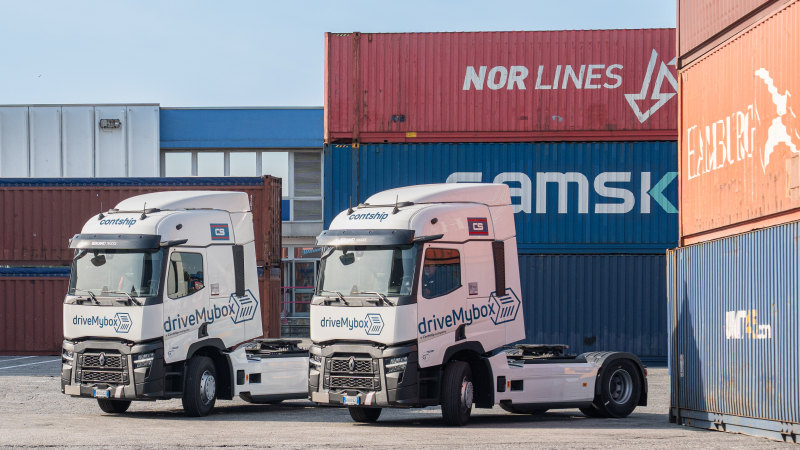
In land transport, road capacity is distributed slightly more than half across owned vehicles, with the remainder entrusted to selected and established third-party hauliers. “The real benefit of having part of the fleet in-house and part made up of external suppliers is that it allows flexibility to be managed strategically,” Pieragnolo explains, adding that the company selects carriers on the basis of economic and environmental sustainability, track record and reliability. Access to this supplier network is governed by a rigorous qualification process, which favours structured operators with established operations, limiting the use of single-vehicle operators or micro-enterprises. Daily trip planning, both pure road movements and those integrated with intermodal services, is centralised through the driveMybox Control Tower, which receives orders and organises the entire movement of the fleet.
On rail, Pieragnolo identifies the transport of unaccompanied semi-trailers as one of the fastest-growing markets. “The customer always chooses the option of managing intermodal transport with a semi-trailer because it avoids breaking the load.” In this context, the Rotterdam links, launched in 2021, have progressively consolidated operations and now serve three terminals, with a fourth in the start-up phase. Pieragnolo describes this node as key to relaunching traffic to the United Kingdom and Scandinavia. The Melzo terminal, Rail Hub Milano, is the main inland hub in the Contship system and currently handles containers and craneable semi-trailers because, Pieragnolo notes, fleets are gradually shifting towards this mode of transport.
For Pieragnolo, “the scope for growth in modal shift remains significant. In many logistics corridors and industrial contexts, intermodality has not yet expressed its full potential and represents a strategic lever for increasing supply chain efficiency. Clearly, this requires infrastructural solidity and probably also a change in culture and approach. It is necessary to encourage greater openness towards integrated and multimodal logistics solutions compared with the prevailing all-road model, strengthening expertise and planning capacity. Only in this way will it be possible to balance transit time, economic efficiency and the overall sustainability of intermodal solutions effectively.” He adds that, in road-rail intermodality, the group provides first- and last-mile traction services both from Italy and at destination, to any destination, although the main customers in the continental segment are large hauliers which, in most cases, already have their own traction.
There are, however, unresolved issues, especially in land traffic linked to maritime flows, where the group often finds itself close to the limit when managing capacity peaks. “We try to encourage cooperation between road and rail, not competition, because if we do not think in terms of an integrated service, we will fall into the same mistakes as in the past, when market demand could not be met during periods of congestion.” This is compounded by a structural trend that Pieragnolo describes clearly. “Total capacity, especially in road transport, is gradually declining, a phenomenon that we believe could intensify further in the coming years as a result of driver shortages linked to the high average age of the profession and insufficient generational turnover.”
On the national corridor, the rail link to and from Marcianise, in the province of Caserta, with the Melzo hub is operational, serving as a gateway towards northern Europe. The line currently carries tanks, containers and swap bodies, but not semi-trailers, for infrastructural reasons: the profile of the Tyrrhenian line, on the Florence-Bologna section, is not yet suitable for units four metres high. Pieragnolo says the upgrade is not expected before 2028, while the Adriatic line is already suitable for transporting four-metre semi-trailers.
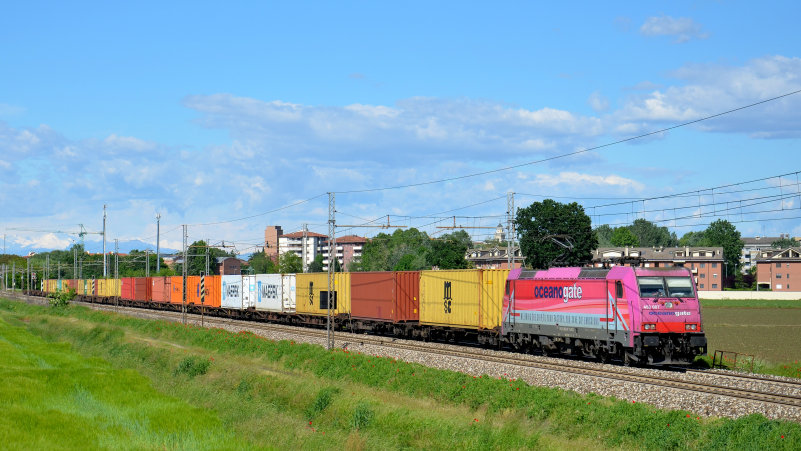
The group is also working on digitalisation and artificial intelligence projects, both internally and across the supply chain. In the intermodal segment, it is developing algorithms to improve the planning and enhancement of rail flows, with particular attention to trip balancing. “The train must first and foremost be sustainable, and we are working with our IT department to develop load optimisation solutions and identify synergies to make rail transport increasingly efficient.”
Contship is also collaborating with other organisations and contributed to the creation of Synlog Alliance, the first data consortium in the logistics sector, presented at the Contship Logistics Forum in March 2025. Pieragnolo explains that the initiative aims to bring together supply chain operators with the goal of sharing operational data, while respecting mutual confidentiality, and enabling, through the use of artificial intelligence, improvements in operational efficiency, process reliability and decision-making capacity across the entire logistics chain. “Today, all the players involved speak through different systems and languages, have fragmented data, and the end user is unable to take advantage of the potential offered by consolidating these data. The consortium aims to overcome these discontinuities, making the entire container logistics chain more efficient.”
In line with its Moves That Matter corporate sustainability strategy, the group has already launched practical trials using low-emission fuels in road transport, particularly HVO, with the aim of reducing CO2 emissions. Electric traction is being followed with interest, but at present it is not yet considered mature for the sector’s operational needs, especially in the Italian infrastructure context. “If the scenario continues to evolve, we will be ready to seize every opportunity that can generate value both economically and environmentally, also with a view to achieving our Net Zero targets by 2050,” Pieragnolo concludes.
M.L.