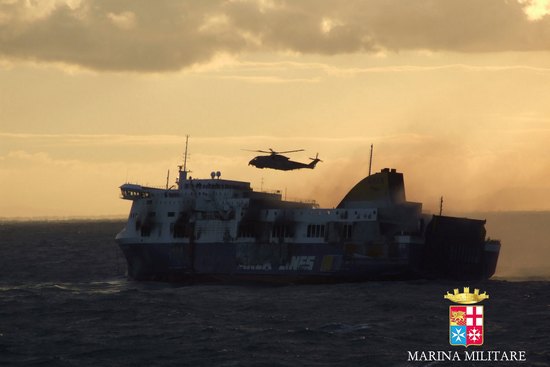
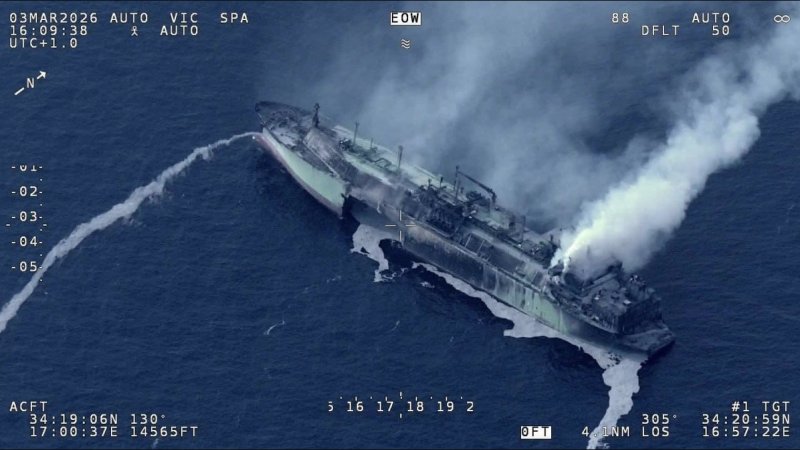






The winds of war are still sweeping across the Persian Gulf, with serious repercussions for commercial shipping, which has suffered a fresh attack: the Pasdaran (Islamic Revolutionary Guard Corps) hit the 7,000 TEU container ship Gfs Galaxy as it was crossing the Strait of Hormuz eastbound, about 4.4 nautical miles off the coast of Oman. The impact, which struck the stern, severely damaged the engine room and triggered a large fire, leaving the vessel disabled and adrift. The Gfs Galaxy, more than 300 metres long, flies the Cypriot flag but is owned by AD Ports Group, a United Arab Emirates group, and operated by Global Feeder Shipping, a Dubai-based company. The crew abandoned ship in lifeboats and Omani emergency services rescued the seafarers, including ten Indian nationals. One sailor, also an Indian national, is missing and the search is continuing.
The incident has prompted international reactions, including condemnation from the Indian Ministry of External Affairs, while tensions have spread to other regional players: reports of attacks and reprisals have also involved the Omani port of Duqm and Qatar. Tehran described the attack as a warning strike against a vessel that, according to Iran, was following an unauthorised route, and formally declared the Strait of Hormuz closed, threatening to block any transit. United States Central Command (Centcom) responded with the third wave of air strikes this week against Iranian military targets, saying it had hit about 140 of them, with the aim of limiting Tehran’s naval offensive capability.
The de facto closure of the strait has brought merchant traffic close to zero for vessels without protection or specific agreements, after several weeks in which a few dozen tankers and container ships a day had resumed transiting the waterway. Many vessels have chosen to remain at anchor or postpone departure, while insurers have rapidly raised war-risk premiums, in some cases refusing cover for transits not considered necessary.
The prolonged crisis in the Persian Gulf is now affecting transhipment hubs in South-east Asia, where vessel bunching is being recorded: the simultaneous and large-scale arrival of ships that have accumulated delays of two to four weeks because of diversions, attacks and closures in the Strait of Hormuz. The vessels are converging together on major Asian transhipment ports, concentrating within a few days traffic that would normally be spread over several weeks.
Ports such as Port Klang and Tanjung Pelepas in Malaysia, as well as nearby Singapore, are having to manage this build-up. Until early July, Malaysian terminals had kept yard density at manageable levels of between 75% and 80%, but congestion in Singapore, where berth waiting times have risen from five to seven days, is now spilling over into Malaysia: carriers are diverting cargo to Port Klang and Tanjung Pelepas to avoid Singapore’s bottlenecks, but are also ending up saturating those ports. Shippers using southern Malaysian ports are being advised to allow an additional three to seven days for transhipment operations.
The accumulation of ships is forcing port authorities and shipping companies into a reorganisation that goes beyond straightforward unloading operations: empty containers are not where they are needed for the next wave of Asian exports, berthing schedules have to be rebuilt almost day by day with new quay allocations, and crew changes, which often take place in these hubs, are being complicated by prolonged delays. Analysts estimate that clearing the backlog will take time: up to three weeks for an initial, limited improvement and up to two months for a significant reduction in congestion, provided the situation in the Middle East does not deteriorate further. Freight rates will not follow the same curve: they will remain high even after yard operations return to normal, as carriers will use this phase to recover the extra costs already accumulated for diversion fuel, war-risk insurance premiums and penalties linked to network inefficiency.
M.L.