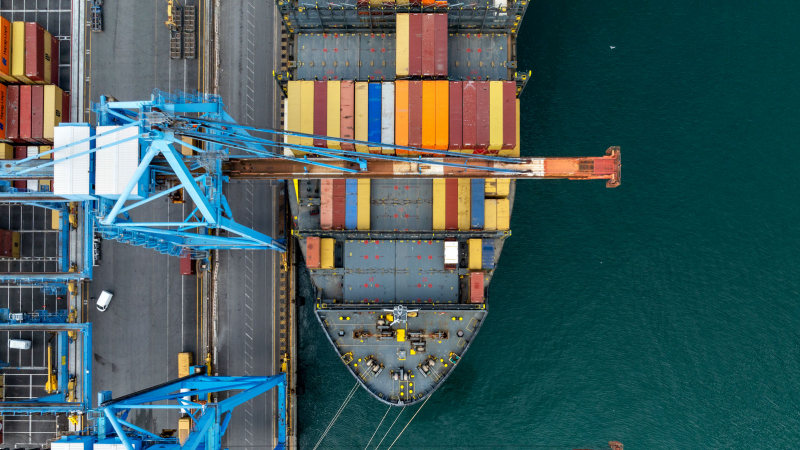





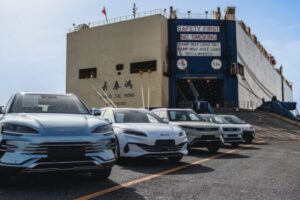
Chinese vehicle manufacturer BYD has reportedly ordered ten new pure car and truck carriers (PCTCs), each with a capacity of 9,200 CEU, according to several international media reports citing unidentified industry sources whose claims initially circulated on LinkedIn. The vessels are expected to be built by China Merchants Shipbuilding Industry Group at its Jinling and Haimen shipyards, with deliveries staggered between 2027 and 2029. Neither BYD nor the shipbuilder has so far confirmed the order, which, if confirmed, would add 92,000 CEU of capacity and increase BYD’s owned fleet from eight to 18 vessels, with a combined capacity of more than 130,000 CEU. The eight PCTCs currently in operation are Pioneer 1, Shenzhen, Changzhou, Xi'an, Hefei, Changsha, Zhengzhou and Jinan.
The fleet expansion comes amid rapid growth in Chinese vehicle exports: China Passenger Car Association (CPCA) attributes 183,746 exports of BYD-branded passenger vehicles to the carmaker in August 2026, up 130.8% year on year. Between January and August, exports totalled 1,126,797 vehicles, giving BYD a 33.9% share of overall Chinese NEV exports. A shortage of shipping capacity is reported to have constrained overseas sales in 2026: a Deutsche Bank note reporting management comments following the quarterly results said volumes would have been higher if sufficient maritime transport capacity had been available. BYD has nevertheless raised its overseas sales target for 2026 to between 1.9 million and 2 million vehicles, from the 1.3 million indicated in January, and is aiming to exceed 2.5 million in 2027.
Meanwhile, PCTC charter rates are experiencing considerable volatility. After peaking at more than $100,000 a day in 2024, the rate for a 5,000-CEU vessel fell to $30,000 a day by November 2025. At the same time, newbuilding orders collapsed to just six vessels over the entire year, compared with an annual average of 612,000 CEU between 2022 and 2024. The trend reversed in 2026, however: the one-year charter rate for a standard PCTC reached $52,200 a day in the second quarter, up 14.1% from the previous quarter, while rates for medium-sized vessels rose by 29.2%. Orders consequently picked up again, with 87,200 CEU commissioned in the second quarter of 2026 alone, an increase of 652% compared with the same period in 2025.
Analysts mainly attribute the reversal to diversions caused by the Red Sea crisis, which lengthen Asia-Europe routes by around 25% and keep demand measured in CEU-miles at elevated levels, as well as to growth in Chinese light-vehicle exports, which rose 63% year on year in the first five months of 2026, according to Veson Nautical. By the end of June 2026, China had already exported more than five million vehicles during the first six months of the year, involving a broad range of manufacturers - including BYD, Chery, Geely, SAIC and Great Wall - and an increasingly diverse range of destination markets, from South-East Asia and the Middle East to Latin America.
In terms of deliveries, PCTCs entering the global fleet increased from 12 vessels in 2023 to 46 in 2024, reaching a record 75 in 2025. Around 67 vessels, equivalent to 518,000 CEU, are expected in 2026, followed by another 50 in 2027 and 26 in 2028. Around 80% of the vessels scheduled for delivery between 2023 and 2028 are being built by Chinese shipyards.
M.G.