







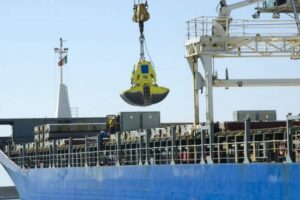

Dfds to double Trieste-Damietta frequency
Dfds has announced that it will increase the frequency of its ro-ro service between Trieste and Damietta from one to two weekly sailings from October 2026. The actual launch, however, remains subject to the availability of a second vessel, while a definitive start date and the new service schedule have yet to be published. Launched in late November 2024, the route connects the Italian port with its Egyptian counterpart with a crossing time of around 68 hours and is primarily aimed at semi-trailers and rolling cargo. Traffic includes Egyptian agri-food and perishable products bound for European markets. Doubling the frequency would shorten the interval between departures and increase available capacity, with the main impact expected on the management of refrigerated cargo. The expansion was already envisaged in the original service plan, which provided for an increase to two weekly sailings once sufficient volumes had been reached.
Jost strengthens German network
Jost Group has acquired 100% of Ctj Janssen, a German transport and logistics operator headquartered in Grevenbroich. The transaction, notified to the Bundeskartellamt (German Federal Cartel Office) on 3 August 2026, involves the acquisition of all shares and sole control of the company. Ctj generates annual revenue of around €135 million, while the acquisition price has not been disclosed. The company employs around 650 people and operates 400 trucks and more than 500 trailers and semi-trailers, with the capacity to coordinate around 650 shipments a day. Its activities include full and partial loads, logistics and warehousing, particularly in the food, beverage and fast-moving consumer goods sectors. Following the integration, Jost is expected to have around 4,000 employees, 2,100 trucks and 4,500 trailers. The acquisition will particularly strengthen the group's presence in North Rhine-Westphalia and add a German domestic transport network to its existing international operations. Ctj also has a presence in Landsberg, supporting coverage of central Germany. The transaction is therefore intended to integrate German domestic connections more closely with cross-border flows to Belgium, the Netherlands and northern France. Ctj's organisational structure and operational autonomy are expected to be retained.
Kyrgyzstan prepares Sary-Tash hub
Kyrgyzstan has begun preparations for an international transport and logistics centre in Sary-Tash, in the southern Osh region, through a memorandum signed on 10 September 2026 by the National Agency for Investments and Textile Trans. The agreement aims to attract investment of up to $100 million, but does not represent funding already committed or a final investment decision. The project includes warehouses, facilities for cargo consolidation and transhipment, weighing, customs and brokerage services, and digital systems for monitoring cargo flows. Sary-Tash lies along the Osh-Sary-Tash-Irkeshtam road corridor, around 70 kilometres from the Irkeshtam border crossing with China, in a position providing links towards Osh, the Fergana Valley, Tajikistan and the Pamirs. The centre is expected to serve the China-Kyrgyzstan-Uzbekistan-Afghanistan corridor, with a possible extension towards Pakistan, providing cargo consolidation, customs clearance, transfer and routing services. The project is mainly focused on road transport, and there are currently no reported direct links to rail terminals or to the China-Kyrgyzstan-Uzbekistan railway. The aim is to strengthen Kyrgyzstan's role in trade flows between China, Central Asia and South Asia, supporting transit traffic, trade, local production and employment. The route towards Afghanistan and Pakistan, however, involves operational issues related to security, infrastructure, customs transit, cargo insurability and the predictability of delivery times. No construction timetable, binding financing commitments, operating capacity, tender procedures or investor identities have been made public. The initiative therefore remains at the preparation and capital-raising stage.
Technical phase begins for Tripoli-Homs railway
Lebanon and Syria have begun technical preparations for the potential restoration of the railway link between the port of Tripoli and Homs, via Al-Abboudieh on the Syrian border. The project is primarily intended for freight and container traffic and aims to connect the Lebanese port with the Syrian rail network. On the Lebanese side, the planned route is around 35 km long, with a further 6 km required to connect to the Syrian network. In May 2026, Lebanon had already launched a tender procedure for the rehabilitation and design of the Tripoli-Al-Abboudieh section. At the end of August, Beirut and Damascus agreed to establish a joint technical group, while in September Lebanon commissioned a consultancy firm to update the design and feasibility study. The six-month assignment will examine technical requirements, transport demand, costs, implementation phases and tender documents. The logistics objective is to strengthen the role of the port of Tripoli in trade with Syria and, in the longer term, in regional connections. The project nevertheless remains at the study stage: no construction contract has been awarded, no definitive funding has been secured and no opening date has been set. Issues still to be resolved include financing, the availability of the railway right-of-way in Lebanon and the restoration of the necessary infrastructure in Syria. Any future passenger service remains secondary to the priority given to freight transport.