




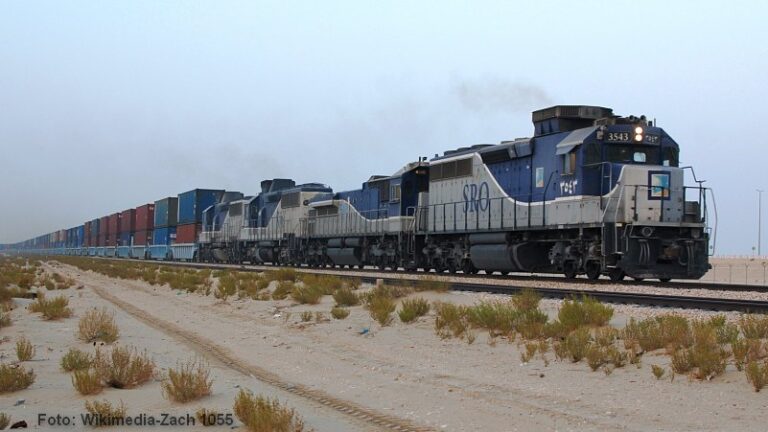
Saudi Arabia is mobilising its resources to move freight along overland routes in order to avoid shipping through the Strait of Hormuz, which remains effectively closed. Saudi Railway Company has announced plans to activate five new logistics corridors aimed at strengthening links between Gulf ports, inland areas and the northern border with Jordan. The network is intermodal, combining rail and road transport, and connects major Gulf ports – including Dammam, Jubail and Ras Al-Khair – with Riyadh Dry Port, a central hub for domestic container handling, as well as industrial centres such as Al-Kharj and Hail.
Available information does not include a detailed technical breakdown of the five corridors, nor operational parameters such as capacity in tonnes or TEU. However, the nodes identified suggest a modular network configuration. The corridors combine existing rail segments with road connections to serve different types of flows, including container traffic, petrochemicals and mining-related cargo. In this setup, Riyadh Dry Port acts as the central sorting hub, while coastal terminals serve as entry and exit points for maritime traffic. The multimodal corridors are designed to reduce transit times and costs through greater use of rail over long distances, with the aim of shifting freight from road to rail, improving flow reliability and reducing dependence on a road network prone to congestion.
The initiative forms part of the National Transport and Logistics Strategy and Saudi Vision 2030, which aim to diversify the country’s economy and strengthen its role in trade flows between Asia, Europe and Africa. In this context, rail corridors represent the land component of an integrated network that also includes port and airport infrastructure. Through this approach, Saudi Arabia is seeking to position itself as a logistics hub along the east–west axis, leveraging its geographic location and ongoing infrastructure investment.
From a network configuration perspective, the corridors can be seen as complementary to the Saudi Landbridge project, the planned rail backbone linking the Gulf and the Red Sea. In this view, the new links function as feeder and distribution systems, designed to channel flows towards a future high-capacity east–west corridor. At the same time, the connection to the Jordanian border strengthens the role of the Saudi network as a land bridge to the Levant, expanding options for regional traffic.
Despite the project’s technical framework, several areas of uncertainty remain for logistics operators. First, the lack of data on capacity, frequency and transit times makes it difficult to assess the service’s competitiveness compared with road transport or other regional alternatives. Second, there is no information on pricing models or potential incentives to encourage modal shift. Another key issue concerns the level of operational integration between railways, ports and customs systems. The effective functioning of the corridors depends on the ability to coordinate flows, documentation and terminal access, yet available sources do not provide details on the digital systems or procedures in place to ensure operational continuity across the entire logistics chain.