





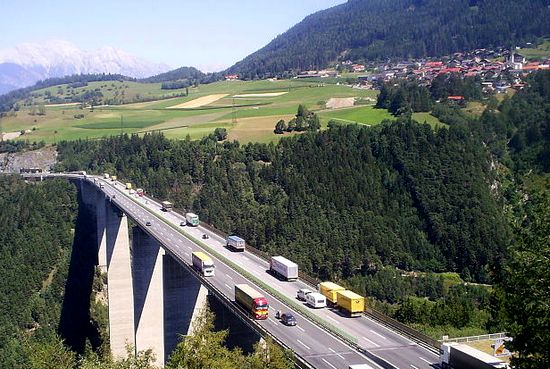
- Bavaria, Alto Adige and Trentino launched a joint feasibility study at the end of May 2026 to assess the introduction of a variable toll for heavy goods vehicles on the Brenner corridor. The system would apply higher charges during peak hours and lower ones during periods of weaker demand, with the aim of spreading freight traffic flows more evenly throughout the day.
- The study, which is due to be completed by the end of 2026, will have to assess the technical, legal and economic feasibility of the model, including possible reactions from road haulage companies in terms of changes to transit times, potential route diversions and the impact on operating costs. Initial simulations cited by the Bavarian ministry indicate that a significantly higher toll during peak hours reduces the number of transits in those periods.
- The current system - Austria’s Go-Maut on the A13 and tolls on Italy’s A22 - is based on kilometres travelled, number of axles and environmental class, with a limited day-night difference applying only to the Austrian section. The proposed variable toll would introduce much more pronounced modulation, shifting the tariff logic from infrastructure cost recovery to active demand management.
At the end of May 2026, the Bavarian Ministry of Transport and Infrastructure, Stmb (Bayerisches Staatsministerium für Wohnen, Bau und Verkehr), announced the launch of a joint Machbarkeitsstudie, or feasibility study, with the autonomous provinces of Alto Adige and Trentino to assess the introduction of a variable toll for heavy goods vehicles on the Brenner corridor. Stmb explains that the principle behind the initiative is that charges should be higher during the busiest periods and lower when demand is weaker, with the aim of spreading traffic flows and easing pressure on the route.
The study must verify the feasibility of the model on three separate levels: technical, legal and economic. The key issues the research will have to address include the practical structure of the toll system, hourly and daily segmentation, forms of differentiation that are "reasonable and legally admissible" and the likely reactions of road haulage companies. The latter point concerns, in particular, the willingness to shift crossing times, the possibility of route diversions, and the impact on costs and competitiveness in the sector. The study is due to be completed by the end of 2026, as stated by the Bavarian ministry, and its findings will form the basis for any subsequent political decisions.
The first simulations cited by the promoters of the initiative - Bavaria, Alto Adige and Trentino - indicate that a significantly higher toll during peak hours does in fact reduce the number of transits in those periods. However, neither the methodology nor the assumed price levels behind these data have yet been made public. For now, they are elements of political justification rather than a completed and available scientific report.
Politically, the three administrations present the variable toll as an alternative to the unilateral measures adopted so far by Austria to manage traffic peaks on the corridor, such as Blockabfertigung, the block-based regulation of incoming heavy goods vehicles, and night driving bans. While such measures have a restrictive effect, they are considered problematic for the European single market and for supply chains that depend on the continuity of the corridor. The Bavarian ministry frames the new model as a "tool recognised at European level" for managing transit corridors, referring to the EU framework on toll differentiation based on CO2, congestion and pollution.
Austria, however, has not joined the initiative, a crucial factor in transit policy along the Brenner route. Only Germany and Italy are taking part in the Machbarkeitsstudie, through Bavaria, Alto Adige and Trentino, while Tyrol and Vienna remain outside it. The reason is linked to the ongoing dispute before the Court of Justice of the European Union over the traffic restrictions imposed by Tyrol, a case brought by the Italian Government. As long as the case remains open, the Austrian region and the federal Government in Vienna cannot take part in a shared plan to reform tolling on the corridor.
To understand the scope of the proposal, it is useful to compare it with the current system. On the Austrian side, the kilometre-based Go-Maut applies to vehicles weighing more than 3.5 tonnes on the A13 and on the A12 section between Kufstein and Innsbruck. The toll depends on the number of axles, Euro class and CO2 emissions class, with surcharges on Alpine sections. On the A13 alone, there is already a difference between daytime and night-time tariffs: between 22:00 and 05:00, a surcharge applies to vehicles with four or more axles, which can bring the cost close to, or almost double, the daytime rate. On the Italian side, A22 Brennero applies tolls according to kilometres travelled and vehicle class, and from 1 January 2026 a 1.46% tariff adjustment was introduced, without time-based modulation.
The current system follows a structural and environmental tariff logic: charges are set annually according to the vehicle’s technical characteristics and certain special sections, with limited and narrowly defined time-based differentiation. The variable toll, by contrast, would introduce much more granular modulation, with different tariff levels based on expected congestion profiles, both during the day and on the days of the week with higher demand. The logic would no longer be to cover infrastructure costs, but to actively manage flows by using price as a lever to encourage voluntary changes in transit times.
For road haulage companies, this paradigm shift would have direct consequences for operational planning. Today, toll cost optimisation is mainly focused on vehicle choice, such as Euro class, CO2 emissions and number of axles, and, to a lesser extent, on avoiding the night-time period on the A13 when the surcharge is particularly high. Under a variable tariff system, the central variable would become transit time. Convoys that currently cross the corridor during the most congested hours could be steered towards the early morning, late evening or less busy days, provided that the tariff differential exceeds the costs of reorganisation. The effects would concern driver shift management, driving and rest times, load organisation and synchronisation with departure and arrival terminals.
Pietro Rossoni