






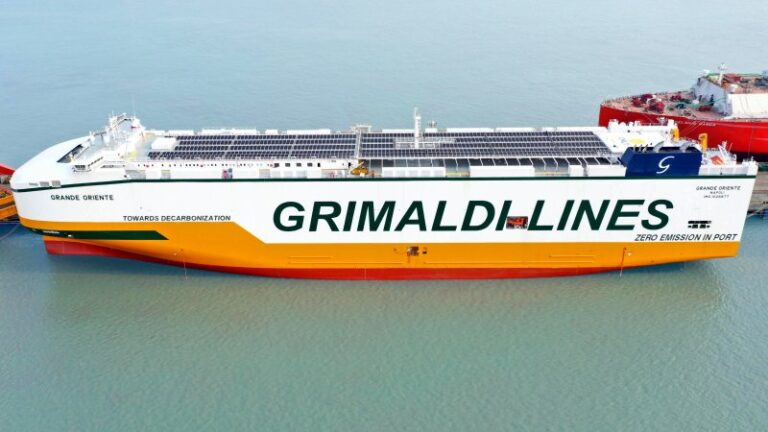
Grimaldi Group took delivery on 30 June 2026 of the Grande Oriente, a new vessel for transporting cars, trucks and ro-ro cargo built by China Merchants Heavy Industries Jiangsu. The ship is the twelfth in the Naples-based company’s fleet to be prepared for future conversion to ammonia as an alternative zero-carbon fuel. The new car carrier will shortly enter service on the route between Asia and Europe, with its maiden voyage departing from Taicang, China, bound for Portbury in the United Kingdom. It will carry 700 linear metres of ro-ro cargo and more than 6,200 cars.
The ship belongs to the PCTC category, comprising vessels specialised in the transport of cars, trucks and other wheeled cargo. With a length of 220 metres, a beam of 38 metres, a gross tonnage of 93,145 tonnes and a cruising speed of 18 knots, the Grande Oriente can transport electric vehicles and vehicles powered by fossil fuels, with a maximum capacity of 9,000 CEU. The Grande Oriente has received the Ammonia Ready class notation from Registro Italiano Navale Rina (Italian Naval Register), certifying that it is prepared for conversion to use ammonia. The choice is part of a fleet renewal strategy aimed at reducing the impact of vehicle carriers, a segment in which cargo capacity and fuel consumption have a direct effect on logistics costs per unit transported. Grimaldi Group says this class of vessel can cut consumption by up to 50% compared with previous-generation car carriers, thanks to a combination of new hull design, more efficient propulsion systems and onboard technologies designed to reduce energy requirements during navigation and while in port.
The Grande Oriente is equipped with lithium batteries with a total capacity of 5 megawatt hours and a shore power system. Where port infrastructure allows, the ship can connect to the electricity grid at berth and switch off its onboard generators, reducing local emissions to zero during port stays. Energy efficiency measures include 2,500 square metres of solar panels, silicon-based hull coatings to reduce resistance while sailing, and smart systems to optimise ventilation and air conditioning. The electronically controlled engine is combined with an exhaust gas cleaning system to reduce sulphur oxides and particulate matter, while selective catalytic reduction keeps nitrogen oxides below Tier III levels.
The equipment also includes an air lubrication system, an improved hull and a gate rudder installed for the first time on PCTC vessels. This rudder consists of two wing-profile blades positioned on either side of the propeller and, according to the group, improves both propulsion efficiency and manoeuvrability. The ship has also received the Green Plus, Green Star 3, Comfort Vibration and Comfort Noise Port class notations. These certifications concern the environmental and comfort standards adopted on board, with particular reference to reducing operational impact and improving the ship’s working conditions.
The name Grande Oriente reflects Grimaldi Group’s expansion in Far Eastern markets. In recent years, according to the company, the group has strengthened a more extensive and frequent network of maritime services in the region, linked to a global system serving more than 150 ports on five continents. "The Grande Oriente is not only a new latest-generation vessel, but also the symbol of a strategy firmly focused on Eastern markets, which are becoming increasingly central to global trade flows", said Emanuele Grimaldi, chief executive of Grimaldi Group. According to Grimaldi, investment in fleet renewal and the expansion of the service network is intended to strengthen the group’s ability to offer extensive, frequent and sustainable maritime connections, with particular attention to the logistics needs of vehicle manufacturers.