







From 1 July 2026, the second-generation smart tachograph, known as G2V2, becomes mandatory for light commercial vehicles with a gross vehicle weight of between 2.5 and 3.5 tonnes, but only when they are used for international goods transport or cabotage operations. The measure stems from EU Regulation 2020/1054, which amended Regulation EC No 561/2006 on driving times and rest periods and EU Regulation No 165/2014 on tachographs in road haulage. According to an IRU estimate, around three million vehicles are affected across the European Union, the European Economic Area and the United Kingdom. Until 1 July, vans below 3.5 tonnes were outside the electronic controls on driving times reserved for heavy goods vehicles, a regulatory gap that encouraged a model of cross-border express deliveries based on crews free from the time constraints applied to the heavy-duty sector. The new requirement closes that window, bringing international vans into line with the same standards of safety and worker protection already in force for vehicles above 3.5 tonnes.
Application of the rule does not depend on vehicle weight alone, but on a combination of three criteria. The first concerns mass: Regulation 2020/1054 also takes into account the gross weight of the vehicle combination, including any trailers, to prevent avoidance through additional towing. The second criterion is territorial: the vehicle must operate in international transport, meaning it crosses at least one border, or perform cabotage, namely paid domestic transport in a state other than the one in which the company is established. A single border crossing is enough to trigger the requirement. The third criterion is the commercial nature of the transport, which systematically covers hire-or-reward operations and, under stricter conditions, own-account transport.
International own-account transport is the most complex aspect of the reform. The exemption provided for by Article 3(ha) of Regulation 561/2006 applies only if driving is not the driver’s main activity, with the threshold set at below 30% of continuous monthly working time under the principles of EU Directive 2022/2561. The exemption ceases to apply if the employee is classified as a driver or if, despite holding a different role, driving is in practice the predominant activity. International own-account transport also requires five conditions set out in Regulation EC No 1072/2009: ownership of the goods carried, the transport being functional to the company’s needs, driving carried out by employed staff, availability of the vehicle through ownership or a valid lease, and the ancillary nature of the transport activity in relation to the company’s main business. If even one of these requirements is missing, the exemption no longer applies.
There is also a second derogation, provided for by Article 3(aa), designed for craft trades: it covers vehicles or combinations of up to 7.5 tonnes used to transport materials or equipment needed for the driver’s profession. In the international context, however, this exemption applies only within a 100-kilometre radius of the company’s premises, a limit that Article 3(ha) on own-account transport does not provide for.
A separate issue concerns hauliers from third countries outside the Union. For the United Kingdom, the obligations still apply to British vans under the post-Brexit Trade and Cooperation Agreement. The situation differs for countries that are party to the European Agreement concerning the Work of Crews of Vehicles Engaged in International Road Transport (AETR), including Serbia, Bosnia and Herzegovina, Montenegro, North Macedonia and Turkey, as the international agreement has not yet been updated for the second-generation tachograph because of resistance from Turkey and the Russian Federation within the United Nations Economic Commission for Europe (Unece). Many European jurisdictions could nevertheless apply the principle of territoriality to non-EU vehicles operating on their roads, exposing hauliers from the Balkans and Eastern Europe to an operational risk that has not yet been clearly regulated.
For fleets alternating between domestic and international routes, the device includes a dedicated function called Out (out of scope), which makes it possible to distinguish activity subject to Regulation 561/2006 from exempt activity. During a check on an international route, the driver must be able to demonstrate the activity carried out over the previous 56 days, so that inspectors can verify that domestic driving periods have not compromised the rest periods required for the foreign leg. The retroactive obligation lapses only for those who have never previously been subject to Regulation 561.
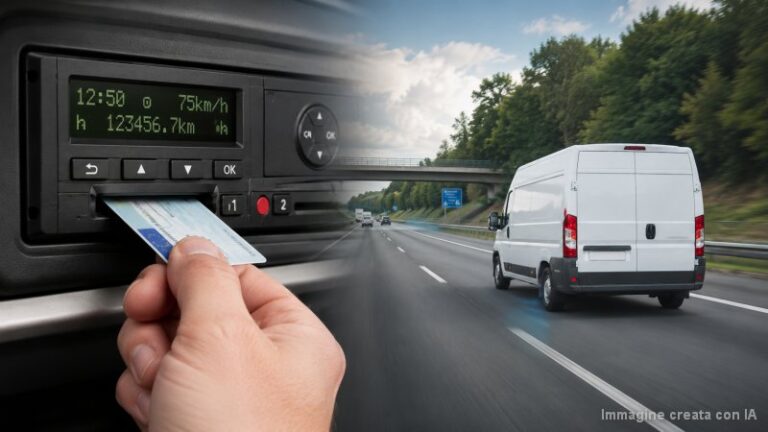
The G2V2 fully replaces analogue tachographs, first-generation digital tachographs and the first version of the smart tachograph (G2V1), whose use on international vans after 1 July will constitute a direct breach of Regulation 165/2014. Compared with previous versions, the device incorporates a satellite navigation module (GNSS) that automatically records the date, time and coordinates of every border crossing, removing the manual requirement introduced in 2020. The satellite signal is protected by OS-NMA technology, an authentication protocol for the Galileo constellation that makes positioning data immune to spoofing and jamming. A short-range interface (DSRC) allows police forces to interrogate the tachograph remotely while the vehicle is moving, targeting checks on higher-risk vehicles. The system also records loading and unloading places and times through manual entries validated by GNSS, and includes Bluetooth connectivity for connection with apps and telematics systems (ITS), supporting remote file downloads. Storage capacity rises from 28 to 56 days, combined with new second-generation cards carrying the type-approval code "e3 1004"; old "e3 1003" cards remain valid until expiry, but the law requires printouts to be kept for data that can no longer be stored. Retrofit installation must be carried out exclusively at workshops certified by the ministry, which handle fitting, sensor sealing, initial calibration and activation of the company card. Recalibration is mandatory every two years.
Van drivers, who often hold only a category B driving licence and lack the specialist training required for heavy vehicles, must comply with the same constraints imposed on heavy goods vehicles. The limit for continuous driving is four hours and 30 minutes, after which a break of at least 45 minutes is mandatory. This may be split only into an initial 15-minute period followed by a 30-minute period, while other combinations are sanctionable. Daily driving may not exceed nine hours, extendable to 10 hours no more than twice a week. On a weekly basis, the limit is 56 hours, while over two consecutive weeks the ceiling falls to a total of 90 hours. Regular daily rest must be at least 11 hours, may be split into 3+9, and may be reduced to a minimum of nine hours no more than three times between two weekly rest periods. Regular weekly rest is 45 consecutive hours; a reduction to 24 hours is permitted, but the missing hours must be recovered in one block by the end of the third following week, attached to another rest period of at least nine hours. It is also forbidden to take regular weekly rest inside the cab, even if it is fitted with a bunk: the company must guarantee and pay for suitable accommodation, and organise shifts so that the driver can return home or to base at least once every four weeks.
As regards cabotage, a van engaged in international transport may carry out no more than three operations within seven days of the last unloading, and once these have been completed it is subject to a four-day cooling-off period before re-entering the same state for further operations. When transport takes place to or from a member state, the driver also acquires the status of posted worker under EU Directive 2020/1057: the company must register the assignment in advance on the European IMI portal, carry the relevant certificate on board together with consignment notes and eCMR documents, and guarantee the driver the minimum wage or contractual pay levels of the host state, if higher than those in the country of origin.
Compliance has a substantial impact on the total cost of fleet ownership. In Italy, for example, for a van without factory preparation, retrofitting a G2V2 costs between €1,400 and €2,400, falling to €900-€1,400 for more recent models that are already wired. This is in addition to biennial recalibrations, costing €150-€200 each, as well as vehicle downtime. The rules also require regular file downloads, at least every 28 days from the driver card and every 90 days from the tachograph memory, with archiving for 12-24 months: a volume of data that, for fleets with multiple drivers, requires the adoption of management platforms and related licence costs. Further costs include tachograph cards, around €40 per card for both the company card and the driver card, as well as training costs for staff who, driving with a category B licence, do not hold the Certificate of Professional Competence required of heavy-vehicle drivers. The longer transit times imposed by driving limits will also push companies to expand headcount in order to maintain the same delivery volumes.
Penalties vary significantly from country to country. In Italy, violations involving absence, tampering or failure to test the G2V2 are punished under Articles 174 and 179 of the Codice della Strada (Highway Code) with fines ranging from €866 to €3,464, a deduction of 10 points from the driving licence or CPC, and suspension of the driving licence for between 15 days and three months. Documentation shortcomings covering the 28-56 day period entail an additional fine of €333. In the United Kingdom, the Driver and Vehicle Standards Agency applies on-the-spot fines of £300, around €348, for each infringement, with a cumulative ceiling that can rise to £1,500, around €1,740, per check. In Germany, the BALM, formerly BAG, sanctions breaches of the Güterkraftverkehrsgesetz with fines of between €200 and €1,500. In the Netherlands, the ILT authority may impose fines of up to €4,400, while in Austria penalties start at €400 and reach €5,000 for serious or repeated breaches. Financial penalties are accompanied by the administrative detention of the vehicle when the infringement cannot be remedied at the roadside, and by notification to the European Register of Road Transport Undertakings (ERRU), which worsens the company’s risk profile and may lead, in cases of repeated offending, to suspension of the Community licence.
Market data point to a high level of unpreparedness. A pan-European IRU survey conducted in May 2026 among operators of light commercial vehicles used on cross-border routes found that 88% of the vans concerned were still not fitted with G2V2 equipment, while only 27.7% of the fleet managers surveyed said they were confident about their level of readiness. The reasons cannot be attributed solely to limited regulatory awareness: the network of workshops authorised to install, seal and calibrate tachographs is saturated. Retrofitting vans is also a more complex operation than on heavy goods vehicles, as they lack a dedicated tachograph slot, while the production of electronic components is affected by delays linked to simultaneous demand generated by the heavy-vehicle compliance process, completed in August 2025.
Unlike what happened for heavy goods vehicles, which in 2024 obtained an unofficial two-month extension until 28 February 2025 because of proven supply shortages, the Commissione Europea (European Commission) has not granted any extension for the 1 July 2026 deadline covering vans. According to Roadpol, roadside checks will begin without prior notice and supply difficulties or workshop delays will not constitute valid grounds for appeal.
Pietro Rossoni