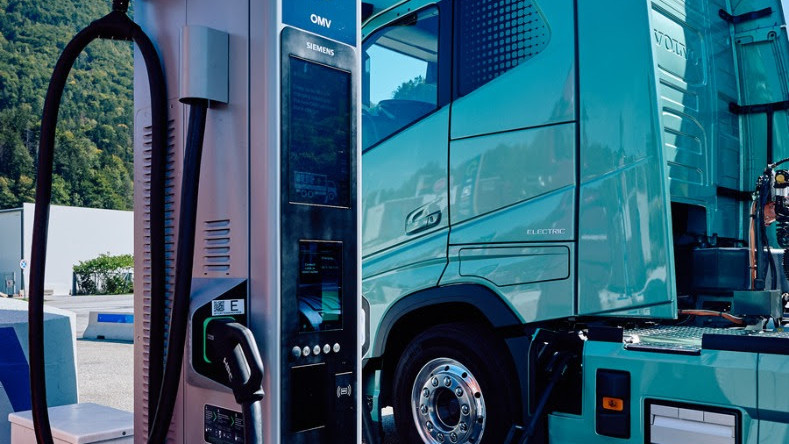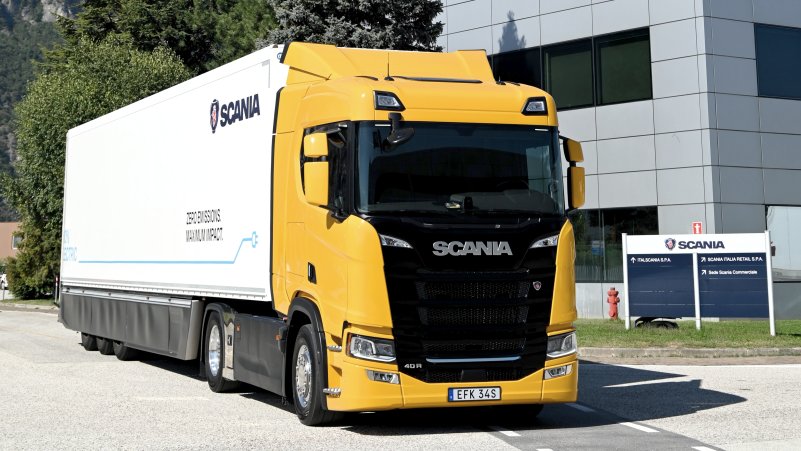







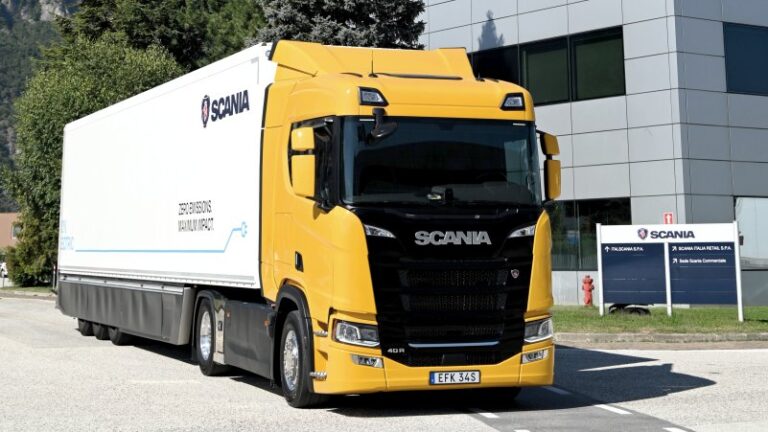
Scania announced on 29 September 2026 that it had become the first commercial vehicle manufacturer to charge one of its battery-electric vehicles in Italy using the Megawatt Charging System (MCS). The manufacturer tested a Scania 40 R at two stations along the Brenner corridor: one at the Bolzano Sud toll plaza on the A22 motorway, operated by Autostrada del Brennero, and another at Varna, near Bressanone, developed by Ide2n (Energy Systems & E-Mobility) and operated by Kostner Service Stations. The session confirmed compatibility between Scania’s system and Alpitronic charging infrastructure already operating in Italy. The Bolzano Sud facility, in the Firmian car park, is Italy’s first public charging installation for electric commercial vehicles equipped with MCS technology.
The standard was developed for rapid charging of electric commercial vehicles used on long-distance routes. Compared with CCS2, currently the most widely used charging standard for these vehicles, it handles higher currents and power levels, with a potential current capacity of up to 3,000 amps. Scania’s current system supports 1,000 amps, enabling it to add 400 kilometres of range in 30 minutes, according to Simone Martinelli, E-mobility, Urban & Construction Sales at Scania Italia. This is the distance a driver covers during the four and a half hours of driving before the mandatory break. Using scheduled stops for charging, Scania adds, maintains productivity and makes transport operations more predictable.
The Scania 40 R A4x2NB used in the test has a 400 kW EM C1-4 electric motor paired with a four-speed GE14M1 gearbox. Its battery comprises five packs, with an installed capacity of 445 kWh, of which 400 kWh is usable. At a 90% state of charge, the available energy is 405 kWh. MCS charging power reaches 750 kW at 1,000 amps, while CCS2 charging reaches 375 kW at 500 amps. The wheelbase measures 4,150 mm and the tractor unit weighs 9,690 kg.
The Alpitronic Hypercharger HYC1000 has a one-megawatt power unit, whose full output is available through MCS, while CCS2 charging is limited to 600 kW. The system comprises eight modules, with dynamic power allocation in 62.5 kW increments, and operates at a DC output voltage of between 150 and 1,000 volts. High-power charging is key to making electric trucks competitive on long-haul routes, according to Philipp Senoner, CEO of Alpitronic. With high diesel prices weighing on logistics, he notes, electric vehicles can deliver substantial reductions in operating costs. The HYC1000’s MCS dispenser enables charging sessions lasting up to 45 minutes, compatible with drivers’ mandatory breaks. At Varna, the MCS station runs entirely on renewable energy, partly generated by the company’s own photovoltaic installations and partly supplied by Kosi, the Kostner Group’s clean energy provider.
For Fredrik Swartling, managing director of Scania Italia, electrification requires vehicles capable of communicating with complex, continually updated systems, alongside adequate infrastructure. It therefore also requires suppliers able to design and manage reliable solutions along the main freight transport routes. Carlo Costa, general technical director of Autostrada del Brennero, explained that the motorway operator is working on two fronts: rapid charging at reasonable prices for battery-electric vehicles and a distribution network for green hydrogen. Projects are under way in both areas.
P.R.