





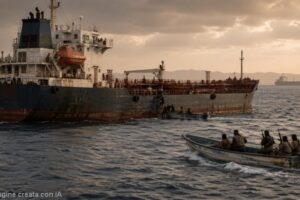

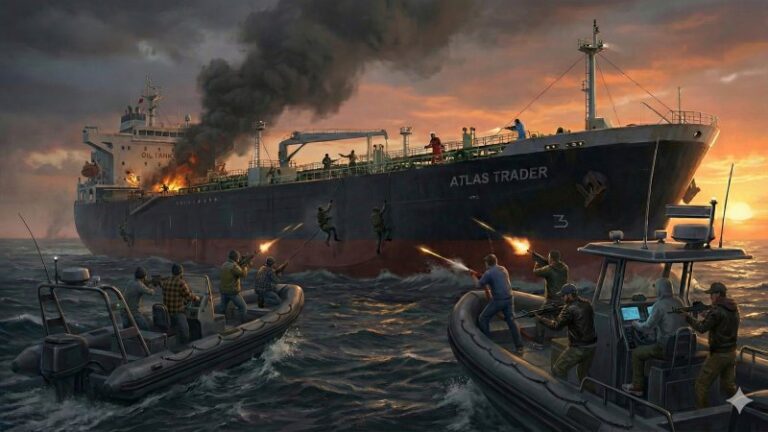
- Puntland authorities retook the tanker Honour 25 on 29 September 2026, after it was hijacked on 21 April with seventeen seafarers on board. Five were killed and four wounded. They are the first deaths attributed to Somali pirates in more than a decade.
- In the first half of 2026, the IMB recorded 38 incidents of piracy and armed robbery worldwide, the lowest level since 1992. Ten were attributed to Somali pirates, compared with three in the same period of 2025: five hijackings, three ships fired upon and two attempted approaches. Somali groups accounted for 94% of the 67 seafarers taken hostage.
- According to RUSI, pirates have seized six merchant ships since late April, four of them tankers, compared with three in almost fourteen years. Factors include the reduction in naval deployments, with vessels redeployed towards Hormuz and Bab el-Mandeb, and the absence of armed guards on board. With the Honour 25 and Eureka, five of the six ships have now been freed.
Five months of captivity ended with five seafarers killed in the battle fought by Puntland maritime police on 29 September 2029 off Dharin-baar, in the Bandar Beyla district, to free the tanker Honour 25, hijacked by pirates on 21 April. The Ministry of Information of the semi-autonomous region said the victims were three Pakistani nationals, one from Myanmar and one Indian, while four seafarers, three Pakistanis and one Indian, were wounded. These are the first killings attributed to Somali pirate attacks in more than a decade. Honour 25, a small Palau-flagged product tanker, was carrying 18,500 barrels of fuel and seventeen crew members, ten of them Pakistani. Pirates boarded the vessel while it was sailing from Oman to Somalia, bound for Mogadishu.
There are two conflicting accounts of how the killings occurred. The Puntland government says the pirates killed the five seafarers before the operation began, but has not specified how or when. Two Pakistani survivors, interviewed by the Ansar Burney Welfare Trust and quoted by The Express Tribune, gave a different account: the intervention by Somali forces allegedly triggered a gunfight and, under pressure, the hijackers opened fire on the crew as they abandoned the vessel, also damaging the wheelhouse and leaving the tanker unable to manoeuvre. Even before the attack, some seafarers had warned a Pakistani association that their captors were threatening to kill the hostages if an attempt was made to retake the ship. So far, there has been no independent verification of what happened.
The number of arrests was also revised: Puntland reported sixteen arrests after initially announcing twenty-one, with at least eleven hijackers escaping and still at large. Meanwhile, Pakistan's Ministry of Foreign Affairs released the names of the three Pakistani nationals killed: Rafi Ullah Khan, Syed Kashif Umer and Mahmood Ahmed Ansari, and said the survivors had been taken ashore at Bandar Beyla. According to The Express Tribune, the ransom demand changed several times before falling to one million dollars, about €870,000.
On the same day, the Eureka case also came to an end. The pirates who had held the vessel for 150 days grounded it at Hulcaanood, also in the Bandar Beyla district, put the twelve seafarers ashore, eight Egyptians and four Indians, and fled. According to Puntland Police, the hijackers escaped inland as military personnel approached. Four days earlier, Sibu 1, also known as Seamull, a US-sanctioned tanker hijacked in August, had been retaken. That operation, however, ended with 28 of the 41 suspects escaping during an overnight road transfer from Garacad to Garowe.
Following the operations on 29 September, five of the six ships seized by pirates off Somalia by late August have now been freed. Sward, a Saint Kitts and Nevis-flagged cargo ship, was released on 11 September after 138 days in captivity and the payment of an undisclosed ransom, with unconfirmed estimates putting the amount at between $1.7 million and $2.7 million, about €1.5 million to €2.3 million. The pirates had also used the vessel as a mother ship to capture at least two Iranian fishing boats and the Cameroon-flagged cargo ship Lutuf. Accounts of the latter's release differ: Puntland security sources say a ransom of $2.5 million, about €2.2 million, was paid, while the Federal Government attributes the release to military pressure from the Turkish Navy and Somali armed forces.
The Honour 25 case is the most serious among the incidents covered by the IMB report for the first half of 2026. Worldwide, incidents of piracy and armed robbery against ships totalled 38, compared with 90 in the same period of 2025 and 60 in 2024. This was the lowest half-year figure since 1992, although the Somali share increased: the Centre attributed ten incidents to Somali pirates, compared with three in the first half of 2025 and eight in 2024. Above all, Somali groups were responsible for 94% of the seafarers taken hostage worldwide, a total of 67 during the six-month period. Of the ten Somali incidents, five were hijackings involving two product tankers, two dhows and one general cargo ship. Three vessels were fired upon and two experienced attempted approaches.
After a relatively quiet first quarter, the second half of April marked a turning point. Following the Honour 25, on 23 April the cargo ship Elfriede repelled an attack by a speedboat: at a distance of about 600 metres, gunfire was exchanged between four pirates and the armed security team on board. Two days later, the UAE dhow Fahad 4 was hijacked and subsequently released on 4 May, while Sward was seized on 26 April about 20 miles from Garacad. On 2 May, Eureka, a Togo-flagged tanker, was boarded while at anchor about 12 miles from the Qana terminal in Yemen by nine armed men, who took the twelve seafarers hostage and directed the vessel towards Somalia.
In June, the pressure shifted to the Gulf of Aden, but with a different outcome. On 15 June, the container ship Greta Star and tanker Vst Amara came under gunfire. A rocket was also fired at the latter but missed, and the armed security team returned fire. On 21 June, the tanker Sea Heart experienced an attempted approach. According to the IMB, in all these cases the vessels avoided being boarded by applying Best Management Practices, and the organisation has called on naval forces in the area to adopt a more robust posture and provide a strong naval deterrent. It also notes that attacks have previously occurred more than a thousand miles from the Somali coast and that some hijackings of dhows and fishing vessels may have gone unreported.
A broader interpretation of the resurgence in Somali piracy comes from Christopher Hockey, a RUSI researcher in Nairobi, in an analysis published on 23 September. In almost fourteen years, between the collapse of the phenomenon in 2012 and the beginning of 2026, only three cargo ships were hijacked off the Horn of Africa, while six have been seized since late April 2026 alone. The incidents have occurred in two areas: three ships were captured along Puntland's eastern coast, between Garacad and Durdura, and three on the Yemeni side of the Gulf of Aden, before all were moved into Somali waters. Four of the six were tankers. Among the causes, Hockey identifies the reduction in international naval deployments since 2021 and a further redeployment of vessels in 2026 towards Hormuz and Bab el-Mandeb. This has been compounded by increased traffic off Somalia due to route diversions linked to the war involving the United States and Israel against Iran, together with higher oil prices and unusually calm sea conditions. The Indian Ocean High Risk Area was also removed in January 2023, prompting shipping companies to cut spending on protective measures. None of the ships hijacked this year had armed guards on board.
On land, the analysis continues, the picture has not changed. Coastal communities in Puntland receive limited services, cuts in international aid are taking their toll, food and fuel prices are rising and illegal fishing continues to deplete stocks. Leaders, operatives and financiers from the 2008-2012 piracy period moved into smuggling, and some remain connected to the security apparatus of Puntland or the Federal Government. RUSI remains cautious about the role of the Houthis. There are unconfirmed reports of training, equipment and funding being provided to some pirate groups and indications that operations have departed from settlements in Yemen with the involvement of Yemeni nationals. Puntland officials have attributed involvement in the hijacking of Eureka to individuals linked to the Houthis, while confidential sources claim the Sward hijacking was financed by them. Hockey himself, however, describes the evidence of a direct link as circumstantial. The IMB nevertheless keeps missile and drone attacks in the Red Sea and Gulf of Aden separate, and does not classify them as piracy.
The analysis also highlights the unusual profile of some of the vessels captured. Honour 25 is reportedly owned by a Puntland businessman, Asana is said to have been carrying a false cargo and has disputed ownership, Sibu 1 has been linked to the Iranian shadow fleet, and Lutuf is reported to have been carrying Turkish weapons bound for Mogadishu. According to Hockey, the course of the current wave will depend on how the ships are released, although the use of force also carries a cost: Puntland accuses Turkey of carrying out air strikes to free Lutuf, killing at least fourteen people, and the incident has triggered a dispute with the Federal Government. The last merchant ship still in pirate hands is Asana, a tanker hijacked on 17 July. Mohamed Mubarak, head of Puntland's security coordination office, said there are no longer any vessels being held off the region and that the remaining ship is in the waters of neighbouring Galmudug State.
M.G.