






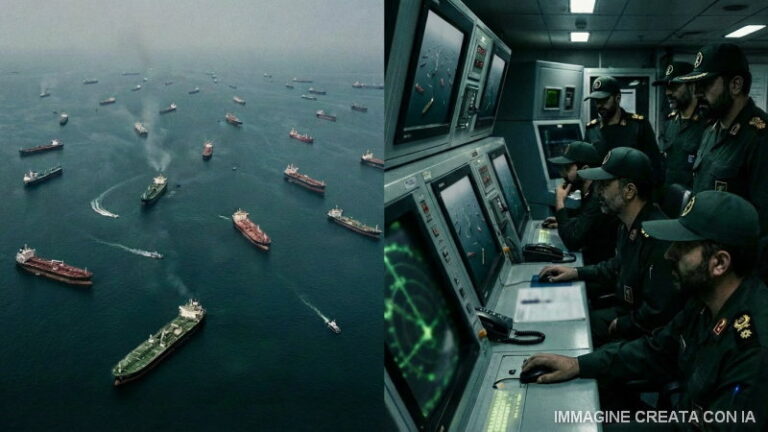
The truce between the United States and Iran, announced overnight on 7–8 April 2026, proved extremely short-lived as a mechanism to normalise traffic through the Strait of Hormuz. Less than twenty-four hours after the agreement, the passage was effectively blocked again, with tankers forced to turn back and tracking systems showing a sudden drop in transits. The two-week ceasefire, mediated by Pakistan and supported by China, centred on reopening the strait to commercial traffic. US Vice President Jd Vance summarised the agreement in simple terms: "the Iranians have agreed to reopen Hormuz, the United States have agreed to stop the attacks". However, the conditional nature of that reopening became clear almost immediately after the announcement.
Iranian Foreign Minister Abbas Araghchi specified that transit would take place "in coordination with the Iranian armed forces" and that vessels would need prior authorisation from Tehran’s navy, along with the payment of a toll. A radio recording cited by the Wall Street Journal included an explicit warning: "any vessel attempting to pass without permission will be destroyed". This was therefore not a reopening in the strict sense, but a militarised management of traffic under full Iranian sovereignty.
On the morning of 8 April, MarineTraffic tracking systems recorded the passage of the first vessels following the truce, including the Liberia-flagged bulk carrier Daytona Beach and the Greek-owned Nj Earth. Images of these ships in transit influenced financial markets, triggering an initial drop in oil prices. However, by the evening it was already evident that traffic volumes were lower than the previous day and that the strait had not fully reopened.
The turning point came between the evening of 8 April and the early hours of 9 April, with Israeli raids on more than one hundred targets in Beirut and the Bekaa Valley. Tehran interpreted these attacks as a violation of the spirit of the ceasefire and decided to halt vessel transit through Hormuz once again. The Iranian agency Fars, cited by several international media outlets, reported a blockade of tanker traffic. The Italian news agency Agi then noted that a tanker identified as Auroura had made a sudden 180-degree turn back towards the Persian Gulf, an operational signal of the renewed closure.
The Mehr news agency added that, "to protect themselves from possible collisions with mines", vessels would need to follow "alternative routes" through the strait, in coordination with the navy of the Islamic Revolutionary Guard Corps, with mapped corridors south and north of Larak Island. By the morning of 9 April, there was open talk of a "fragile truce" and a new closure of Hormuz, while Hezbollah responded to the raids in Lebanon with rocket fire into northern Israel. Tankers were forced to reverse course, with an immediate impact on energy markets: oil prices rose again after the previous day’s decline.
Reactions from major container shipping companies to the truce were cautious from the outset, and the rapid reclosure of the strait confirmed the validity of that approach. Maersk was the clearest and most prompt in its response. After the ceasefire announcement, the Danish carrier described the truce as "a potential opportunity for transits", but immediately stressed that conditions did not yet provide a sufficient level of safety to resume normal operations. The company therefore adopted "a cautious approach", stating that it would not make any changes to its services for the time being.
Other major carriers – including Msc, Cma Cgm, Hapag-Lloyd and Cosco – maintained an even lower profile, limiting themselves to general statements committing to "closely monitor" developments without announcing any service resumptions. Cosco, which had suspended new bookings on routes crossing Hormuz, had not communicated a full reinstatement at the time of the truce. The Norwegian Shipowners' Association reported that many Norwegian vessels were not yet ready to resume transit, describing a "still uncertain situation" despite the formal reopening.
The reasons for this caution operate on three distinct levels: operational safety, insurance coverage and the stability of the political agreement. On safety, Maersk reiterated in its communications that any decision to transit Hormuz would be based on continuous risk assessments and guidance from relevant authorities. IMO (International Maritime Organization) Secretary-General Arsenio Dominguez welcomed the ceasefire, stating he was "working with stakeholders" to define safe corridors and procedures to ensure seafarer welfare and navigational safety. ICS (International Chamber of Shipping), which represents over 80% of the world’s merchant tonnage, described the truce as "a sign of a possible return to stability", while also calling for coordinated and immediate action to restore safe vessel movements.
On the insurance side, during the peak of the crisis many insurers classified Hormuz as a "high-risk area", reducing or suspending standard coverage and imposing significant additional premiums. A two-week truce alone is not enough to bring those premiums back to pre-crisis levels: until insurers perceive a sustained de-escalation, the cost of transiting the strait will remain high. The third factor is the limited duration of the agreement itself: a two-week horizon makes caution a rational choice, as carriers risk reopening services only to suspend them again within days, incurring substantial operational and reputational costs.
The conflict and the closure of Hormuz have increased costs for the global merchant fleet by millions of euros, including fuel, insurance and rerouting expenses, with knock-on effects on maritime freight rates and air logistics. The sectors most affected include automotive logistics, general cargo and agri-food, all of which have faced delays, shortages of empty containers, rate volatility and difficulties in planning shipments to the Middle East. The truce contributed to a drop in oil prices, with Brent and WTI falling significantly from crisis peaks, temporarily easing pressure on bunker costs. However, the persistence of longer routes, emergency surcharges and uncertainty over scheduled departures continues to drive volatility in container freight rates, with direct consequences for shippers and global supply chains.
With the renewed closure on 9 April, the situation has largely reset to its starting point: carriers are maintaining alternative routing schemes until perceived risk declines structurally, while the work of IMO and ICS to define safe corridors and controlled transit mechanisms remains a prerequisite for shipowners to consider Hormuz a viable passage again. For carriers, a strait is truly open only when the risk of incidents, seizures or attacks is perceived as close to zero.
Mara Gambetta