





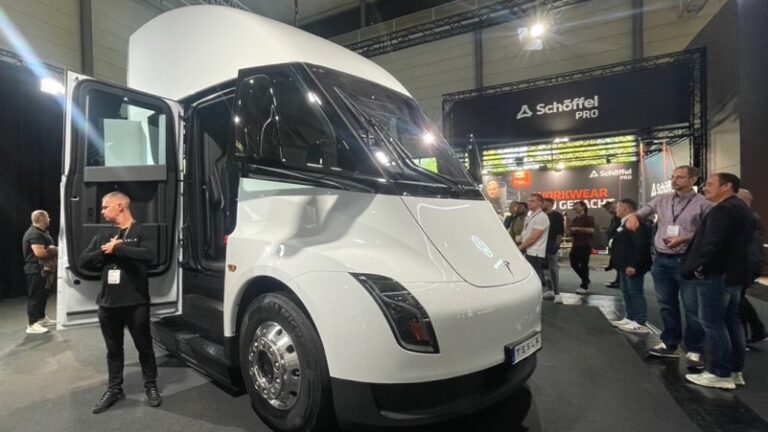
Tesla announced on 20 August 2026 that it will unveil technical specifications and details of the commercial launch in Europe of the Semi, its electric tractor unit, during IAA Transportation, the biennial Hannover trade fair dedicated to commercial vehicles and logistics. Unlike the 2024 edition of the German event, when Tesla brought two US-spec examples to Hannover without giving any indication of its European commercial plan, Musk’s company has now confirmed via X that it will provide details on the European variant of the model and its sale. A first concrete signal comes from France, where Tesla has hired a business development manager for Semi sales, tasked with overseeing commercial operations in the country.
From a technical standpoint, the company has so far only said that the vehicle it will show in Hannover is the updated version of the Semi presented last autumn. The news comes shortly after the start of series production of the Tesla Semi in the United States, which began in 2026 near the Gigafactory Nevada, a step that could also support exports to Europe. In the United States, the vehicle is offered in two variants: Standard Range, with a 548 kWh battery and a claimed range of about 523 kilometres, and Long Range, with an 822 kWh battery and a range of up to 805 kilometres at full load. Both feature three rear electric motors with a combined output of 1,073 hp (800 kW). Charging uses Tesla’s proprietary Megacharger technology, which the company says can restore 60% of range in about 30 minutes at power of up to 1,200 kW.
For European type approval, however, adaptations will be needed, because articulated lorries in the EU must comply with dimensional limits of 16.5 metres in length and 2.55 metres in width, as well as mandatory ADAS systems, requirements that do not apply in the US. It is not yet clear whether both battery variants will be marketed in Europe. Tesla’s UK website currently lists only the Standard Range, an indication that could for now exclude the United Kingdom from the long-range version. It also remains to be seen whether charging infrastructure in Europe will be based on the proprietary Megacharger standard or on the European MCS connector.
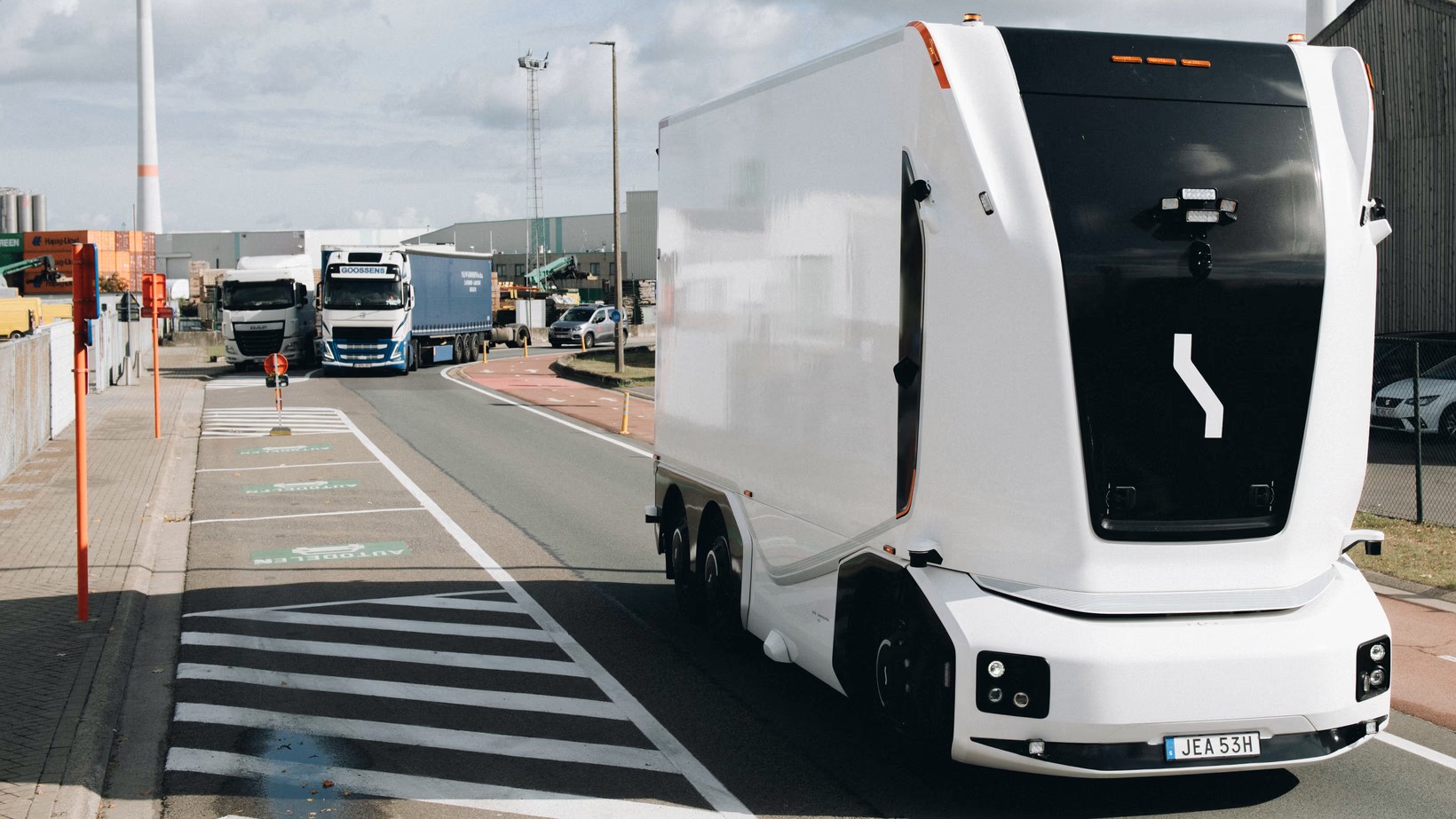
Tesla has meanwhile already secured a substantial sale in Europe from Swedish transport company Einride, which has ordered 500 Semi units, the largest single order so far received by the US company for this model. However, some caution is needed over the timing of the vehicles’ actual arrival on European roads. As early as 2024, during the previous edition of IAA Transportation, Semi programme manager Dan Priestley identified 2026 as the timeframe for a large-scale launch in Europe, subject to completion of the production ramp-up in the United States. More recently, in February 2026, Elon Musk spoke of a European arrival “hopefully next year”, therefore referring to 2027.
In Europe, the Tesla Semi will have to compete with rival models that have already been on the road for some time, produced by almost all the traditional manufacturers, which already have a strong commercial and aftersales presence. It will also have to contend with several Chinese brands that are putting vehicles on European roads this year, and not only that: some have also started vehicle assembly, using “rented” factories, such as Steyr’s plant in Austria. In short, 2027 is shaping up to be an interesting year for the electric truck.