







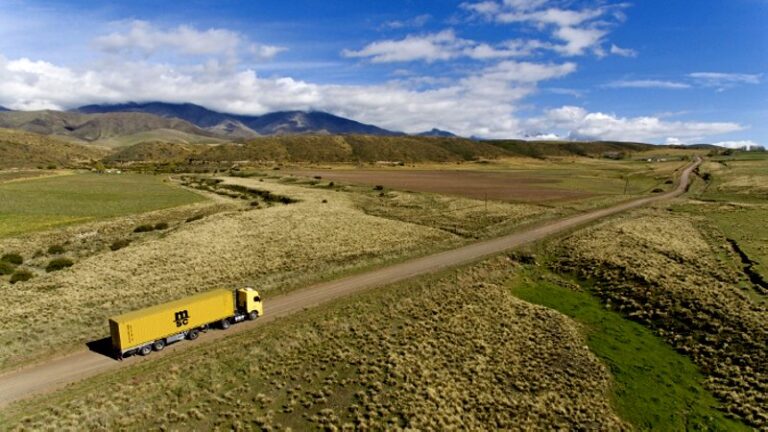
The 1970s were the golden age of road haulage between Europe and the Middle East, with thousands of articulated trucks carrying a wide range of goods – from consumer products to equipment for the oil industry – eastwards. At that time, maritime container transport was still a niche sector and ports in the Arabian area were unable to cope with the surge in demand for goods that followed the rise in oil prices which enriched Arab countries.
Vehicles departed from several European countries, crossed the difficult roads of Yugoslavia and Bulgaria and reached Istanbul. Around six thousand tonnes per day crossed the then new Bosphorus road bridge from Europe to Asia. From there, the flow of trucks split into two main corridors: towards Iran, Iraq or Syria, depending on the final destination. It was a real epic, not only because of the distances involved: freezing winters and scorching summers, damaged or barely sketched-out roads, long waits at borders and criminal attacks severely tested the work of drivers.
However, this period was relatively short-lived, as the context changed with the development of port infrastructure and maritime container transport, along with major geopolitical events, most notably the Islamic Revolution in Iran and the subsequent war with Iraq. These developments cut off a large part of the road arteries while maritime transport expanded. Yet the Iranian context is now triggering a revival of land traffic, although on a much smaller scale than during the golden age.
The closure of the Strait of Hormuz is trapping thousands of containers in the Persian Gulf, reviving road transport both for direct links to Europe and for routes crossing the Arabian Peninsula to reach the Red Sea without passing through the Straits of Hormuz and Bab el-Mandeb. From there, containers can be reloaded onto ships bound for the Suez Canal. The reopening of road haulage corridors is also being facilitated by the stabilisation of Syria, which opens the route towards Turkey and therefore the Mediterranean. On the regulatory side, a key facilitator is the TIR regulation, adopted by many countries in the region and increasingly streamlined through digitalisation.
Two corridors are now emerging. The first connects Iraq with Turkey and Jordan and has become particularly interesting since Baghdad joined the TIR system in June 2025. This allows transport from Poland to the United Arab Emirates or Saudi Arabia in around ten days, using combined road-sea transport while avoiding congested ports involved in the conflict.
The reactivation of the TIR regime in Syria allows the country to be used for a second corridor linking Turkey with Jordan and the Gulf area. Ankara and Damascus recently signed a road transport agreement to reopen the historic Turkish–Middle Eastern corridor. The Turkish Minister of Trade announced that the corridor should be fully operational in 2026, with initial transits already under way towards Jordan and the Gulf. On the European side, flows connect with international transport backbones using the TEN-T motorway network and the Balkan gateways towards Turkey.
Alongside these two north–south routes, a third transversal corridor runs through Saudi Arabia, linking the ports of Dammam and Jubail on the Persian Gulf with Jeddah on the Red Sea via Riyadh. From Jeddah, containers can be shipped towards the Suez Strait along a stretch of sea beyond the reach of Houthi attacks.
Road routes are not without critical issues. The first is limited capacity compared with maritime transport, due to the restricted availability of heavy vehicles. Instability also persists, particularly in Iraq – which in recent hours has been turning into a conflict zone – and in Syria. Road haulage is also affected by rising costs, especially fuel prices, driven by the Iranian conflict itself. This factor inevitably increases road transport costs, making the mode suitable only for a limited range of high-value goods.
These constraints have not prevented the development of new services or the strengthening of existing ones, often promoted by shipping companies themselves. On 3 March 2026, for example, MSC relaunched the Tiger and Phoenix multimodal services, which move containers from the Turkish ports of Mersin and Iskenderun respectively into Iraq (Zakho, Dohuk, Mosul, Erbil, Sulaymaniyah and Baghdad). The future of this transport mode nevertheless remains uncertain, as it depends on the duration and outcome of the conflict currently inflaming the entire Gulf region.
Michele Latorre