






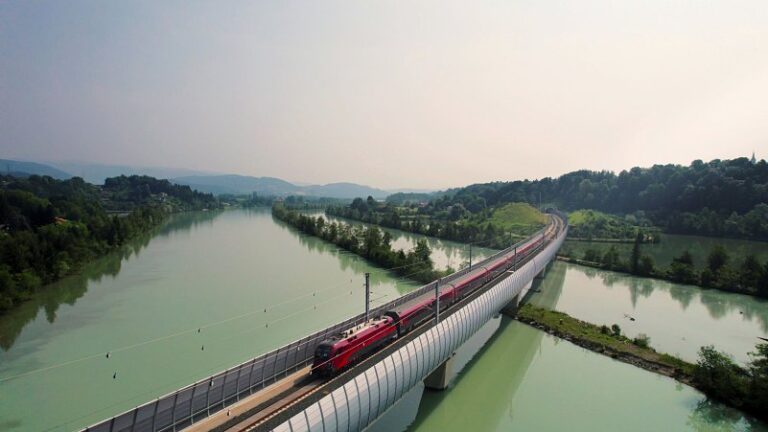
In Austria, the countdown to operational launch can now begin, following the positive outcome of more than 280 trials involving different train types and increasing speeds of up to 250 km/h. These tests have focused in particular on the 32.9-kilometre base tunnel beneath the Koralpe mountain range, which stands as the most remarkable engineering work along the new route, known as the Koralmbahn.
The new railway, which has involved an investment of six billion euros, stretches 130 kilometres between Klagenfurt in Carinthia and Graz in Styria, providing a transversal link across southern Austria. For freight traffic, including cross-border movements between Italy and central-eastern Europe, it would be no exaggeration to call it a historic turning point. In Austria too, with a degree of emphasis, the Koralmbahn is described as the project of the century. The new line is not merely an upgrade of an existing route—except for minor sections—nor is it just another base tunnel to be compared with the Gotthard, Brenner or the new Mont Cenis, but rather a missing piece now integrated into the Baltic-Adriatic corridor.
With testing complete, authorisation procedures are still under way, but confirmation has been given that the Koralmbahn will be fully accessible to all types of trains from the 14 december 2025 timetable update. Freight trains, however, will begin using the line from october. As seen in the case of the Gotthard base tunnel, freight services will commence ahead of passenger operations to ensure real-world verification of the full functionality of the line and its systems, minimising the risk of any emergencies which, if involving passenger trains, would require full-scale rescue operations in the tunnel.
The Koralmbahn’s high-capacity layout provides optimal conditions for the transit of long freight trains without the need for double traction, as the route is effectively flat. For this reason, Austrian rail operators foresee a significant increase in weekly freight train traffic along the southern corridor, potentially rising from the current 40 to at least 100.
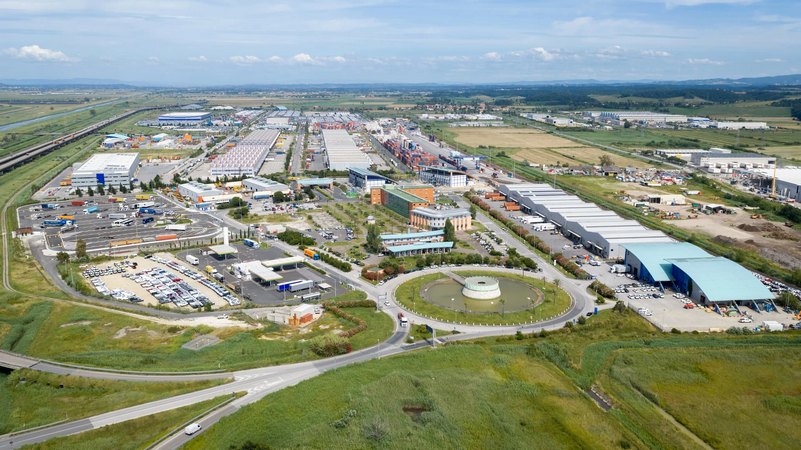
The port of Trieste and northern Italy are expected to benefit most significantly from the opening of the Koralmbahn. On the Austrian side, Graz and its Cargo Center aim to strengthen their position as a logistics hub serving Poland, Romania and southeastern Europe. However, positive effects will also be felt across the wider area stretching transversally from Bavaria through Baden-Württemberg to the Rhine-Main region.
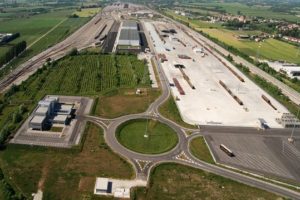
The new railway beneath the Koralpe has prompted a series of upgrade and modernisation works across the Austrian network sections connected to the new route. These investments include, to the west, the Carinthian network and, to the east, the Styrian railways. In Carinthia, construction efforts have focused in particular on upgrading the line from Villach—therefore indirectly from Italy via Tarvisio—to Klagenfurt, which serves as the Koralmbahn’s western gateway. Longer-term prospects concern the largest investment already under way for freight transport: the extensive redevelopment of the Villach-Süd marshalling yard, which is scheduled to be fully rebuilt in multiple phases by 2040, alongside the logistics site of the Fürnitz intermodal terminal.
Attention must also be paid to another major project nearing completion, with an investment of 4.2 billion euros and expected to have an impact on the Austrian rail system comparable to that of the Koralmbahn. This is the new Semmering base tunnel, stretching 27.3 kilometres as an alternative to the historic mountain line between Gloggnitz in Lower Austria and Mürzzuschlag in Styria. Its opening is scheduled for 2030. The new route will offer a more favourable alignment for freight trains, forming the central link in the Baltic-Adriatic corridor between Adriatic ports and the Baltic Sea in Poland, via Graz and Vienna.
Piermario Curti Sacchi