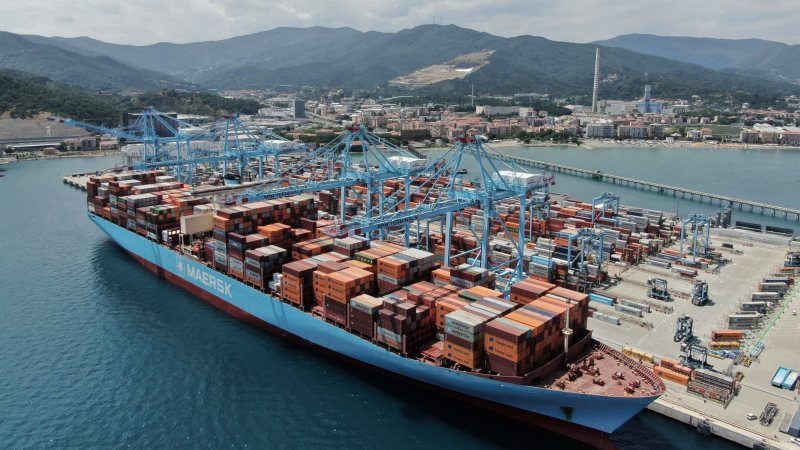







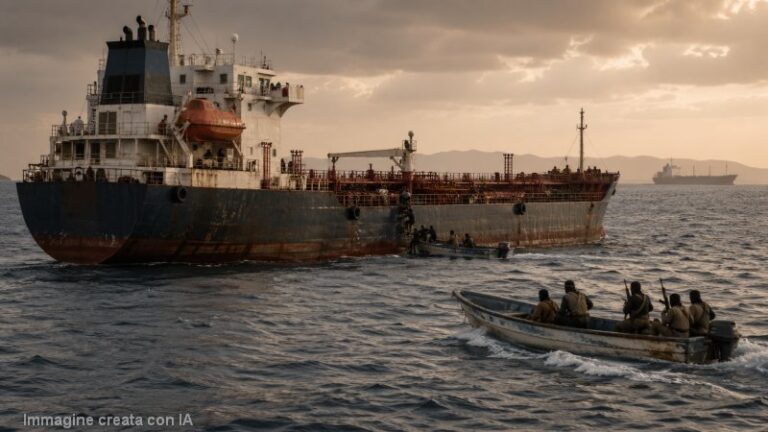
The Honour 25, a Palau-registered tanker with 17 crew members on board, has been hijacked off Somalia about 30 nautical miles from the coast. The incident, which took place late on 22 April 2026, puts Somali piracy back at the centre of maritime risk in the Gulf of Aden, an area that for more than a decade had been considered better controlled thanks to the international naval presence and the protection measures adopted by shipowners. The Honour 25 fits the profile of the most exposed vessels: small and medium-sized tankers used in regional fuel trades, operating on routes close to the coast and often less visible than large container ships or tankers engaged in ocean-going trades.
The return of Somali piracy comes at a time of reduced surveillance in this area compared with the years when international naval missions, armed guards on board and self-defence measures had curbed the operational capacity of criminal groups. According to analyses based on data from the International Maritime Bureau, attacks in the Gulf of Aden have shown signs of a resurgence as military and commercial attention has shifted towards the Red Sea and Bab el-Mandeb, where attacks on merchant vessels have changed routes, insurance costs and voyage times. This dynamic shows that Somali piracy is not growing as an isolated phenomenon, but is exploiting windows of vulnerability. When the naval presence declines, or when strategic priorities move to other fronts, coastal groups can resume attacks on less protected vessels.
The precedent of the Aris 13, hijacked in 2017 while carrying fuel from Djibouti to Mogadishu, shows that this pattern is not new. Then too, the target was a product tanker operating on regional links. The difference lies in the current context: today the Gulf of Aden is not an isolated critical area, but one section of a wider corridor that includes the Red Sea, Bab el-Mandeb, the Persian Gulf and the Strait of Hormuz. Piracy is therefore returning in an environment already under pressure for military, energy and insurance-related reasons. To the west, between the Red Sea and Bab el-Mandeb, attacks on commercial shipping have already prompted many companies to review their routes. In the centre, in the Gulf of Aden and along the Somali coast, pirate groups can exploit reduced surveillance and the greater dispersal of traffic. To the east, in the Strait of Hormuz, tensions between Iran, the United States and allied countries introduce a different risk, state-related in nature, linked to detentions, seizures and pressure on ships perceived as connected to opposing interests.