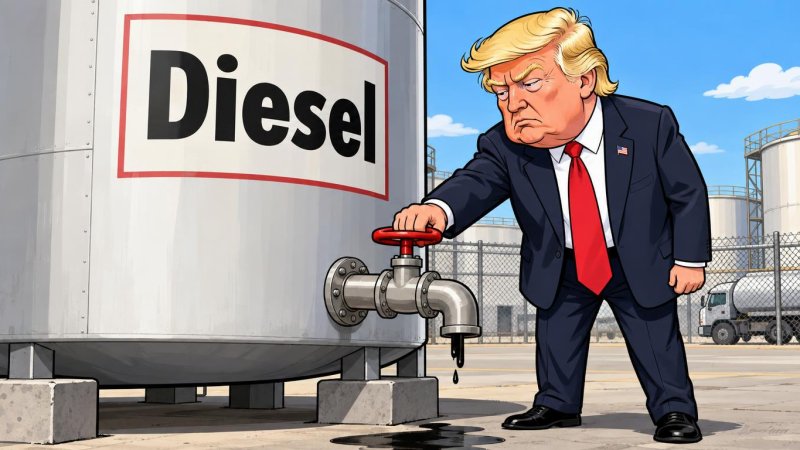




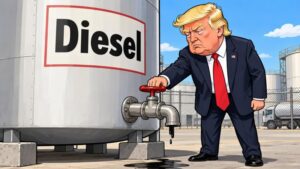
Either the European Union releases 120 million barrels of diesel from its emergency stocks onto the market over the next six months, or the United States will block exports of its own product. This is the ultimatum that, according to a Reuters report published on 1 October 2026 citing three people familiar with the matter, President Trump has issued to Europe. The warning comes as Donald Trump considers banning diesel exports in an effort to bring down domestic prices ahead of November’s midterm elections, against a backdrop in which diesel shortages, and therefore rising prices, have resulted from the war launched by the United States and Israel against Iran and European sanctions on Russia. The volume of diesel demanded by Trump would be equivalent to drawing down more than 40% of the 39 million tonnes of emergency diesel held by EU member states, according to Eurostat figures from May 2025. At that date, France held 8.2 million tonnes and Germany 5.6 million tonnes, together accounting for about 35% of the total. A later source cited by Reuters gave a tighter deadline: 100 million barrels within 20 days, again according to anonymous sources.
Trump’s ultimatum to Europe was accompanied by statements from his administration that appear to lend support to the Reuters report. Energy Secretary Chris Wright said on 1 October that the administration expected announcements from Europe soon on additional diesel supplies and, the following day, told Fox News he was very confident that Europe could ease prices by drawing on its reserves. Trump himself had said in the previous days that he was considering a ban on diesel exports and, according to Reuters, Washington has also considered alternatives, including voluntary limits on exports by refiners and greater availability of “red diesel”, the tax-exempt fuel. A US official, one of the agency’s sources, said it was in Europe’s interest to cooperate while the United States explores several ways of increasing the supply of refined products.
For Europe, even a reduction in diesel imports - which fuel road transport, agriculture and industry - would create a serious emergency, potentially the most severe since the pandemic. The continent has become increasingly dependent on US fuel following the ban on Russian imports, extended until the end of October because of damage inflicted on refineries by Ukrainian attacks, and after the war waged by the United States and Israel against Iran disrupted supplies from the Middle East. The market is also being affected by the suspension of overseas fuel sales by Chinese refineries, which in October are prioritising domestic stocks.
To address the issue, on 1 October the European Commission, Germany, France, Italy, Ireland and the United Kingdom held a video meeting to assess whether diesel stocks may need to be released, according to an EU official quoted by Reuters. The problem is that the reserve mechanism is less straightforward than it may appear. Members of the International Energy Agency (IEA) are required to maintain reserves equivalent to at least 90 days of net imports, held either by governments or by companies under public obligations. The agency estimates that its member countries hold more than 1.2 billion barrels of emergency stocks, alongside a further 600 million barrels of compulsory industry stocks. EU countries hold almost 109 million tonnes of crude oil and petroleum products in total, and only part of this is diesel that can be released quickly. Actual availability also depends on quality, seasonal specifications, the location of storage facilities and transport capacity. On 2 October, again according to Reuters, EU governments examined a French proposal for the release of 50 million barrels of diesel in Europe, accompanied by possible IEA action involving another 50 million barrels of crude oil. Paris, however, has made the plan conditional on a US commitment not to impose a unilateral embargo on exports.
What could be the consequences for European consumers of releasing part of the diesel reserves? In the very short term, it could reduce pump prices by about 5-10 euro cents per litre. However, some governments, including Italy’s, would be legally required to rebuild their reserves in the following months and, if wholesale prices rose by 30-50%, replenishing the stocks would cost the Italian public finances alone an additional €500 million to €860 million, according to an estimate by Energia Oltre. Moreover, once the released reserves were exhausted, pump prices could rise again. The use of emergency stocks would therefore clearly benefit Trump alone by helping to contain diesel price increases in the United States ahead of the midterm elections.
P.R.