







- The US Department of Justice announced on 18 May 2026 a criminal indictment against China International Marine Containers, Dong Fang International, Cxic Group Containers and Singamas Container Holdings, together with seven of their executives, for violating the Sherman Antitrust Act. The charges concern agreements to restrict production and fix prices for standard dry containers between November 2019 and January 2024.
- According to the Doj’s reconstruction, the four companies, which account for about 95% of global standard dry container production, allegedly agreed to reduce factory shifts, close production lines and prevent the opening of new capacity at a time when demand was at record highs. Container prices almost doubled between 2019 and 2021, while profits rose about one hundredfold for some manufacturers.
- The indictment, initially filed in January 2024 and made public only in May 2026, exposes the companies to substantial fines and the executives to prison sentences. Since all the parties involved are based in China, enforcement remains uncertain, but the investigation carries risks of arrest in third countries, travel restrictions and reputational consequences in dealings with Western counterparties.
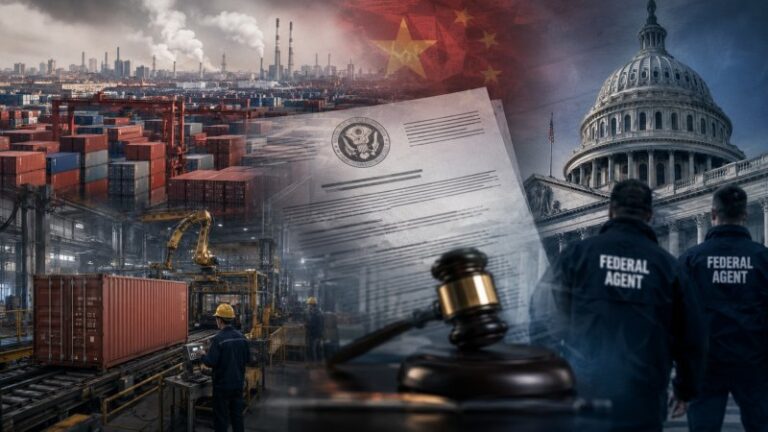
Chinese container production is in the sights of the US Department of Justice, which has indicted four of the world’s largest producers of standard dry units and seven of their executives on charges of forming a global cartel between November 2019 and January 2024. The indictment, initially filed under seal in January 2024 and made public on 18 May 2026, alleges a violation of Section 1 of the Sherman Antitrust Act, the federal law prohibiting agreements between companies that restrict competition, particularly arrangements on prices and production volumes.
The indicted companies are China International Marine Containers (Cimc), Dong Fang International, also operating as Shanghai Universal Logistics Equipment, Cxic Group Containers and Singamas Container Holdings, all based in China or Hong Kong. Seven of their executives, all Chinese nationals, are also under investigation. According to US authorities, the four companies together account for about 95% of global production of standard dry containers, the type that forms the backbone of liner shipping and moves the vast majority of goods in global trade.
The Doj describes the alleged conduct with an unusual level of detail for an antitrust indictment: the four companies allegedly reached agreements to limit the production of new containers, coordinate higher sale prices and forgo new investment in production capacity, keeping supply artificially low at a time when demand was at its highest level in decades, driven by the post-Covid recovery and congestion in global supply chains. According to the prosecution’s reconstruction, communication between the manufacturers on the coordination of prices and volumes began as early as 2019, before the Covid-19 pandemic broke out and before the global logistics crisis became visible to the public.
The cartel allegedly operated through the coordinated closure of production lines, agreed reductions in factory shifts and, in some cases, the installation of cameras or other monitoring systems inside plants to verify that output did not exceed the jointly agreed limits. This level of internal operational coordination suggests that the arrangement was not limited to exchanges of information between executives, but had an active control structure over the production chain of each company involved.
According to the Doj, the market impact was significant. Prices for standard dry containers almost doubled between 2019 and 2021, and for some of the manufacturers involved, profits rose about one hundredfold compared with levels before the alleged cartel. In a market on which shipping companies, container leasing firms, freight forwarders and shippers around the world depend, this increase affected the entire logistics cost system, not only the equipment manufacturing segment.
The standard dry container is not a high-value-added product. It is a mature good: standardised in size, interchangeable and produced in large volumes, with a price largely determined by steel costs, labour costs and the balance between demand and installed capacity. Precisely because of these characteristics, an agreement between operators controlling 95% of global production has the ability to distort the market systemically, without buyers, whether shipping lines or leasing companies, having viable alternatives. In this respect, the case differs from previous antitrust cases involving carriers, which concerned freight rates rather than equipment. Here, the alleged conduct concerns an asset within the transport chain, with effects that spread downstream to all operators buying or leasing containers.
The procedural implications are nevertheless complex. The indictment is criminal in nature: the companies face substantial fines and the executives could be sentenced to prison, as often happens in criminal antitrust proceedings in the United States. The Doj has said the case falls within the Antitrust Division’s strategy of pursuing global cartels involving goods considered strategic for economic security and supply chain resilience, a line of action strengthened by the experience of the pandemic.
In practical terms, however, enforcement of any convictions is uncertain. All the parties involved, both companies and executives, are based in China, a country that has no extradition treaty with the United States. The indictment still has concrete effects: the executives charged face the risk of arrest if they travel through third countries with which the US has judicial cooperation agreements, are subject to travel restrictions and are in a position of strong reputational vulnerability towards Western banking, insurance and commercial counterparties. For the companies, the criminal proceedings open the way to possible civil damages actions brought by carriers, leasing firms or major shippers that bought containers in the 2019 to 2021 period and could seek reimbursement of the “cartel overcharge”, as has already happened in other major international antitrust proceedings.
This case forms part of an existing strand of US competition policy targeting the container sector. The Doj’s Antitrust Division had previously blocked Cimc’s acquisition of Maersk Container Industry, the Danish group’s division specialising in refrigerated container production, because of concerns over excessive concentration in a segment considered strategic. The current investigation extends attention beyond refrigerated containers and targets the dry segment, the largest and most central to the functioning of the global transport system, reinforcing the view that production concentration in maritime logistics has become a structural issue for US authorities.
For industry operators, the case raises questions that go beyond the individual criminal proceeding. The combination of near-total production concentration in a single country, allegations of collusive conduct and growing regulatory scrutiny could reignite ongoing discussions on the geographical diversification of container manufacturing capacity, potentially with public support or incentives from Western governments seeking to reduce dependence on a small number of major manufacturers. In the short term, the companies involved may adopt more cautious pricing behaviour to avoid further regulatory attention, while in the medium term the outcome of the proceedings and any compliance obligations imposed could at least partly reshape the competitive dynamics of a market that, until now, has operated under conditions of almost unchallenged oligopoly.
M.L.