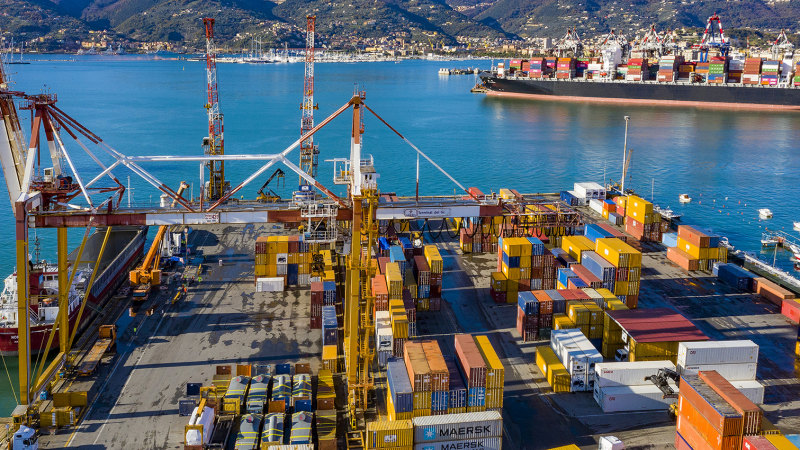








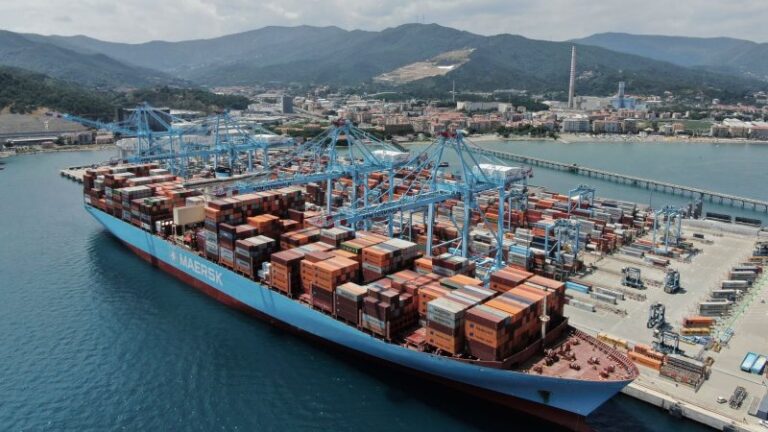
The container ship Maersk Makutu is expected on Thursday 4 June at the Deep Sea quay of Vado Gateway’s Container Terminal in Vado Ligure. The vessel, 292 metres long and 32 metres wide, has a capacity of 4,650 TEU and will be the first of five units deployed by Maersk on the weekly Sla Baltic Sea service. The inclusion of the Savona port in the rotation opens a new direct connection between the northern Tyrrhenian Sea, the Baltic Sea and the eastern Mediterranean.
The service will be operated with five ships with capacities of between 4,000 and 5,000 TEU. The rotation will start from Port Tangier Mediterranee, in Morocco, and call at Algeciras, Gdansk, Bremerhaven, Vado Ligure, Port Said East and Alexandria. Vado Gateway will therefore be the only Italian terminal included in the service, strengthening the Ligurian port’s position within liner networks between the Mediterranean and northern Europe.
For the Italian market, the new connection will reduce transit times for containers bound for Egypt. Daniela Mossa, commercial director of Vado Gateway, said Port Said East and Alexandria Old Port will be reachable in four and five days respectively. From Port Said East, a transhipment connection to Jeddah is also planned, with arrival in nine days, reducing transit times compared with services currently available. Santi Casciano, chief executive of Vado Gateway, linked the terminal’s inclusion in the Sla Baltic Sea service to the consolidation of its role in the international port landscape. The new line increases routing options for import, export and transhipment traffic, with a connection combining northern Europe, the western Mediterranean, the eastern Mediterranean and the Red Sea.
In 2025, Vado’s two terminals, the Container Terminal Deep Sea and the adjacent Reefer Terminal, handled a total of around 600,000 TEU, up 58.4% on 2024. The breakdown reported by the company includes 24% export traffic, 37% import traffic and 33% transhipment. The Reefer Terminal can also handle dry containers carrying goods that do not require temperature-controlled transport, broadening the range of cargo that can be managed within the Vado port system.