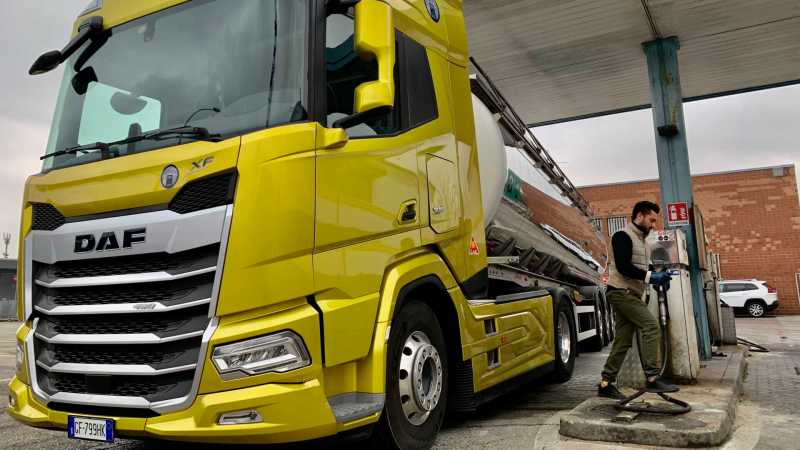






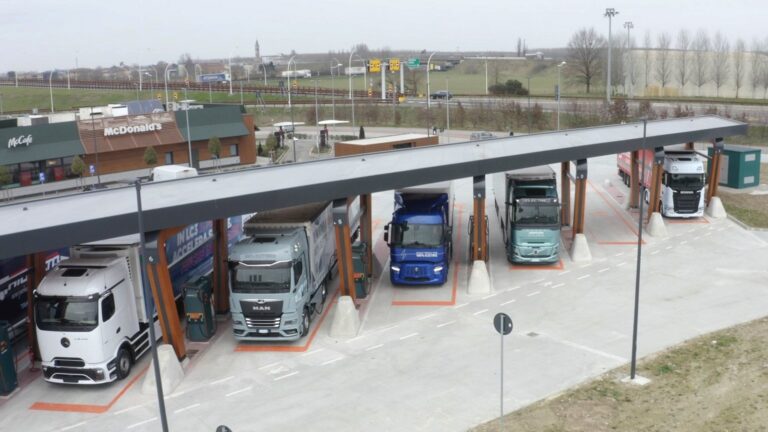
On 4 May 2026, Germany’s Bundesministerium für Verkehr, BMV (Federal Ministry of Transport) announced a funding programme to build charging infrastructure for battery-electric heavy goods vehicles in Germany. The measure covers both companies planning to install charging points at their own depots and operators and investors interested in developing publicly accessible stations. The stated aim is to support the transition of road haulage towards lower-emission powertrains by addressing one of the main operational constraints: the availability of a charging network suited to truck requirements.
According to the ministry’s statement, €1bn will be available for the programme over four years. The first package of calls allocates €200m and covers three areas: non-public infrastructure for small and medium-sized enterprises, non-public infrastructure for all companies, and publicly accessible infrastructure. The measure forms part of the Masterplan Ladeinfrastruktur 2030 (Charging Infrastructure Masterplan 2030), Germany’s framework for developing the network needed for electric mobility.
The new support scheme does not focus solely on charging stations. The BMV says grid connections, battery storage systems and charging load management systems are also eligible for funding. For transport and logistics companies, this approach is important because the cost and complexity of an electrified depot do not depend only on the purchase of charging points. Available power, upgrades to the grid connection, the simultaneous management of several vehicles charging and the possible use of storage systems to reduce peak demand all carry significant weight.
The application timetable varies by category. The call reserved for non-public infrastructure for small and medium-sized enterprises will open on 5 June 2026. In this case, the allocation of the flat-rate grant will follow the order in which applications are received. The choice points to a more direct procedure for smaller companies, which may have less administrative capacity than large operators and often face proportionally heavier investment to upgrade yards, depots and electrical systems. For non-public infrastructure intended for all companies, applications may be submitted from 26 May to 7 July 2026. Funding will be allocated after the window closes and once a competitive procedure has been completed. The same timetable applies to the call for publicly accessible charging, which will also be open from 26 May to 7 July 2026. In both cases, the central priority criterion will be the ratio between the amount of grant requested in euros and the installed charging capacity.
This criterion shifts the focus to the efficiency of public investment. The logic is to reward projects that generate more charging capacity for industrial vehicles for the same level of support. For operators, this may influence the technical design of infrastructure: the number of charging points, installed capacity, site configuration, connection costs and service capacity become decisive elements not only for day-to-day use, but also for the project’s position in the competitive procedure.
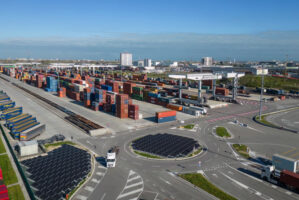
The distinction between depot charging and publicly accessible charging responds to two different needs in heavy freight transport. At depots, charging mainly serves fleets with scheduled returns, regional transport, distribution and operations with predictable shifts. Public infrastructure, by contrast, is needed for longer routes, less repetitive services and transport networks in which the vehicle cannot rely solely on its company base. The German programme therefore seeks to intervene at both levels of the operational chain.
For logistics companies, the extension of funding to storage systems and load management has particular value. In depots with several electric trucks, simultaneous charging can require high power levels and generate significant grid costs. Load management systems make it possible to distribute available power among vehicles, schedule charging according to shifts and reduce the risk of oversizing the installation. Storage systems can also help manage peaks, although their cost-effectiveness depends on the depot’s usage profile and local grid conditions.
The programme will run for four years and, in addition to the first calls in 2026, provides for further funding windows adapted to market developments. This approach allows the ministry to adjust interventions according to actual demand, the development of the electric truck market, the expansion of the charging network and the needs that emerge from operators. For operators, multi-year continuity can support more orderly investment planning, especially where electrification requires long lead times for permits, grid works and yard upgrades.