







Japan is accelerating its push into hydrogen for road haulage with a project designed to reshape the country’s logistics from north-east to south-west. The Japan Hydrogen Association, in coordination with Toyota and other major industrial groups, has presented a plan for the so-called “major hydrogen artery” - also known as the “hydrogen aorta” - a corridor linking Fukushima, in the Tohoku region, with Fukuoka, on the island of Kyushu, via the country’s main metropolitan areas. The route passes through five major urban and production centres: Fukushima, the Tokyo conurbation, the Aichi region with the Nagoya district, the Osaka area and finally Fukuoka. According to an analysis published by Nikkei, the corridor is more than 1,300 kilometres long, making it an unprecedented energy and logistics infrastructure project in the zero-emission road transport sector.
At the heart of the programme is the deployment of more than 1,000 fuel cell electric commercial vehicles. The decision to start with commercial vehicles rather than cars is driven by both technical and economic factors. Long-distance transport with heavy loads makes use of hydrogen’s energy density compared with batteries, which still struggle to compete in high-tonnage operations and over longer ranges. The regular working cycles of freight fleets make it possible to plan refuelling around a limited number of hubs on fixed routes. The willingness of operators to pay to reduce downtime, with refuelling completed in a few minutes compared with the hours needed for battery charging, also makes the model economically attractive.
The plan would not start from scratch. According to a note from the Japanese Ministry of the Environment, 154 hydrogen refuelling stations were operating in the country in April 2025. The “hydrogen aorta” project aims to focus network expansion along the Fukushima-Fukuoka corridor, increasing the density of refuelling points on the routes most heavily used by trucks and using freight flows as a stable demand base for new stations. This would reduce the risk of underused infrastructure, one of the structural problems that has held back the spread of hydrogen in private mobility.
Fukushima is not a random choice as the starting point. After the 2011 nuclear disaster, the prefecture built an alternative identity as a global laboratory for renewable energy and hydrogen. The Fukushima Hydrogen Energy Research Field (Fh2r), presented as early as 2020 as one of the world’s largest plants for green hydrogen production, is powered by a 20 MW solar field and can produce about 1,200 cubic metres of hydrogen an hour. In October 2025, during the Renewable Energy Industrial Fair in Koriyama, local authorities reiterated their intention to “spread the use of hydrogen from Fukushima to all of Japan”, announcing a structured collaboration with Toyota.
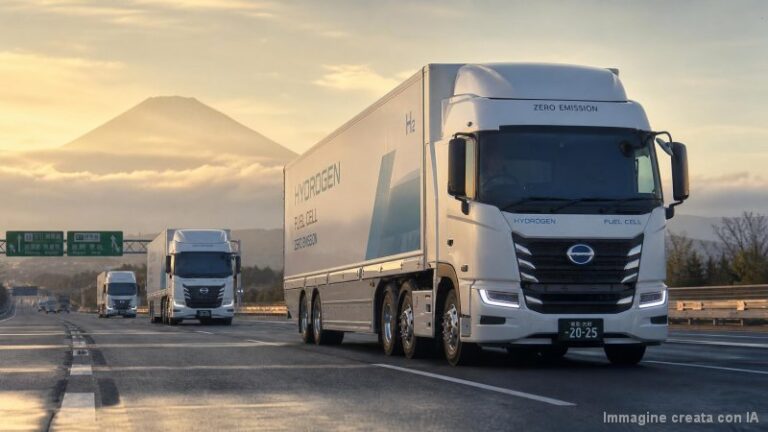
The industrial front backing the corridor is wide-ranging. At its centre is Toyota, which supplies fuel cell systems, coordinates several pilot projects in heavy transport and supports Fukushima’s transformation into an energy hub. Hino Motors has launched the first hydrogen electric truck available on the Japanese market, stressing that it has moved beyond the purely experimental stage. Fuso, controlled by Daimler Truck, is developing two hydrogen truck prototypes in parallel – one fuel cell vehicle and one with an internal combustion engine – as part of the national strategy.
A complementary element of the corridor is the agreement signed by Isuzu Motors and Toyota Motor Corporation to develop a light-duty fuel cell truck for high-mileage applications. The vehicle will be based on the Isuzu Elf Ev, a battery-electric light truck, combined with Toyota’s third-generation fuel cell system. The aim is to start mass production in fiscal year 2027, with a market debut expected between 2027 and 2028. The vehicle is aimed at intensive-use fleets: urban and regional distribution, refrigerated transport and medium-distance missions where range and downtime are key variables. Isuzu and Toyota emphasise that hydrogen refuelling takes only a few minutes and offers greater range than battery-only vehicles. The collaboration draws on experience gained with the Erga Fcv fuel cell city bus and pilot projects run by Commercial Japan Partnership Technologies Corporation.
In the Japanese debate, the project is presented more as a medium-term industrial plan than as infrastructure that is already operational. The figures currently circulating - more than 1,000 fuel cell trucks, a 1,300-kilometre corridor and a dedicated station network - represent a phased target to be reached over the coming years, with a horizon extending beyond 2030. The infrastructure base already exists, but the refuelling network along the Fukushima-Fukuoka axis will need to be substantially densified. Manufacturers’ timetables are beginning to align, with Hino already on the market, Isuzu-Toyota targeting 2027 and Fuso developing prototypes.
Pietro Rossoni