






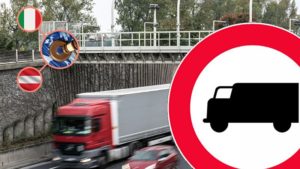
On 21 April 2026, the Court of Justice of the European Union held a hearing in Luxembourg in case C-524/24, Italy v Austria, concerning the regime of restrictions on heavy traffic along the Brenner corridor. The proceedings were initiated by the Italian government under Article 259 TFEU, which allows one Member State to bring a case directly against another for alleged breaches of EU law. At the centre of the dispute is a set of measures introduced by the Land Tyrol on the A12 Inntal motorway and along the Brenner axis, which Rome considers incompatible with the free movement of goods guaranteed by Articles 34 and 35 of the Treaty.
The hearing concluded on the same day, with no detailed official accounts yet available on how the discussion unfolded. According to a brief statement from the Ministry of Transport, the Italian side reiterated the seriousness of the restrictions for the proper functioning of the internal market and the continuity of flows along the main link between Italy and Germany. The Advocate General’s opinion is expected on 16 July, while the Court’s ruling is due by the end of 2026.
The case forms part of a long-running dispute between the two countries over transalpine traffic, which has already been the subject of Court rulings in 2005 and 2011. In this new phase, however, the confrontation takes on broader significance, also due to the direct involvement of the European Commission, which has intervened in support of Italy’s position, and the implications for the entire TEN-T corridor network.
At the heart of the dispute is a complex package of measures introduced by Tyrol. These include a night-time driving ban for heavy goods vehicles, accompanied by a limited system of exemptions, and a sectoral ban excluding certain categories of goods from road transport in order to encourage modal shift to rail. These are complemented by seasonal restrictions and limits during peak tourist periods, as well as a traffic metering system regulating access for heavy vehicles to the motorway through hourly quotas.
According to Italy’s application, the combined effect of these measures results in a structural reduction in corridor capacity, with direct repercussions on transit times, logistics costs and the reliability of supply chains. Operational bottlenecks are particularly evident on metered traffic days, when queues of heavy vehicles can reach up to 80 kilometres, undermining the smooth flow of intra-European trade and causing knock-on congestion on the Italian side as well. In its submission and arguments before the Court, the Italian government maintains that the Tyrolean measures fail to meet the criteria of necessity and proportionality required under EU law to justify derogations from free movement. In particular, it challenges the lack of a comparative assessment of less restrictive alternative solutions and the decision to concentrate a significant share of traffic containment measures on a single corridor.
Austria’s position, by contrast, is based on the protection of the environment and public health along the Inn Valley, one of the most congested Alpine routes. In 2025, the Brenner corridor recorded around 2.4 million truck transits, a figure used by Tyrolean authorities to justify containment policies and to support the need to accelerate modal shift to rail. Vienna refers to the European legal framework that allows restrictions on the movement of goods on environmental grounds, provided they are appropriate and proportionate.
A central element of the dispute is the stance taken by the European Commission. In its 2024 opinion issued during the procedure, Brussels considered that the system of bans – including night-time, sectoral, seasonal restrictions and traffic metering – is neither sufficiently justified nor consistent with the stated objectives. This position strengthens Italy’s case and gives the proceedings a systemic dimension for the entire single market.
The debate also includes the views of economic operators. Anita (Associazione Nazionale Imprese Trasporti Automobilistici – National Association of Road Haulage Companies), the transport and logistics association within Confindustria, expressed support for the Italian government following the hearing, calling for a decisive phase in resolving the dispute. The association highlighted how the unilateral restrictions adopted by Austria continue to generate significant disruption along one of the main TEN-T corridors, affecting business competitiveness. According to the Italian road haulage association, the environmental context cited by Austria has changed in recent years: monitoring stations along the corridor, also thanks to fleet renewal, no longer record exceedances of EU limits. From this perspective, removing the night-time ban would allow traffic to be spread over a wider time frame, reducing daytime pressure and making early-morning quota systems less necessary.
“Restrictions adopted by Austria represent a clear violation of the fundamental principles of the European Union, starting with the free movement of goods, and we expect the Court of Justice to uphold Italy’s arguments,” said Thomas Baumgartner, Anita’s delegate for the Brenner, highlighting the impact of the dispute on the entire European economic system. The Court’s decision could set a precedent for all Alpine crossings. Upholding Italy’s claim would reinforce a restrictive interpretation of environmental derogations, while rejecting it would broaden the scope for regional policies limiting heavy traffic.
Antonio Illariuzzi