





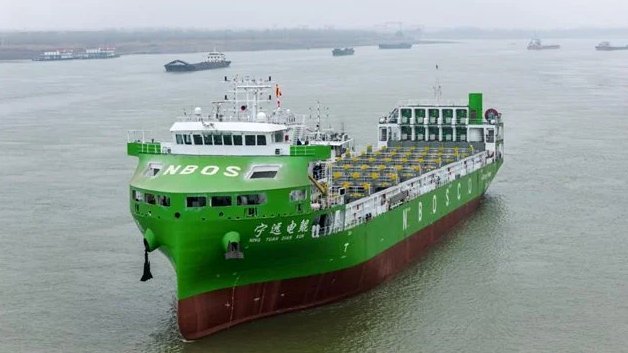
On 15 April 2026, the container ship Ning Yuan Dian Kun began commercial operations on the Ningbo-Zhoushan–Zhapu route in China’s Zhejiang province. It is the country’s first 10,000-tonne-class coastal vessel powered entirely by electricity and equipped with “intelligent” navigation systems. The ship is operated by Ningbo Ocean Shipping and was developed as part of an industrial project coordinated with China State Shipbuilding Corporation and built by Jiangxi Jiangxin Shipbuilding, as reported by Xinhua and People’s Daily.
The container ship, measuring 127.8 metres in length and 21.6 metres in width, has a capacity of around 740 TEU and features an open-top configuration for coastal feeder services, with a declared maximum speed of 11.5 knots. The core element of the project is its electric propulsion system powered by containerised batteries. The vessel uses ten battery modules with a total capacity of around 19,000 kWh, supplying two 875 kW permanent magnet motors. The batteries can be recharged at berth via high-voltage connections or swapped with fully charged modules, introducing into maritime transport an operational model based on rapid energy storage exchange, already widely implemented in China for electric vehicles. In addition, part of the onboard energy is generated by photovoltaic panels for auxiliary services.
The ship employs “intelligent” navigation systems that include real-time environmental perception, automatic route planning and collision prevention functions. Different operating modes, ranging from assisted to autonomous navigation in open waters, are designed to improve safety and energy efficiency along fixed routes.
The inaugural route connects the Beilun terminal in the port of Ningbo-Zhoushan with the port area of Zhapu in Jiaxing, one of the busiest routes along China’s eastern seaboard. In this context, characterised by high container traffic volumes, the introduction of a fully electric vessel represents a test bed for the electrification of coastal shipping. The initiative forms part of the broader development of the port of Ningbo-Zhoushan, which handled more than 1.4 billion tonnes of cargo in 2025. Within this framework, the introduction of electric coastal services complements the development of sea-rail intermodality and shore power infrastructure, strengthening integration between port, industry and logistics networks across the Yangtze River Delta.