





Chinese giant Cosco Shipping Ports is returning to direct investment in a European port through a joint venture with Ptp Ibérica, the Spanish subsidiary of Argentina’s Ptp group, after winning the concession to redevelop and operate the Moll d’Andalusia at the port of Tarragona. The deal, already approved by the Board of Directors of the Port Authority, involves net investment in infrastructure and equipment of around €116.8 million, rising to about €144.6 million when taxes and interest are included. The concession will run for 50 years, the maximum term allowed under the tender, secured through a financial commitment above the minimum threshold required.
The corporate vehicle is Rapport Investment Limited, linked to Cosco Shipping Ports and Cosco Bulk, which holds 51% of the joint venture, while Ptp Ibérica controls the remaining 49%. The concession covers a total area of around 510,586 square metres: more than 452,000 square metres at the Moll d’Andalusia and about 58,400 square metres at the La Boella intermodal terminal, which has been considered an integral part of the project from the outset.
For Cosco Shipping Ports, this is its first major investment in an EU port after several years of pause, following the controversy triggered by its entry into the capital of the Hamburg terminal. The significance of the operation is therefore also political, at a time when debate over China’s presence in European critical infrastructure remains open in Brussels and national capitals.
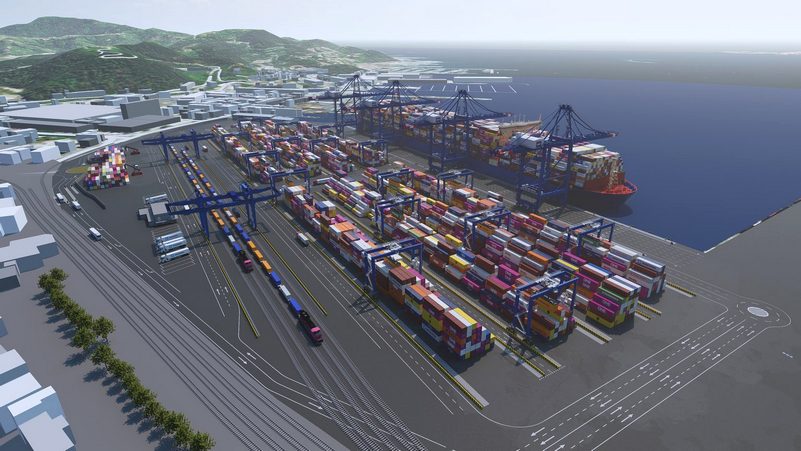
The terminal is a multipurpose facility capable of handling containers, general cargo, ro-ro traffic, vehicles and refrigerated products through a dedicated cold logistics area, with functional zones separated by traffic type. Its estimated maximum capacity is around 680,000 TEU equivalent, combining pure container traffic with other cargo flows converted into equivalent units. The industrial plan includes a minimum commitment of 360,000 TEU equivalent from 2031, of which at least 200,000 TEU will be pure container traffic.
The timetable for the operation is divided into three phases. By the end of 2026, once the concession has been signed with the Port Authority, the project company is expected to be formally established and begin its first commercial activities. The construction phase itself is scheduled for 2027 and 2028, with completion of the works by the end of that year. Full operations are expected by the end of 2028, with volumes increasing progressively until maximum capacity is reached around 2031.
A defining element of the project is the rail link with the La Boella intermodal terminal, which will act as the port’s rail extension, connecting Tarragona with the main logistics nodes in the Spanish hinterland and the rest of Europe. This design choice positions the Tarragona hub more as an integrated intermodal platform than a simple maritime gateway, a distinction that also sets it apart from the pure container terminals in Valencia and Bilbao already operated by Cosco in Spain. On the employment front, the project explicitly links the concession to the creation of local jobs: at least 150 direct employees from 2027, with the figure expected to rise to 180 once full operational capacity is reached around 2031. The Port Authority and the Generalitat de Catalunya (Government of Catalonia) present the operation as a key step in consolidating Tarragona as a logistics node in the western Mediterranean and an intermodal platform for Europe-Asia-Latin America traffic.
Tarragona is not Cosco’s first move into the Iberian port and logistics system, but rather the latest chapter in a long-term strategy. Through Csp Spain, the group’s terminal operating arm created from the transformation of Noatum Ports after the acquisition of 51% of the Valencia and Bilbao operations in 2017, Cosco already manages two maritime container terminals in the two ports and two inland intermodal terminals in Zaragoza and Madrid through Conterail. These activities are complemented by Csp Logitren, the group’s rail operator, which runs container trains between ports and inland interports and operates regular services on the Valencia-Zaragoza corridor with three weekly rotations.
Valencia remains the core of Cosco’s Iberian presence. The Csp Iberian Valencia Terminal is described by the group as a “key” port for its strategy in Spain: a hub for Far East-Europe traffic and a node on the Silk Road, with a role as the main gateway to Madrid and the Iberian Peninsula, strengthened by its presence in Zal Valencia. Bilbao completes the group’s Atlantic footprint, capturing container traffic to northern Europe and the United Kingdom, integrated with its inland rail services. In the first half of 2025, Cosco’s Spanish terminals handled around 1.8 million TEU, an increase of almost 6% compared with the previous year.
Some sector analyses underline how Tarragona could become an “elastic” node for Cosco for mixed traffic, containers and bulk or palletised cargo, serving the Iberian Peninsula and southern France, with a profile that complements the major container hubs of Barcelona and Valencia. In maritime services, Cosco Shipping Lines Spain already operates a network of connections from Valencia, Bilbao and Algeciras to the Far East, the Middle East, India, Australia, the US, South America, West Africa and northern Europe, with a recent strengthening of Africa-Europe services via a call at Algeciras.
Some aspects still need to be defined. The formal signing of the concession is conditional on the establishment of the project company and completion of the agreement with the Port Authority. On the financial side, sources report slightly differing figures, from “more than €116 million” to €117 million, depending on whether taxes, interest and specific equipment components are included. As for the political context, as this is one of the first Chinese investments in an EU port after the controversies of recent years in Germany and other countries, sustained attention from European institutions and national governments on the issue of control over critical infrastructure is likely.
Antonio Illariuzzi