







It is a step forward for the Rovereto rail bypass. On 8 July 2026, the procedure manager published the final report closing the Public Debate procedure on the project for the Rovereto freight bypass along the Brenner corridor. The consultation began in March 2026 and continued until 8 May, with observations submitted by stakeholders representing widespread local interests. Under the procedures set out in the 2023 regulations on the Public Debate, the railway infrastructure manager has 60 days to prepare the final document, incorporating the observations gathered during the various meetings together with the responses to the project. The full authorisation procedure will then follow.
This process will still not be short and will lead to tenders and then the opening of construction sites only at the end. Even so, the importance of this stage in the authorisation process should not be underestimated. The reason is straightforward. The Rovereto rail bypass, which will in effect be a variant intended mainly for freight train traffic, was originally included together with the Trento bypass in the broader selective quadrupling of the railway between Verona and Fortezza, where the southern portal of the Brenner Base Tunnel is located. However, this second lot was later removed and effectively postponed indefinitely, without any fully convincing explanation. It is no coincidence that the projects to upgrade the Brenner axis included four variants considered priorities, identifying the Trento bypass as lot 3A and the subsequent Rovereto bypass as lot 3B. This is why it can be described as a turning point.
The priority lots between the Base Tunnel and the Verona node comprise, from north to south, the quadrupling of the Fortezza-Ponte Gardena section, the Bolzano, Trento and Rovereto bypasses, and the northern access connection into Verona. Of all these projects, the Fortezza-Ponte Gardena section and the Trento bypass are the only ones at an advanced stage of construction, while all the others are at more or less advanced design stages.
The Rovereto bypass involves the construction of a new double-track railway line, mainly in tunnel, with two open-air sections at the portals: to the south, just beyond Serravalle station, and to the north in the Acquaviva area, where, as well as connecting with the existing line, it will link directly into the future Trento bypass. During the Public Debate, three different design alternatives were examined and formed the focus of the consultation. The final report includes all the observations collected and sets out operational guidance for RFI’s designers to ensure the best integration of the project into the local area.
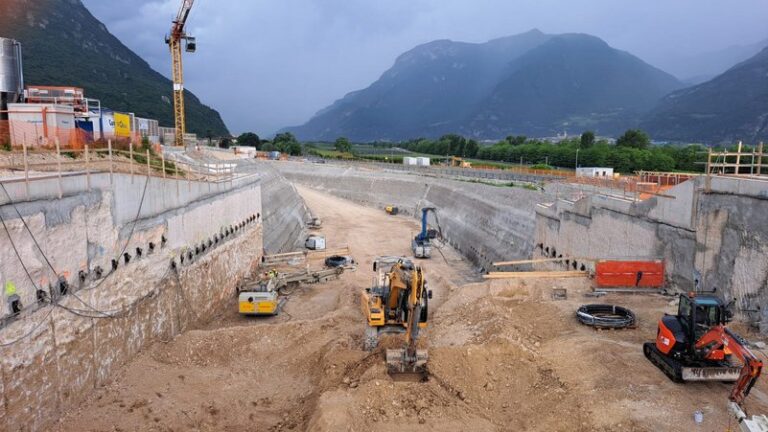
As for the Fortezza-Ponte Gardena section, the most important of the priority variants because it bypasses one of the steepest stretches of the existing line, the major tunnel boring machine “Kathrin” was launched on 13 May 2026 following completion of all preparatory works, including excavation of the caverns and access adits. The machine has a power output of 3.5 MW and a cutterhead with a diameter of almost 10 metres. The TBM will excavate the twin-bore Gardena tunnel, with a total length of 16 kilometres.
There are also developments north of the Brenner, where the Austrian Federal Railways ÖBB are implementing specific measures to further increase the capacity of the new high-capacity line between Kundl and Baumkirchen. Since 2012, this line has formed the backbone of rail infrastructure in the lower Inn Valley in Tyrol, allowing freight trains to use a favourable alignment, much of it in tunnel.
During construction of the new railway, ÖBB made provision for the creation of an overtaking track at Vomp. A third and fourth track are already present in the railway tunnel for a length of around two kilometres. The installation of eight turnouts and modern railway technologies in this section will support the increase in overall capacity. In the Münster and Terfen tunnels, the federal railways are giving a further boost to the modernisation of the line, as the already installed European-standard ETCS signalling system will definitively replace national signals, increasing the available sections and therefore offering more train paths.
Piermario Curti Sacchi