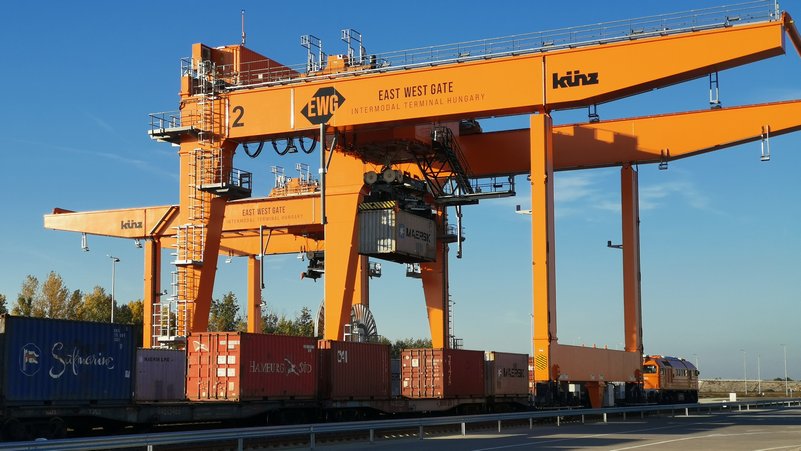



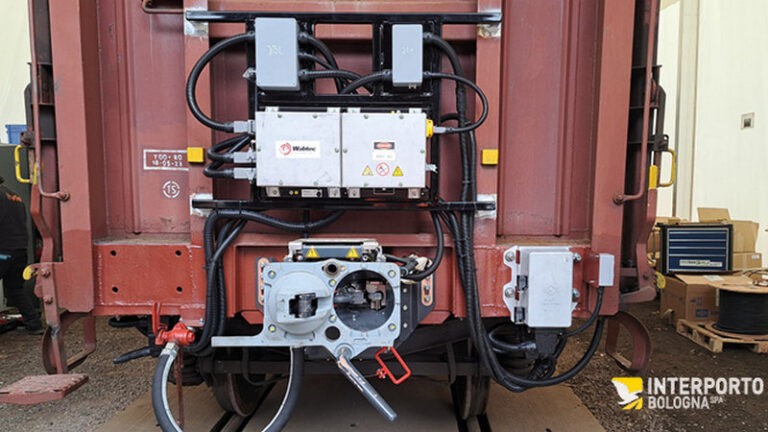
Testing ahead of the Italian demo train dedicated to Digital Automatic Coupling (Dac) is due to begin at Interporto di Bologna by July 2026. The project, led by Interporto Bologna in collaboration with Mercitalia Intermodal, Mercitalia Rail and Mercitalia Shunting & Terminal, forms part of FP5 Trans4M-R, the European project designed to test and validate the adoption of digital automatic coupling in rail freight transport. This series of tests will make it possible to assess the system’s potential in the field, in a real rail freight environment, with shunting, train formation and interaction with the logistics processes already operating at the Bologna terminal. Interporto Bologna is taking part in FP5 Trans4M-R alongside other European rail freight and logistics organisations, in a project that brings together railway operators, terminal managers, industry players and research centres.
The total cost of the initiative stands at around €95.1 million, with a maximum contribution from the European Union of €40.6 million. The project is expected to run for 54 months and began in summer 2022, within the Horizon Europe 2021-2027 framework. A mid-term plenary meeting was held in Vienna, at the headquarters of ÖBB, in May 2024 to review progress on the activities. The Dac demo trains in Austria and Italy were originally scheduled for 2025: the Bologna test, due to start in July 2026, therefore comes at a later stage than initially planned, while the wider deployment of the so-called pioneer trains remains scheduled between 2026 and 2027.
FP5 Trans4M-R, short for Flagship Project 5-Sustainable Competitive Digital Green Rail Freight Services, operates under the Horizon Europe programme through ERJU (European Rail Joint Undertaking), the European Union public-private partnership dedicated to railway research. The project falls under the Horizon-ER-JU-2022-01 call, topic Horizon-ER-JU-2022-FA5-01, and involves more than 70 organisations, including railway operators, infrastructure managers, industry players and research centres.
It is organised into two clusters: Full Digital Freight Train Operation (FDFTO) and Seamless Freight Operation, which develop, validate and demonstrate the technologies needed for fully digital freight trains and seamless operations across the entire logistics chain. Coordination with the European Dac Delivery Programme defines the migration plan and financial aspects for the transition from demonstrators to large-scale deployment across Europe’s rail fleet.
In northern Europe, the project also involves Rail Sweden and Trafikverket, which are engaged in Dac tests conducted in some of the continent’s most severe climatic conditions and designed to support the authorisation process for pioneer trains. Other entities are operating in Spain, the Czech Republic and other European countries, confirming a research and demonstration network spread across multiple corridors and national markets. The broader objective is to raise rail’s modal share of freight transport to 50% by 2030, in line with the EU’s climate targets. The FP5 Trans4M-R pathway also continues through the Future4Freight project, which further develops activities linked to the digitalisation of rail freight transport.
Dac automates the coupling and uncoupling of wagons, operations that are currently carried out manually, and integrates power supply and data transmission along the entire train. The availability of a continuous digital channel enables remote diagnostics, remote control of shunting operations, dynamic train formation and automated terminal operations, with direct effects on safety, interoperability and productivity along Europe’s main logistics corridors.
The push towards digitalisation responds to the need to increase capacity on Europe’s rail freight network, which is currently congested, and to cut emissions compared with road transport over medium and long distances. A single, interoperable technology framework at European Union level is intended to overcome the fragmentation of national rules and systems, enabling cross-border operations without the technical barriers that currently limit interchange between networks. The project is linked to other Europe’s Rail flagships, FP1, FP2, FP3, FP4 and FP6, which cover complementary areas such as infrastructure, passenger transport and control systems.
Antonio Illariuzzi