









In mid-August 2026, average spot container shipping freight rates, published by Drewry on 14 August 2026, showed different trends depending on the route. While the weekly index covering all routes tracked by the World Container Index closed the week to 13 August 2026 at $4,339 per 40-foot container, up 1% on the previous seven days and 85% above its level 12 months earlier, an analysis of individual trades shows that the absolute increase, equal to $42 per FEU, came entirely from the transpacific, while spot rates between Asia and Europe declined.
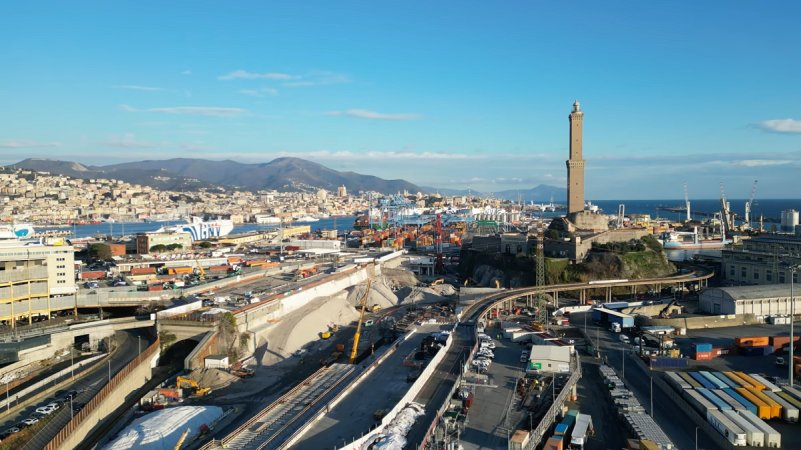
The cooling of the corridor to the Mediterranean was the most significant development of the week. The Shanghai-Genoa route fell by 8% to $5,080 per 40-foot container, a decline of $426 in absolute terms, although the year-on-year comparison remained positive at 65%. On Shanghai-Rotterdam the contraction was smaller, at 5%, taking the rate to $4,425, while the return leg Rotterdam-Shanghai slipped by 2% to $574.
Capacity offered on this trade is tight: Drewry reported only three cancelled sailings announced for the coming week, the same number as in the previous week. The figure is significant because several carriers have announced new FAK rates, applied across all cargo types, ranging from $6,700 to $7,100 per 40-foot container on the Asia-Mediterranean route from 15 August. Weaker demand, Drewry’s analysis warns, raises doubts over whether those levels can hold. For the coming week, however, the company expects freight rates on this corridor to remain broadly stable.
On the transpacific, the weekly trend has reversed. The Shanghai-New York route recorded the largest increase in the entire basket, rising 10% to $8,706 per 40-foot container, with a weekly gain of $813 and a year-on-year jump of 139%. Shanghai-Los Angeles gained 6% to reach $6,244, up $350 on the week, while over 12 months the freight rate has more than doubled, with a 150% increase, the strongest annual rise among all routes monitored by Drewry. The return leg Los Angeles-Shanghai, by contrast, remained almost unchanged, edging down 1% to $830.
Behind these figures is active supply management by shipping companies, which cancelled ten sailings in each of the previous two weeks and scheduled a further seven cancellations for the following week. The capacity squeeze leads Drewry to expect lower freight-rate volatility in the coming days. Another cost factor is also set to have an impact from the autumn: several carriers have announced Panama Canal-related surcharges on Asia-US East Coast and Asia-Gulf of Mexico services, effective from September.
The transatlantic showed more contained and mixed dynamics. The Rotterdam-New York route rose by 4% to $2,884 per 40-foot container, recovering $111 over the week and taking the annual comparison to 48%. In the opposite direction, New York-Rotterdam limited its movement to a 1% decline, at $1,088, with a shift of just $8 and a 29% increase over 12 months. Together with the Pacific return leg, these were the most stable trades of the period.
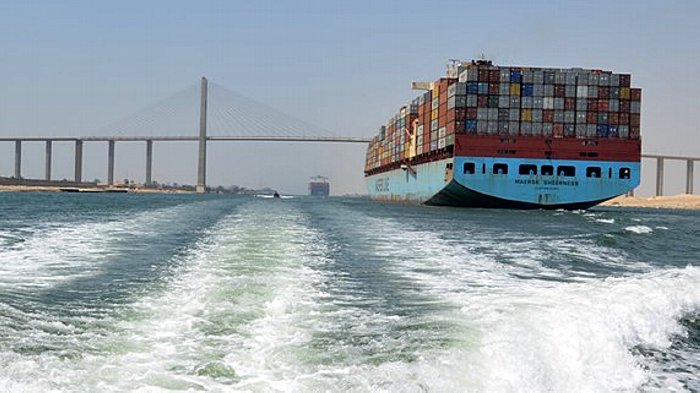
The context behind these movements remains marked by multiple disruptive factors acting simultaneously on routes and transit times. Drewry points to persistent security concerns in the Suez Canal and the Strait of Hormuz, transit restrictions in the Panama Canal, congestion at Asian ports following Typhoon Dolphin, and low water levels on the Rhine, which are affecting river transport on final European inland legs. The combination of these factors continues to weigh on vessel punctuality and the overall reliability of supply chains, while carriers support freight rates through capacity controls and the announcement of new surcharges. Drewry advises shippers to bring bookings forward and allow additional time buffers, to reduce the risk of cargo being rolled and rescheduled onto later vessels, as well as the risk of transit delays.