
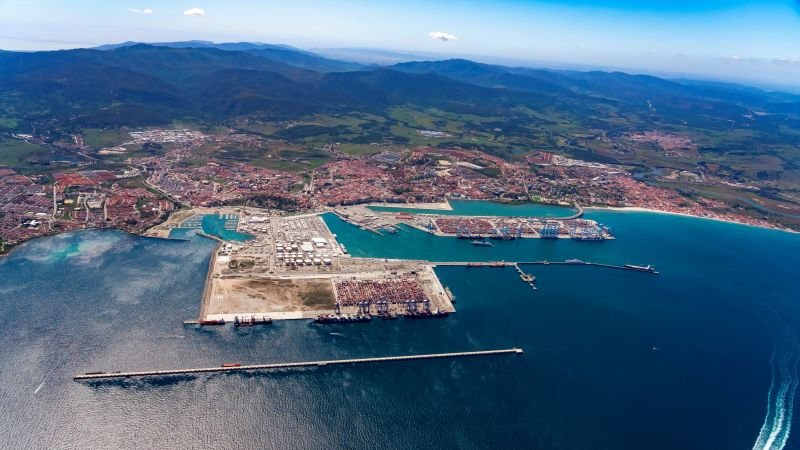



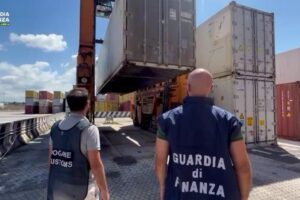

Exfiltration means taking an illegal cargo, already removed from the container that carried it, beyond the customs perimeter of a port. This was precisely the moment when the Guardia di Finanza (Italy’s financial police) stopped two port workers at the Gioia Tauro terminal who were carrying several holdalls containing 252 kilograms of pure cocaine. The arrests were therefore made in the act of committing the offence. The news was released on 10 August 2026, and the Guardia di Finanza said the container from which the drugs had been taken had departed from Australia and transited through Panama before being unloaded at the Calabrian terminal.
The method fits a pattern investigators describe as rip-on/rip-off: narcotics are placed inside a container carrying legitimate goods, without the shipper or consignee necessarily being aware of the illegal use of the box, and are then recovered on arrival or at an intermediate port by a dedicated team. Those who physically remove the cargo and take it beyond the gates clearly operate inside the terminal and must have access, timing and knowledge of operational cycles. This is a method used worldwide. UNODC (United Nations Office on Drugs and Crime) identified it as the main method detected during the 2022 international anti-drug operation Tin Can, which led to the seizure of 99 tonnes of cocaine. Europol, in an analysis of criminal infiltration in European ports, lists port workers, company staff, hauliers and importers among those at risk of recruitment or corruption, and also points to variants based on the unlawful use of container release codes.
The case of 10 August has one unusual feature: the container’s departure from Australia, whereas loading ports are generally in Latin America. But this does not mean the cocaine was loaded there. It could have been inserted into the container during the ship’s call in Panama. To establish this, investigators must analyse cargo manifests, the container’s event history, seal integrity, loading, unloading and transhipment data, vessel and booking information, terminal video recordings and operational communications between staff.
Nor is it certain that the shipment discovered in Gioia Tauro was destined for Italy, because of the transhipment role of the Calabrian port. Containers can change vessel and depart again without even entering national customs territory. High volumes and multiple combinations of origin, intermediate port and apparent destination give traffickers opportunities for concealment that a port used only for imports would not provide. The first seizures of 2026, at the end of March, illustrate this clearly: one cocaine consignment was inside a container from North America, hidden in a cargo of timber bound for the Middle East, meaning the goods were only passing through Gioia Tauro.
That group of operations, three within a week, led to the seizure of almost 400 kilograms of cocaine divided into 309 blocks, with an estimated value of around €60 million according to investigators. In addition to the timber container, a second load was recovered on the shoreline next to the port, where it had been deposited for an attempted exfiltration by sea, with the arrest of a man who was collecting it using a small boat. The final consignment emerged from an underwater inspection by divers from the Air and Naval Operational Units of Vibo Valentia and Palermo, who found a compartment built into the sea inlets in the hull of a vessel also arriving from the American continent.
On 9 July came the third incident of the year at the Calabrian port: more than 113 kilograms of high-purity cocaine hidden in a shipment of pellets from Latin America and destined for import into Italy, with an estimated value of around €20 million. In that case, the container was selected after checks on container movements, then inspected using scanners from the Agenzia delle Dogane (Customs Agency) and dog units from the Guardia di Finanza. Taken together, the three operations mean that in the first eight months of 2026 the port recorded seizures of at least 765 kilograms, while the total quantity of cocaine intercepted at the terminal by the Guardia di Finanza and customs authorities since 2025 exceeds 4.5 tonnes.
The three incidents show different entry channels and detection techniques: documentary analysis and scanners on commercial cargo in March and July, maritime surveillance and underwater inspection of a hull in March, and interception of the recovery team in August. It is this last element, the human component inside the terminal, that had already emerged in the wider investigation conducted in Gioia Tauro in 2026. On 22 July, more than 200 Carabinieri carried out 35 pre-trial detention orders against alleged members of a network believed to have been active across the entire drug trafficking chain, from the import of cocaine from South America to storage, transport and distribution, with its base between Sinopoli and Sant’Eufemia d’Aspromonte.
According to the investigators’ case, accepted by the judge at the precautionary stage, the volume of trafficking reconstructed exceeds 300 kilograms, with some shipments completed and others blocked by seizures, and some port workers were allegedly involved in moving the drugs out of the terminal. The most significant operational issue concerns checks: according to the allegations, the group was even able, thanks to compliant workers, to learn and alter the list of containers selected for inspection by the Guardia di Finanza. The charges against the suspects include criminal association for drug trafficking, aggravated by facilitating the Alvaro clan of Sinopoli, weapons offences and attempted kidnapping for extortion.
Antonio Illariuzzi