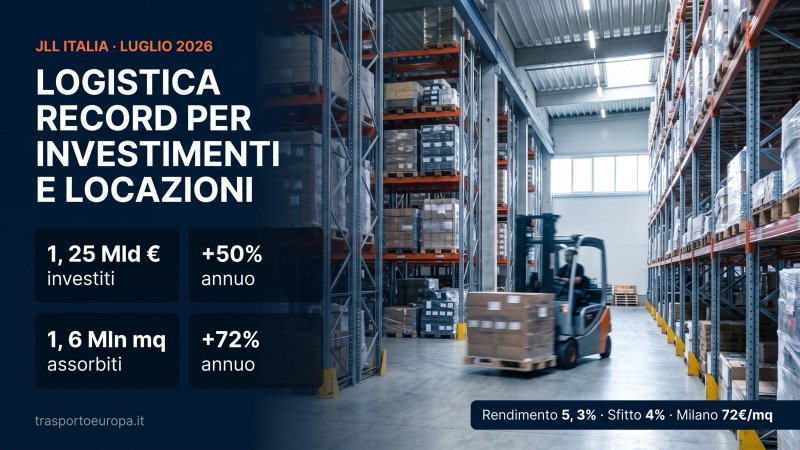









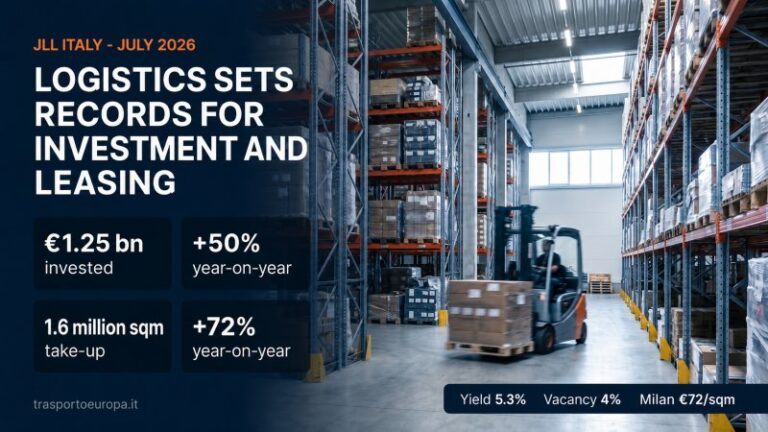
The Italian logistics and industrial real estate market closed the first half of 2026 with record results across both of its defining areas, according to Jll Italia. Investment reached €1.25bn, up 50% year on year, accounting for 16% of total real estate investment volume in the country. At the same time, letting take-up rose to 1.6m square metres, up 72%. The second quarter made a decisive contribution to the half-year result, with around €800m invested, more than 60% of which was attributable to the completion of just two portfolio transactions. In terms of strategy, core deals rose to 37% of total investment from 14% in the same period of 2025, while core plus increased from 28% to 31%; together, the two strategies now account for around 70% of the market. Milan remains the main focus of investor interest, with 22% of total investment, while Bologna and Rome continue to confirm their appeal for investors seeking higher yields. The benchmark yield remained stable at 5.3%.
In terms of take-up, third-party logistics operators remained the main driver of demand, accounting for around 70% of the total, ahead of retail at 18%, manufacturing at 6% and, with smaller shares, e-commerce and other sectors. The average transaction size rose to around 23,000 square metres in the first half of 2026, compared with an average of 18,000 square metres recorded over the same period between 2022 and 2025. On the supply side, almost one million square metres of new logistics space was completed during the half-year, around 57% of it developed speculatively. Despite these new volumes entering the market, the national vacancy rate fell to around 4%.
Transactions below 25,000 square metres remained the most numerous, accounting for 66% of the total, but represented only 35% of space taken up. The 25,000-to-50,000 square metre segment, while accounting for just 26% of deals, represented almost 40% of overall take-up, while transactions above 50,000 square metres were concentrated in the first quarter and mainly involved third-party logistics operators pursuing expansion strategies. In the second quarter, despite the absence of deals above this threshold, the market remained dynamic thanks to the 25,000-to-50,000 square metre segment, which accounted for 27% of quarterly transactions and around 50% of take-up during the period. The largest transactions in this band, between 40,000 and 50,000 square metres, mainly involved retail and manufacturing companies.
In terms of contract types, traditional leases remained predominant, accounting for 75% of take-up, followed by pre-lets at 15% and owner-occupier transactions at 10%. Geographically, the Milan macro-area confirmed its position as Italy’s main logistics hub, accounting for around 60% of overall take-up. Headline rents either increased or remained broadly stable in Italy’s main logistics markets, with the sharpest rises recorded in Milan and Rome. Rents rose to €72 per square metre per year in the Lombardy capital and €70 in the capital, while Bologna remained stable at €67, Veneto at €58 and Turin at €50. In the last-mile segment, Milan and Rome stood at €110 per square metre per year. Negotiations are becoming more flexible: rent-free periods granted to tenants now average between 1.5 and two months for each year of the lease, compared with the previous standard of one month.
For Elena Di Biase, Head of Logistics Capital Markets at Jll Italia, the increase in investment during the half-year confirms the appeal of Italy’s logistics sector, together with a growing selective approach from investors, who are applying strict assessment criteria to the defensiveness of locations and the quality of assets, as well as to medium- to long-term value creation prospects for core plus and value-add strategies. She also highlights the still-significant contribution of end users, which continue to invest directly in properties that support their own operations, and expects the second half of the year to confirm an approach focused on transactions consistent with investors’ risk-return profiles.
Renato Loffredo, Head of Industrial & Logistics Agency at Jll Italia, adds that the growth in take-up did not depend only on a small number of large transactions, but also on a growing number of mid-sized deals, signalling a more mature market. According to Loffredo, the increase in headline rents reflects the strength of the sector’s fundamentals, while greater flexibility in negotiations allows the market to respond more effectively to the needs of both landlords and tenants. These trends are expected to continue in the second half of the year, with the letting market still supported by solid demand.
A.M.B.