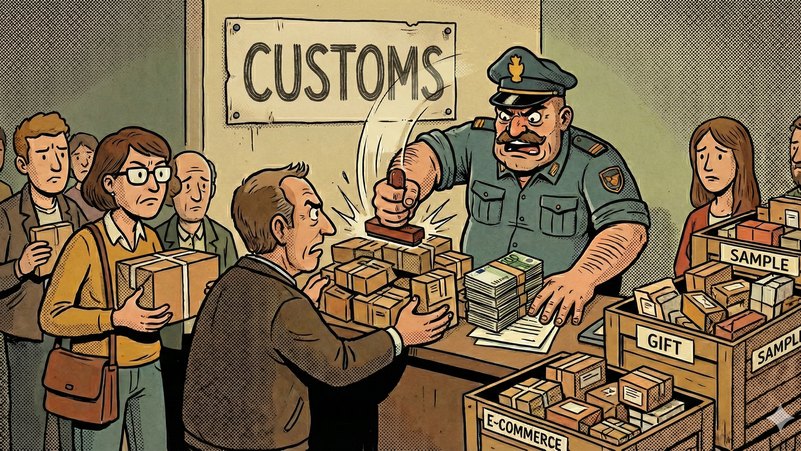










From Thursday, 24 July 2026, postal shipments to the United States lost the customs benefits they had enjoyed for years. The decision was taken by CBP (US Customs and Border Protection), the federal agency responsible for US customs borders, which suspended the de minimis exemption for parcels valued at $800 (about €700) or less and replaced it with a formal customs clearance process. The measure applies to all retailers and e-commerce operators shipping goods overseas through the international postal network.
The new framework requires the transmission of additional shipment data, the use of an authorised customs intermediary and the application of ordinary import duties, instead of the preferential regime in force until now. Customs declarations must be submitted by the importer, the buyer or a licensed customs broker. As a result, many retailers will have to rely on a specialist intermediary to comply with the new requirements. A simplified route remains available for shipments valued at $2,500 (about €2,200) or less, which may continue to benefit from an informal customs clearance procedure, while still being subject to duties.
For the electronic transmission of declarations, CBP has launched a voluntary test called Entry Type 13 (Informal Mail Entry), which will go live on 22 September 2026 and will allow importers and intermediaries to send data digitally through the ACE system, including the postal tracking number and recipient information. A further deadline, separate from the ACE test, will take effect on 22 October 2026. From that date, the temporary exclusions for goods subject to controls by Partner Government Agencies (PGA) and those covered by chapters 98 and 99 of the Harmonized Tariff Schedule will expire. These goods will have to move through formal entry or through Entry Type 13 itself.
Where required, shipments will remain subject to PGA controls. Some product categories may require additional documentation, such as that requested by the FDA (Food and Drug Administration) or the CPSC (Consumer Product Safety Commission), as a condition for completing customs clearance. "The companies best placed to deal with these changes will above all be those that move early," said Gabriele Bavera, Managing Director of Spring Gds Italia, who said accurate product information, complete data for customs purposes and clear visibility of duties already at the online purchase stage would be decisive in ensuring reliable deliveries.
For retailers shipping to the United States, Spring Gds identifies four operational priorities. The first concerns the quality of product data, which must include HS codes, the country of origin and the weight of each item. The second is the prior verification of products subject to PGA requirements, particularly those set by the FDA and CPSC. This is followed by a review of customs procedures and of the methods used to calculate the total landed cost, which is essential for communicating duties transparently before purchase. The final priority is the choice of logistics providers capable of managing the new customs obligations, mandatory brokerage and electronic transmission of declarations without disrupting the customer experience.
The reform is nevertheless an interim step. The US regulatory framework provides for the structural elimination of the de minimis exemption from 1 July 2027, under the law known as the "One Big Beautiful Bill Act". That deadline makes the current procedure a transitional phase towards a permanent customs regime, with no value thresholds exempting incoming international post to the United States.