







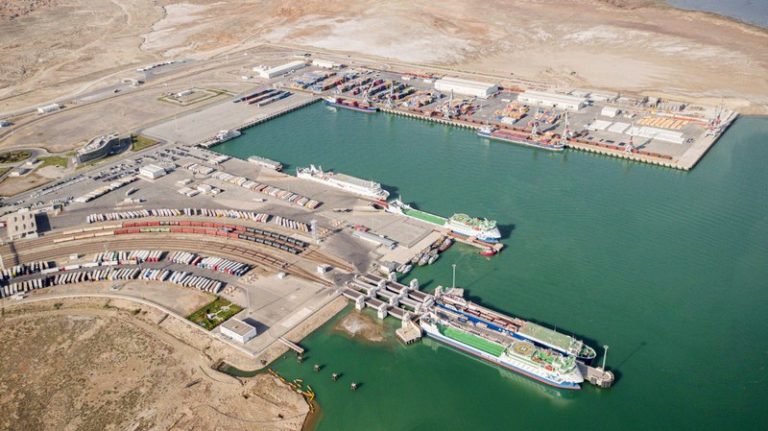
- Overnight between 25 and 26 July, long-range Ukrainian drones struck the Port Olya 2 and the Begey in the Caspian Sea, both merchant vessels already listed on sanctions registers, as well as a Molniya-class patrol boat and Lukoil’s Filanovsky platform. Tehran reported the death of one sailor and said the cargo was civilian.
- The basin, closed to non-littoral navies under the 2018 Aktau convention, hosted the maritime section of the North-South corridor between Iran and Russia, chosen precisely because of its inaccessibility. Underwriters have now placed it on their watch list alongside Hormuz, Suez and Bab el-Mandeb, and from there no diversions are available.
- The Middle Corridor between China and Europe runs across the same body of water, having grown from 586,000 tonnes in 2021 to more than 4.4 million tonnes in 2024. Ro-ro ferrying between Kazakh ports and Baku is already the main bottleneck: without investment, Iru estimates that volumes could be up to 35% below forecasts by 2030.
Until 25 July 2026, the Caspian Sea was considered the quietest section of the land corridor, in this case rail-ro-ro, for container transport between China and Europe. Overnight between 25 and 26 July, however, the picture changed: the Security Service of Ukraine, Sbu, claimed responsibility for a series of long-range drone attacks against vessels sailing in the basin, targeted because, according to the reason given on Telegram, they were subject to international sanctions and used to transport military material between Iran and Russia. Tehran reported the death of one sailor and injuries to other crew members, saying that the vessel hit was carrying civilian cargo. The list of targets named by Kyiv includes the cargo ships Port Olya 2 and Begey, both already included in Western sanctions registers, a Molniya-class missile patrol boat and the Filanovsky oil platform, operated by Lukoil. The Iranian Foreign Ministry has not made public the identity of the vessel on which the sailor died, and no official document links that merchant ship to the units listed by the Sbu. The Tehran authorities thanked the administration of the Astrakhan region for the assistance provided: the port of departure therefore remains the only confirmed point on the route, while the destination and nature of the cargo have not been disclosed.
For maritime transport, the significance of the episode lies in geography. The Caspian is closed to non-littoral navies under the 2018 Aktau convention and can be accessed only through river canals controlled by Russia: the route linking Bandar Anzali and Amirabad with Astrakhan and Makhachkala had been chosen more for its inaccessibility than for its efficiency. The weekend attack removes that condition and establishes that military supplies by sea can be hit regardless of flag, hull and crew nationality. The land node of that route is the port of Olya, in the Volga delta south-west of Astrakhan, connected to the railway network by a 55-kilometre branch line completed in 2004 and with declared terminal capacity of around 1.58 million tonnes a year. The Port Olya 2, IMO number 9481881, belongs to the Russian company MG-Flot, formerly Transmorflot, which was already sanctioned by the United States in May 2022, while the United Kingdom, Canada and Ukraine extended measures to the fleet’s vessels between 2024 and May 2026. This is not the first strike in the area: on 14 August 2025, Ukrainian special operations forces attacked the port, damaging the Port Olya 4, which, according to Kyiv’s General Staff, was carrying components for Shahed drones and ammunition from Iran.
The insurance market reacted promptly. Analysts at the Scandinavian bank Seb noted that the episode highlights the growing exposure of commercial vessels linked to Russian and Iranian supply chains, and the Caspian basin has been added to the Turkish straits, Suez, Bab el-Mandeb, the eastern Mediterranean and the Strait of Hormuz on underwriters’ watch list. The International Maritime Organization (IMO) counts at least 38 vessels attacked since the conflict in the Middle East resumed at the end of February 2026.
The cost of this reclassification is shown by the figures for the Black Sea, where the dynamic has been under way for weeks and should be kept separate: war risk surcharges have exceeded 1% of the vessel’s value, with indications of up to 1.5% from brokerage sources and an estimate of 0.6% from one underwriter, probably net of a no-claims bonus. Also in the Black Sea, the Caspian Pipeline Consortium, the 1,510-kilometre pipeline that carries Kazakh crude to Novorossiysk and handles around 80% of Kazakhstan’s oil exports, suspended loading operations after a brief resumption, following a Ukrainian drone attack on a tanker. The difference between the two basins is that there is no way out of the Caspian. Since 2022, shipping’s response to every crisis has been diversion, with the Cape of Good Hope absorbing Suez within weeks, but here there is no maritime alternative: what remains are the trans-Caspian railway through Azerbaijan and Kazakhstan and the Caucasus land route, both through countries with little willingness to facilitate Russian military logistics. The direct exposure of Western shipowners remains limited, however, because the tonnage operating in the basin is mainly Russian, Iranian and Azerbaijani.
A second corridor also crosses the same body of water, commercial in nature and geopolitically opposite in direction: the Middle Corridor connects China to Europe via Kazakhstan, the Caspian Sea, Azerbaijan, Georgia and Turkey, bypassing Russian territory, and since 2022 has absorbed growing shares of flows previously routed along the northern corridor through Russia, Belarus and Poland towards Duisburg, with volumes rising from 586,000 tonnes in 2021 to more than 4.4 million tonnes in 2024. The Caspian section is covered by ro-ro links between Kazakh ports and Baku, from where freight resumes its rail journey on the Baku-Tbilisi-Kars line, in service since 2017. Time is in the route’s favour: direct services between Chongqing and Duisburg take less than two weeks, compared with 30-40 days by sea via Suez. In April 2026, a direct link between Wuhan and Baku was inaugurated, while the previous August saw China Railway Container Transport Corporation join the joint venture that manages the corridor.
The Caspian crossing is already the main bottleneck in that chain, together with waiting times at the Khorgos and Brest-Małaszewicze border crossings: capacity on ro-ro links is limited and dedicated port infrastructure is scarce. Iru estimates that volumes could triple by 2030, but warns that without investment in borders and Caspian connections, transport demand would remain up to 35% below forecasts. A security variable has now been added to these constraints. The vessels ferrying containers between Aktau and Baku fly Kazakh and Azerbaijani flags and are unrelated to military logistics between Moscow and Tehran, yet they sail in the basin that underwriters have just placed on their watch list, and the war risk premium applies to the area, not to the individual unit.
The Ukrainian attack came close to the latest European sanctions measure. On 24 July, the European Commission adopted the twenty-first package of measures against Russia, introducing transaction bans on two Russian ports, Olya and Vysotsk, and on four airports used to transport defence-sector goods and technologies, extending the ban to refineries processing Russian crude and designating a further 41 vessels, including 34 tankers, six bulk carriers and one service vessel, which are added to the 632 already on the list. The oil price cap remains frozen in the wording of the eighteenth package until July 2027. At this point, it would be worth reflecting on the impact of sanctions against Russia on freight transport: first they drove up the price of natural gas, then that of diesel, Russia being one of the world’s main refiners, and now they also risk increasing the cost of transport between China and Europe.
M.L.