






Another U-turn by President Donald Trump, who reversed course within hours over the economic management of the strait. On Monday, 13 July 2026, he announced the introduction of a 20% toll on all goods in transit, the so-called United States Reimbursement Fee, presented as a charge for the military protection of commercial traffic. The following day he withdrew the proposal, saying he had held very productive talks with Gulf leaders and announcing that countries in the region, first and foremost the United Arab Emirates, Saudi Arabia, Qatar, Kuwait and Bahrain, would instead make substantial direct investments in the United States, without specifying their scale or when and how they would take place. The International Maritime Organization, IMO had meanwhile said it opposed the introduction of tolls on transit through international straits.
The political issue remains, however. It stems from the agreement reached in mid-June, under which Iran undertook not to apply transit tariffs for 60 days, without defining the management of crossing routes, an ambiguity both sides accuse each other of having breached. Trump has nevertheless confirmed the restoration of the naval blockade against Iran, which had been suspended last April as part of the truce: from midnight on Wednesday, Dubai time, the ban applies only to ships heading to or from Iranian ports, or carrying cargo attributable to Tehran, while for all other vessels the strait remains, according to Washington, open to traffic.
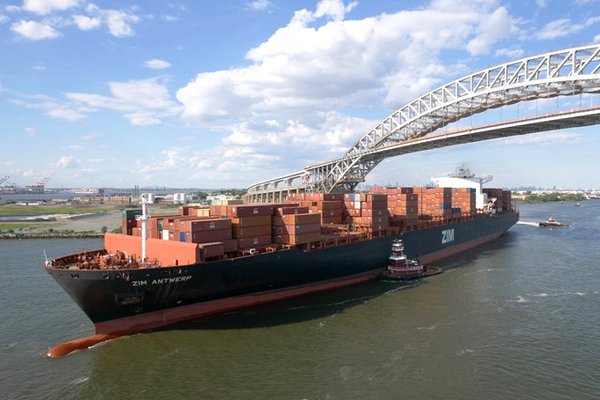
Meanwhile, the container ship GFS Galaxy, hit on 11 July by an unidentified device while transiting the Strait of Hormuz, is now under tow towards the port of Khor Fakkan in the United Arab Emirates. This was confirmed by Cyprus’ Deputy Minister of Shipping, Marina Hadjimanoli, who said the tow was proceeding towards the first available safe anchorage for a damage assessment. The Cyprus-flagged vessel, with a capacity of 6,966 TEU, had a multinational crew of 24 people from India, Ukraine, Sri Lanka, Indonesia and the Philippines on board. Twenty-three seafarers were rescued by the Royal Navy of Oman after abandoning ship in a lifeboat, while the third engineer officer, an Indian national, remains missing.
According to the United States Central Command (Centcom), the attack was carried out by forces from the Iranian Revolutionary Guard Corps, IRGC, which allegedly struck the vessel after it deviated from an approved route and switched off its tracking systems. Tehran, however, said it had fired a warning shot at a vessel that was ignoring calls, stopping it after the impact. It is the fourth attack on commercial shipping in the strait since 6 July and has prompted Washington to launch a third round of raids against Iranian targets, bringing the number of targets hit to more than 300 over three nights of operations. During the same period, Tehran struck targets in Bahrain and Jordan and at least three tankers transiting the strait: the Emirates vessels Mombasa and Al Bahiyah, with one seafarer killed and eight injured, and the Stolt Magnesium, off Oman, whose crew was unharmed despite a fire breaking out in the engine room.
Maritime traffic through the strait has been severely affected. Between 10 and 12 July, trackable transits fell by 52% compared with the previous week, according to MarineTraffic data. Just six ships crossed the strait on Sunday, the lowest figure in the past five weeks according to Kpler, while on 10 July passages stood at 22, compared with 130 before the crisis and the 60 to 70 recorded in the weeks immediately after the June agreement. The southern passage, closest to the Omani coast and protected by Oman and the United States, has seen activity fall to almost zero. Residual traffic is now concentrated on the northern route, which Iran considers the only authorised one.
The Joint Information Centre of the Combined Maritime Forces coalition has raised the threat level to “Severe”, while reiterating that transit remains technically possible. The United Kingdom, through the UKMTO, has also raised its alert level, advising shipowners to exercise maximum caution and suggesting that crews ignore Iranian radio warnings, coordinating passages with coalition forces where possible. War-risk insurance premiums are meanwhile rising sharply. Iran reiterated on 12 July that the strait would remain closed “until the end of US interference in the region”, a position Washington continues to reject, maintaining that its forces are ready to guarantee freedom of navigation.
M.L.