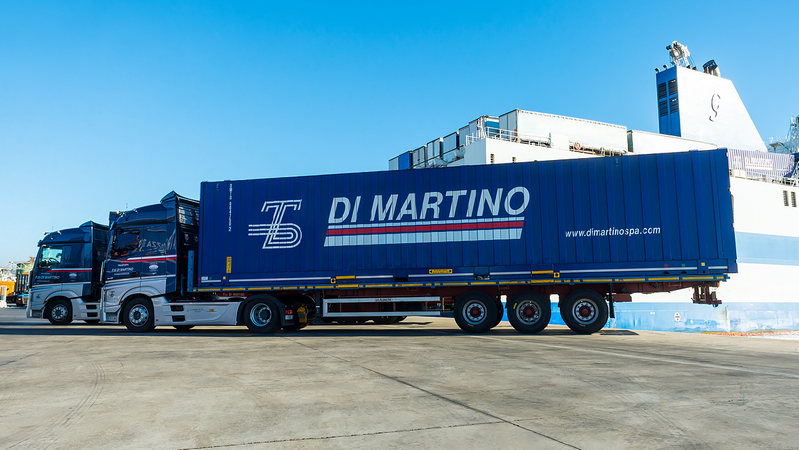




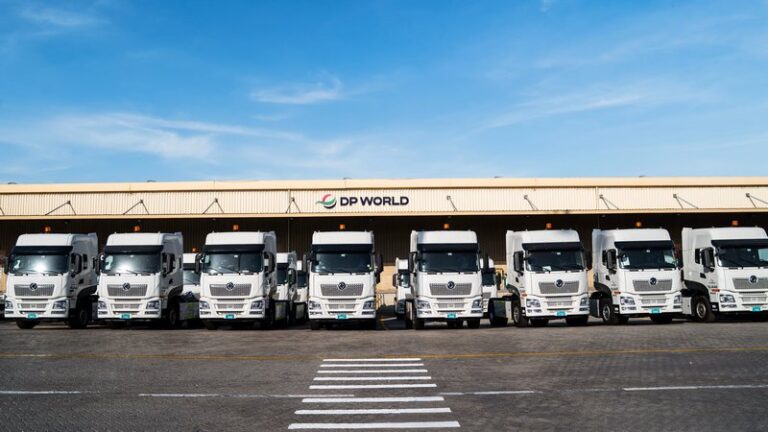
DP World has added 700 new commercial vehicles to its road transport network in the Gulf Cooperation Council (GCC) countries, increasing the Dubai-based group’s capacity to around 35,000 monthly trips and about 3,000 daily movements across the region. The announcement, issued on 8 July 2026, concerns land links connecting the United Arab Emirates, Saudi Arabia, Oman, Qatar, Kuwait and Bahrain, and comes as military tensions between the United States and Iran continue to put pressure on transits through the Strait of Hormuz, which carries about one fifth of global oil trade as well as significant volumes of LNG, LPG and chemicals.
Pressure on the strait dates back to early March, when attacks on several tankers and the de facto closure imposed by the Pasdaran (Islamic Revolutionary Guard Corps) on transits through the strait prompted major shipping lines to suspend passage, following the killing of Iran’s Supreme Leader in a military operation carried out by the United States and Israel. Oil prices and maritime freight rates rose immediately. In April, despite a partial easing of restrictions, Gulf operators had already begun diversifying routes towards land corridors and alternative ports, while the strait continued to be described as a critical and fragile chokepoint.
The move should be seen as a long-term investment to scale up the regional multimodal network, said Ahmad Yousef Al-Hassan, chief executive of DP World GCC. Raveen Guliani, chief operating officer for Logistics at the same division, instead emphasised the efficiency and reliability of the fleet, noting that the new vehicles are being added to a network already capable of handling growing volumes on first-, middle- and last-mile routes, both for containerised and non-containerised cargo, in domestic and cross-border operations.
For DP World, which operates ports, terminals and digital logistics platforms in the Gulf, the expansion of its road fleet is part of a broader strategy to integrate the different nodes of the supply chain. Ports, terminals, economic zones and warehouses are linked within a single network designed to ensure continuity of flows even in the event of further maritime disruption. The strengthened links include the bonded customs corridor connecting the east coast of the United Arab Emirates with Jebel Ali, the route between Sohar in Oman and the same terminal, and land operations connected to the Islamic Port of Jeddah in Saudi Arabia.
Some analyses explicitly link the move to the difficulties faced by the strait in recent years. Disruptions recorded between 2023 and 2026 across Hormuz, the Red Sea and Suez are said to have accelerated a structural reallocation of traffic towards land corridors, alternative ports and pipeline transport infrastructure, with DP World’s fleet expansion representing a concrete example of this shift.