







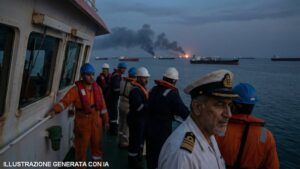
The conflict in the Persian Gulf between the United States and Iran flared up again in early July 2026, with a series of attacks and counter-attacks once again restricting navigation. The trigger came overnight between Monday 6 and Tuesday 7 July 2026, when the Islamic Revolutionary Guard Corps, IRGC, struck three merchant ships with missiles in waters south of the Strait of Hormuz, off the coast of Oman. The United States responded on Tuesday with a new wave of strikes: US Central Command, Centcom claimed that more than 80 targets had been hit with precision munitions in southern Iran, describing the operation as retaliation designed to impose "heavy costs" on those threatening commercial shipping in international waters.
The most serious incident for shipping was the attack on the Qatari-flagged gas carrier Al Rekayyat, which caught fire in the engine room after being hit by an unidentified projectile about eight nautical miles off the coast of Limah, Oman, according to a report by the UK agency Ukmto (United Kingdom Maritime Trade Operations). Qatar blamed Iran for the attack. A second vessel, the Saudi supertanker Wedyan, was damaged in a separate attack: US officials said the IRGC had launched at least two missiles at the vessels, with no casualties on board. Less than 24 hours later, the Revolutionary Guards also struck a third ship in the strait.
The US military operation targeted air defence systems, coastal radar sites, anti-ship missiles and drone launch positions, as well as several dozen small IRGC vessels, according to the account provided by Centcom. The strikes came while President Donald Trump was in Ankara for the Nato summit, where he described the response of Atlantic allies to the war being waged by the United States and Israel against Iran as disappointing.
On the other side, Iran’s parliament speaker, Mohammad Bagher Ghalibaf, accused Washington of breaching the memorandum of understanding reached in June, citing threats of further attacks among the points of contention and rejecting any concession to US pressure. The Joint Maritime Information Center, the US-led maritime intelligence body monitoring traffic in the Gulf, raised the alert level for ships transiting the strait to severe, warning of a high probability of further hostile Iranian action. The warning is likely to prompt many shipowners to suspend navigation through the strait.
Signs of rising tension had already emerged in the preceding days. On 25 June, an attack on the container ship Ever Lovely off Dahit, Oman, prompted the International Maritime Organization, IMO to suspend its plan to evacuate 11,000 seafarers stranded in the area, while Centcom responded by striking missile and radar infrastructure on Qeshm Island. In addition, around 80 naval mines scattered across the central section of the strait still need to be cleared, according to an estimate released by Intertanko, the international association of tanker owners.
The resumption of attacks on both fronts is already driving up oil prices, and not only because of the expected reduction in ships leaving the Persian Gulf. The US Department of the Treasury has revoked, with immediate effect, the exemption that allowed Tehran to sell crude oil and petrochemical products, requiring all ongoing transactions to be closed by 17 July. Iran’s foreign ministry described the measure as a violation of the Islamabad memorandum on ending the conflict and announced countermeasures to protect national security. On the international market, Brent rose on the morning of 8 July to $74.16 a barrel, up 3% in Tuesday’s session, while WTI gained 2.8% to $70.44. These levels remain well below the peak of $126 reached in March, but they have renewed uncertainty over energy prices in the coming weeks.
The rise comes on top of an insurance market that has remained under pressure throughout. War risk premiums for VLCC-class supertankers, the largest crude oil carriers with a deadweight tonnage of more than 200,000 tonnes, transiting the Gulf remain at around 4% of the vessel’s value for one week of cover, compared with 0.001% on ordinary ocean routes: the cost of a single crossing ranges from $250,000 to $375,000 for a vessel valued at $100 million to $150 million. For container ships, June spot rates remained 75% higher on the China-US East Coast route, 51% higher to Northern Europe and 57% higher on the transatlantic route compared with pre-conflict levels, according to Xeneta data.
M.L.