




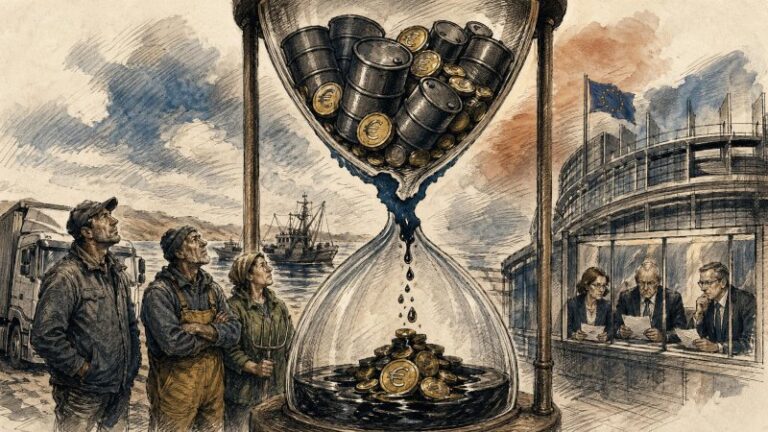
- The European Commission has launched a temporary State aid framework in response to the Middle East crisis that began in February 2026. The blockade of the Strait of Hormuz has sent crude oil prices up by more than 50% and natural gas prices by as much as 85%, putting the entire European logistics chain under pressure.
- The plan allows national governments to reimburse up to 70% of additional fuel costs for road hauliers, short-sea shipping operators, agricultural businesses and fishing fleets. Simplified procedures include a flat-rate ceiling of €50,000 per company, with transparency requirements for aid above €100,000.
- The aviation sector is excluded from the new instruments: the Commission considers the financial hedging already used by airlines and the existing tools for peripheral routes to be adequate. Aid also cannot cover costs linked to the European emissions trading system (ETS), in order to safeguard the objectives of the green transition.
The European Commission adopted a temporary State aid framework on 29 April 2026 in response to the escalation of the Middle East crisis, which began in February 2026 and culminated in the de facto closure of the Strait of Hormuz. The measure authorises EU member state governments to provide direct financial support to companies in the transport, agriculture and fisheries sectors, with the aim of absorbing the inflationary shock on energy and raw material costs and preventing disruption to supply chains. The legal basis for the plan is Article 107(3)(c) of the Treaty on the Functioning of the European Union, TFEU, which allows temporary derogations from ordinary State aid rules in the event of serious economic disruption. But there is a time limit: aid must be granted by 31 December 2026.
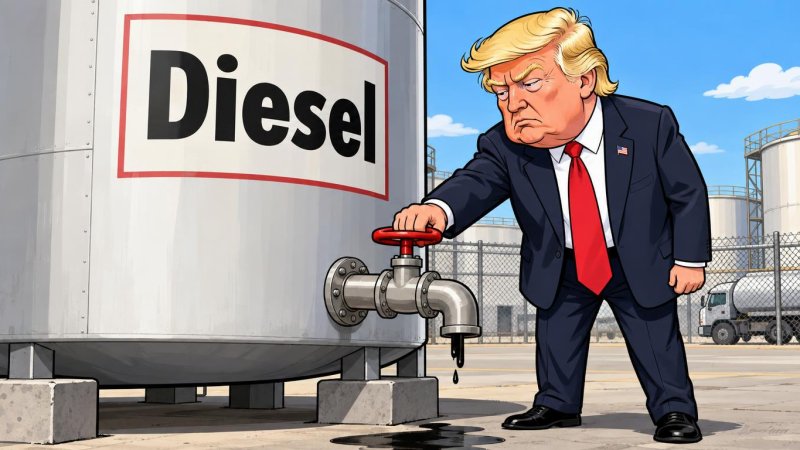
The blockade of the Strait of Hormuz has caused sharp volatility on energy commodity markets. According to the dossier prepared by the Commission, crude oil prices have recorded peaks more than 50% above pre-crisis levels, while natural gas prices rose by almost 85% before partially stabilising. The damage to the Ras Laffan terminal in Qatar, one of the world’s main liquefied natural gas facilities, has also had a lasting impact on global export capacity. The European Central Bank has confirmed that the crisis has worsened the eurozone’s growth outlook, with upside inflation risks. Low-income households are being hit hardest, as the burden of energy costs has more than doubled compared with levels before the conflict.
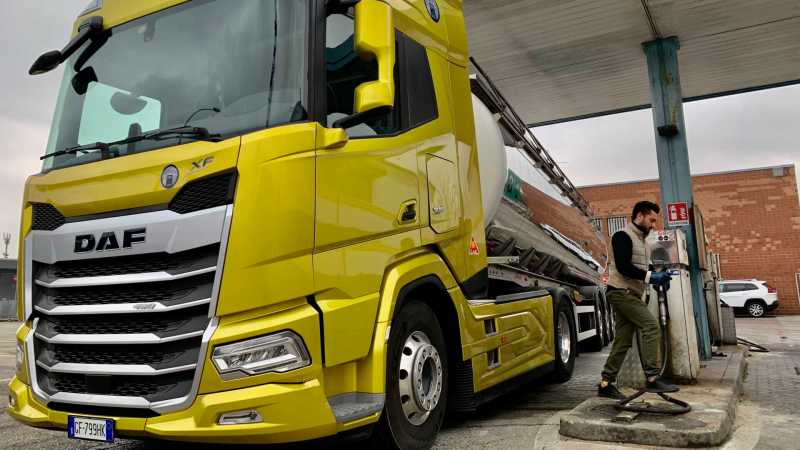
For land transport - by road, rail and inland waterways - the measure addresses a cost structure that leaves very narrow margins even in normal conditions. Fuel accounts for about 30% of road haulage operating costs, while profitability margins average around 2-3%. In March 2026, diesel prices in the EU were 21% higher year on year. In this context, member states will be able to reimburse up to 70% of the additional fuel costs incurred. Under simplified procedures, a flat-rate maximum of €50,000 per company is authorised.
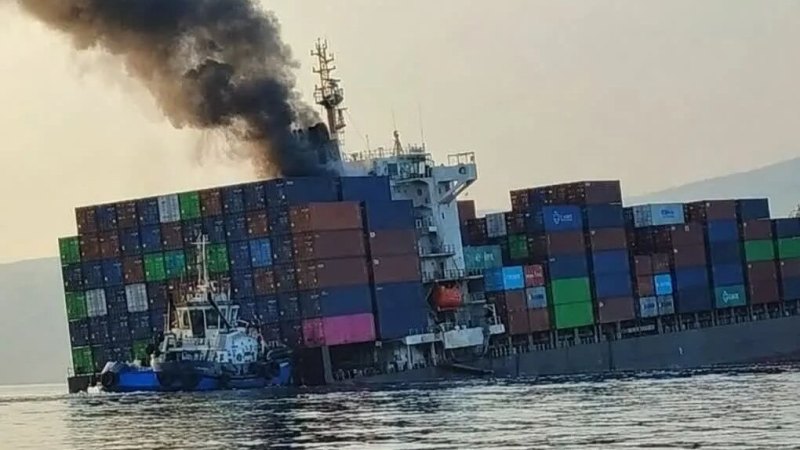
A similar approach is planned for short-sea shipping. These services perform a dual function: easing traffic on continental road networks and ensuring continuity of links with island and peripheral territories. The sudden increase in marine fuel costs risks pushing smaller operators out of the market, with the resulting danger of sector concentration and the isolation of some geographical areas. In this case too, the Commission has provided for coverage of up to 70% of fuel price increases.
Aviation follows a different logic. Although jet fuel has seen significant price increases because it is derived from crude oil, the Commission has not introduced new specific support instruments for airlines. The reason lies in the extensive use of financial hedging against fuel prices, an established practice in the sector that reduces immediate exposure to market fluctuations. For peripheral routes at risk, European institutions consider existing instruments to be adequate, including the possibility of imposing public service obligations and granting social aid to passengers living in remote areas, up to full coverage of the ticket price.
The plan sets precise conditions to avoid long-term distortions of competition. Any aid above €100,000, reduced to €10,000 for the agriculture and fisheries sectors, must be published in a public transparency register within six months of being granted. The funds cannot be used to cover compliance costs linked to the European emissions trading system (ETS), so as not to undermine the objectives of the green transition. The temporary framework is part of the EU’s broader strategy for managing energy crises, but it is designed as an exceptional and time-limited instrument, not as a structural change to State aid rules.
Pietro Rossoni