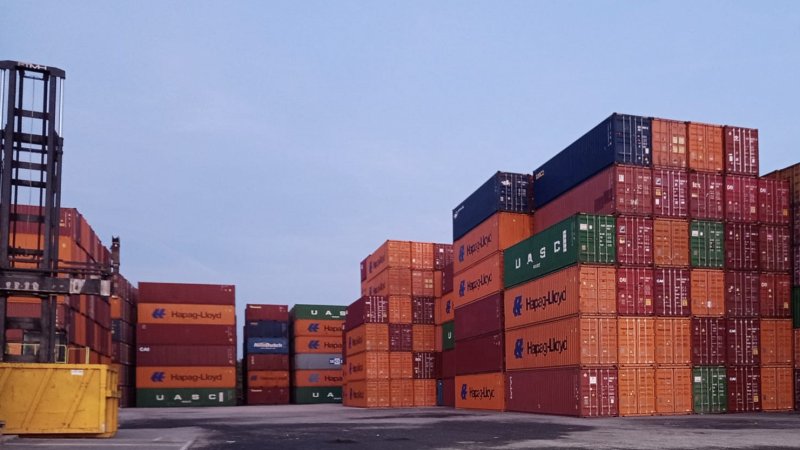







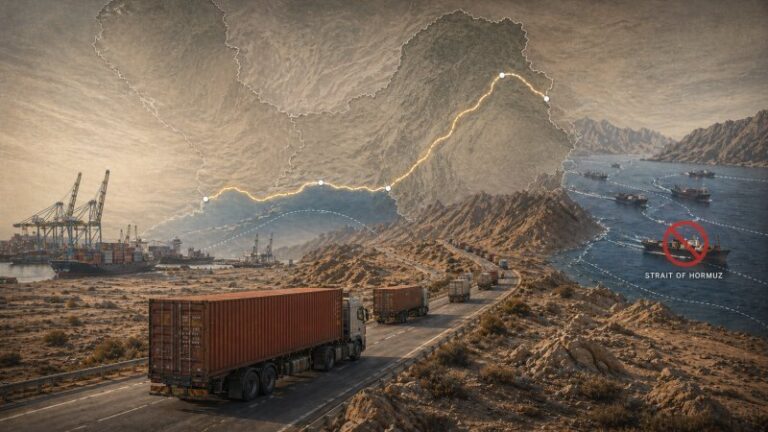
Pakistan has opened six land corridors to allow the road transit of goods bound for Iran, linking the country’s main seaports with border crossings in Balochistan. The measure, notified by Pakistan’s Ministry of Commerce, covers third-country cargo flows stranded at the ports of Karachi, Port Qasim and Gwadar because of difficulties in accessing Iranian ports through the Strait of Hormuz. The new routes allow cargo destined for Iran to be moved by road under customs guarantee regimes. The decision mainly responds to the accumulation of more than 3,000 containers at Pakistani ports, particularly Karachi, after many vessels avoided Iranian calls or the Hormuz route because of military tensions, navigation restrictions and the naval blockade.
The decision was formalised through a statutory regulatory order, or SRO, issued by Pakistan’s Ministry of Commerce. The measure allows cargo in transit to Iran to be handled through a dedicated customs procedure, with guarantees for the control of goods and their exit from Pakistani territory. For freight forwarders, shipping agents and road hauliers, the most important element is the transformation of a maritime problem into a regulated land flow. The corridors connect Karachi, Port Qasim and Gwadar with border crossings into Iran in Balochistan, including Taftan and Gabd. The move affects a region that is already strategic for links between South Asia, the Gulf and the Iranian plateau, but is subject to infrastructure constraints, security checks and complex customs procedures. Opening the routes does not remove these factors, but creates an authorised channel to ease congestion on quaysides and reduce container dwell times at Pakistani terminals.
Against the backdrop of the crisis in the Strait of Hormuz, Pakistan has positioned itself as a transit platform for goods that do not originate in the country but can use its territory to reach the Iranian market. Opening the land corridors allows some of the containers held up at ports to start moving again, but shifts the operational burden onto roads, border crossings and exit customs procedures, with possible bottlenecks. The move from sea to road also changes the cost and risk structure. Goods must be collected at ports, routed towards Balochistan, accompanied by transit documents and covered by customs guarantees up to the Iranian border. For operators, this means greater focus on vehicle availability, convoy security, border-crossing times and the capacity of customs offices to handle additional volumes.
The role of the port of Gwadar deserves particular attention. The port, which is closer to Iran than Karachi and Port Qasim, can offer a more direct base for some overland flows towards the western border. However, its function depends on the ability to integrate port, road, customs and security operations along a coherent corridor. It should be recalled that Pakistan has positioned itself as an intermediary between Washington and Tehran in the Hormuz crisis. This diplomatic dimension is therefore intertwined with the logistics dimension: opening land routes does not simply mean solving a yard congestion problem, but also enables Islamabad to strengthen its role in regional trade flows at a time when traditional maritime routes are exposed to military and sanctions-related decisions.
For freight transport operators, the main issue is the resilience of the corridors over time. Their effectiveness will depend on the stability of authorisations, the clarity of SRO procedures, the availability of accepted customs guarantees, the capacity of the Taftan and Gabd crossings and the security of transit through Balochistan. Without these elements, road transport may work as a temporary solution, but will struggle to provide a continuous replacement for maritime flows heading directly to Iranian ports.
M.L.