






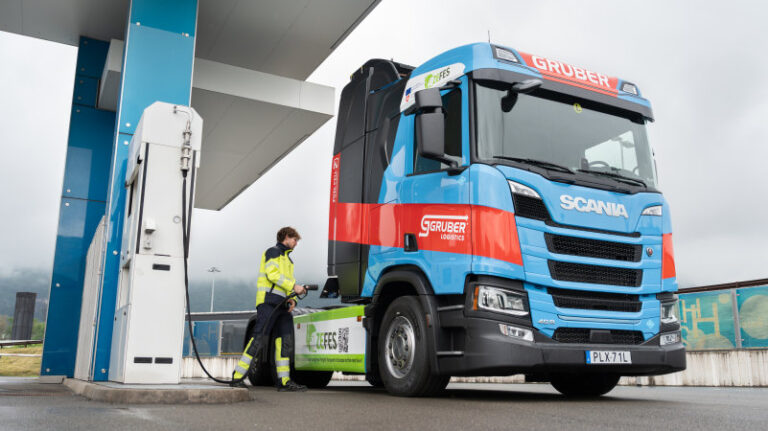
The first road trial of a hydrogen-electric heavy goods vehicle in Italy will begin in May 2026, using a Scania 40 R FCEV, a three-axle tractor unit equipped with fuel cells, which the South Tyrol-based logistics operator will deploy in real transport conditions. The initiative is part of the European Zefes project, which aims to accelerate the decarbonisation of freight transport through operational trials of battery-electric and hydrogen-electric heavy-duty vehicles. Gruber Logistics will use the truck for real shipments, working with Nestlé, P&G, Verallia Italia, ABB and Birra Forst. Martin Gruber, managing director of Gruber Logistics, explains that the vehicle is not yet in production and that the aim is to speed up the introduction of new technologies and understand the difficulties a logistics operator may face in using them day to day.
The trial places Italy among the countries involved in the initial development phase of hydrogen solutions for heavy transport. The sector is still at the pilot stage, with projects mainly launched at European level and a need to gather data on range, refuelling times, reliability and integration into logistics cycles. Against this backdrop, the collaboration between Gruber Logistics and Scania aims to move the technology from a demonstration setting into operating conditions, where payload constraints, delivery times, infrastructure availability and service continuity all have an impact. The project is also part of the Scania Pilot Partner strategy, through which the Swedish manufacturer tests technologies and vehicle architectures with selected customers. Scania confirms that it is focusing on electrification, but considers it necessary to gain a practical understanding of other sustainable transport solutions as well. The hydrogen vehicle therefore does not replace the battery-electric development path, but extends its field of testing to applications where range and refuelling times may play an important role.
The Scania 40 R FCEV is based on Scania’s battery-electric platform. Thanks to the manufacturer’s modular approach, hydrogen tanks and a fuel-cell system have been integrated into the tractor unit. In this case, hydrogen is used as an energy carrier and converted into electricity through the fuel cells, which power the electric driveline. Simone Martinelli, head of electric mobility, urban and construction sales at Scania Italia, says the vehicle does not represent the best final configuration, but is a transitional solution. The battery platform has been integrated with fuel-cell technology to build on developments in electric traction and assess how the system performs in service. The next step will involve improving the configuration, with the aim of reducing space requirements and battery packs, which are currently oversized compared with a more mature future architecture.
Scania indicates a range of up to 1,000 kilometres with a full hydrogen refuelling, made up of 690 kilometres using hydrogen and 310 kilometres using the battery. Installed battery capacity is 416 kWh, while usable capacity is 345 kWh. Charging takes place via a CCS2 system at 500 amps, with power of up to 350 kW. Hydrogen capacity is 56 kilograms, distributed across four 700-bar tanks, and refuelling takes 20 minutes with high-flow, pre-cooled hydrogen at 700 bar. Fuel-cell power is 300 kW, while the electric motor reaches 400 kW. Declared consumption is 0.1 kilograms of hydrogen per kilometre and 1.1 kWh per kilometre.
Compared with a battery-electric vehicle, the fuel-cell configuration introduces several points of interest for logistics. The first concerns range, which may be higher than battery configurations with similar battery packs. The second is refuelling time: 20 minutes is closer to the operational needs of some long-distance services than the time required for rapid battery charging. The third concerns infrastructure, as hydrogen distribution can be assessed more flexibly in certain complex or decentralised operations.
Field testing remains essential. Hydrogen technology for heavy vehicles is still at an early stage and must demonstrate its operational sustainability in relation to the availability of refuelling points, the management of high-pressure tanks, operating costs and service continuity. This is why the Zefes project focuses on real trials, not only theoretical assessments. Operation with commercial loads makes it possible to collect information on distances, timings, refuelling constraints and integration with transport activities. In addition to road operations, Gruber Logistics and Scania plan refuelling tests, static and dynamic demonstrations, and participation in trade fairs and technical conferences. The aim is to share with the sector the results and operating practices that emerge during the trial.
The first public presentation will take place at Transpotec 2026, where the two companies will present the initiative on Thursday 14 May at 12.00 at the Scania stand in hall 22. During the fair, the vehicle will be displayed in the outdoor area. The vehicle will also be on show during the Gruber Logistics Innovation Summit, scheduled for 27 May at the Safety Park in Bolzano and 28 May at NOI Techpark, also in Bolzano.