





In 2026, traffic through the Strait of Hormuz has on some days almost fallen to zero, turning one of the world’s most important maritime corridors into a near-permanent bottleneck, with direct consequences for containers, tankers, freight rates and insurance premiums. The result is a global shipping market under growing pressure, with diverted routes, longer transit times and costs rising sharply again after months of relative calm. However, a Reuters article published on 23 April 2026 highlights a paradox: the same turbulence that is penalising manufacturers, importers and exporters is creating more favourable conditions for Europe’s main logistics operators. According to the agency, some of the sector’s leading groups are expected to report first-quarter 2026 results above forecasts precisely because the disorderly environment has made their services more valuable.
This mechanism is based on three factors. The first concerns higher tariff costs: the operational and geopolitical risks linked to Hormuz and the conflict with Iran allow operators to apply war-risk surcharges, fuel supplements and other ancillary charges that increase the overall value of transport, particularly on routes crossing or bypassing the Persian Gulf. The second factor is network complexity: route diversions and congestion at alternative ports are generating growing demand for high-value-added services, such as transit rescheduling, emergency management and multimodal coordination. The third is bargaining power: large pan-European logistics groups, thanks to their extensive networks and ability to negotiate with shipping companies, can redistribute available capacity, absorb rising costs and pass them on to end customers, with a positive impact on their margins.
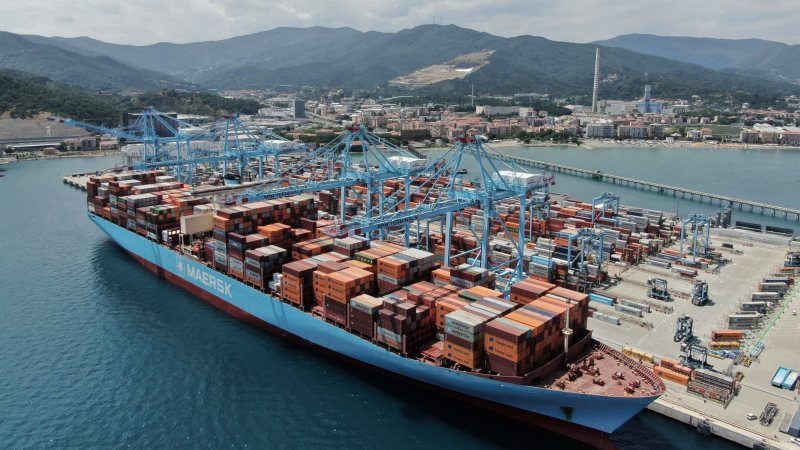
To understand the scale of the reversal now under way, it is necessary to look back only a few months. As recently as 2025, European logistics and maritime transport were under pressure. In the third quarter of that year, container freight rates had returned to their lowest levels since January 2024, driven by the combined effect of excess available capacity and weak demand, also constrained by the lingering impact of new US tariffs. In that context, analysts had cut profit forecasts for several logistics groups, pointing to declining returns in the sea and air segments and a "cautious" trend among Europe’s leading companies in the sector. The Hormuz crisis has abruptly reversed this trajectory. The closure of the strait, diversions towards longer routes and rising insurance premiums have pushed maritime transport costs upwards again, reducing effective available capacity and restoring the importance of pan-European logistics integrators as essential nodes for the continuity of flows. Analysts now expect some of these companies to deliver quarterly results above expectations, while many industrial and commercial businesses are seeing their margins squeezed by higher transport and warehousing costs.
The operational impact in Europe is being felt on several fronts. In addition to geopolitical tensions in the Gulf, the exceptional weather conditions seen in the first months of 2026 have made sailing schedules less reliable, lengthened port dwell times and forced European supply chains to replan transits, inventories and alternative routes almost in real time. Reuters notes that the most structured logistics operators are acting as a buffer between this volatility and the industrial system: they absorb complexity, orchestrate multimodal capacity by sea, rail and road, and monetise these services through higher contracts and fees.
The case of Italian exports to the United States clearly illustrates the asymmetry that is taking shape along the value chain. According to Reuters, Italy has managed to increase its sales in the US despite tariffs, but the agency warns that this result masks deep fragility: exporting companies remain exposed to cost and delivery-time shocks that they are not always able to pass downstream to final customers, while logistics intermediaries strengthen their role and their margins.
A picture is emerging of a two-speed Europe. On one side, logistics appears relatively resilient: when freight rates fall, major operators offset the decline through operational efficiencies, vertical integration in warehousing and distribution, and a diversified customer base; when freight rates rise because of extraordinary crises, as they are doing now, margins improve further. On the other side, manufacturing is proving more vulnerable, exposed to cost and scheduling shocks that it cannot always absorb or pass along the supply chain.
This asymmetry reflects a structural shift in economic power along supply chains: in times of crisis, logistics intermediaries become irreplaceable nodes for the continuity of flows, and their ability to extract margins from complexity is strengthened. Should the "new disorder" of global trade, made up of geopolitical tensions, tariffs, extreme weather events and energy shocks, become a recurring condition, this dynamic could become permanently embedded. The consequences would be significant not only for the profitability of individual companies, but also for the overall competitiveness of Europe’s industrial and commercial system.
M.L.