









Flexis showcased the latest developments of its electric urban logistics project at Solutrans 2025, highlighting its shift from vehicle manufacturer to operational service provider for transport operators in metropolitan areas. The European company, founded in 2024 through a partnership between Renault Group, Volvo Group and CMA CGM, outlined in Lyon its new fleet management service based on advanced telematics, digital tools and on-site depot support designed to increase vehicle efficiency in day-to-day operations.
Visitors to the Lyon trade fair were also able to view two prototypes of electric vans for short-range distribution. These models, scheduled for production in 2026, form part of a new family of vehicles built on a native electric platform featuring a Software Defined Vehicle architecture. According to the company, the platform enables real-time data transmission to fleet managers, remote updates and the capacity for incremental integrations throughout the vehicle’s entire life cycle.
The company stated that access to the range will take place during an industrialisation and pre-commercial phase ahead of production launch at Renault’s Sandouville plant in 2026. Flexis also reported ten letters of intent signed in France, the United Kingdom and Germany, with potential demand for up to 15,000 vehicles over three years. Among the operators involved are Colis Privé and Hived, which will collaborate on developing solutions tailored to their operational needs and those of their subcontractors.
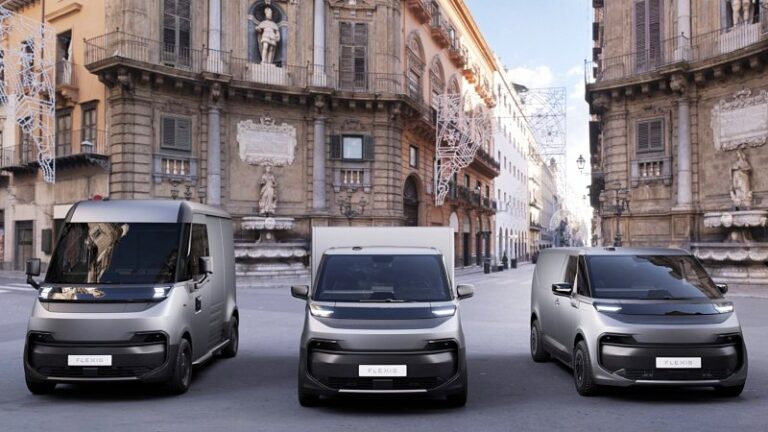
The range comprises three models. The step-in van features sliding front doors and an internal height of 1.90 metres, allowing easy movement between the driving and loading areas and facilitating frequent entries and exits. The panel van, designed for manoeuvrability and an overall height of 1.9 metres, is intended to access underground car parks and urban infrastructure without restrictions. The cargo van chassis offers a modular structure with bodywork adaptable to different configurations, including insulated solutions for temperature-controlled transport. All vehicles share a low floor, customisable fittings and high-capacity batteries able to reach 80% charge in under twenty minutes, with a range of up to 450 kilometres under the WLTP cycle.
On the digital side, Flexis presented Interface, a platform that brings together onboard data and operational tools for professional customers, offering functions such as parcel tracking and keyless vehicle access. The project continues with the introduction of a fleet management programme for last-mile operators, covering scheduled maintenance, charging management, shift optimisation, remote diagnostics and technical depot support provided by Flexis Fleet Advisors. The company notes that the service is multi-brand and can be applied to vehicles with any traction technology, even those without native connectivity.
According to the company’s assessment, a fleet of 25 vehicles reduced operating costs by more than €20,000 in three months thanks to improved planning of charging cycles and increased vehicle uptime. The strategy for scaling the service is built on two agreements signed with Geotab and Ampeco. The first will allow homogeneous data collection from heterogeneous or minimally connected vehicles; the second will enable integrated energy management, from depot charging to dynamic control of electricity costs.
The company also outlined its service ecosystem built around four areas: vehicle availability, operational efficiency, energy and charging systems management, and financial services. These activities will be delivered through the FlexE Connect digital platform, the European service networks of Renault Group and Volvo Group, and a dedicated operations centre. According to Pierre Sirolli, head of services and solutions, the goal is to provide personalised recommendations based on vehicle connectivity, optimise delivery routes, reduce breakdowns through preventive and predictive maintenance and ensure continuous support to resolve any issues quickly.
Development of the range required an investment of €350 million and led to the creation of twenty prototypes that since March 2024 have accumulated around 9,000 hours of testing. Series production will begin in mid-2026 and the vehicles will be sold directly to fleet operators, while Renault Group and Renault Trucks will also offer them through their respective commercial channels.
Massimiliano Barberis