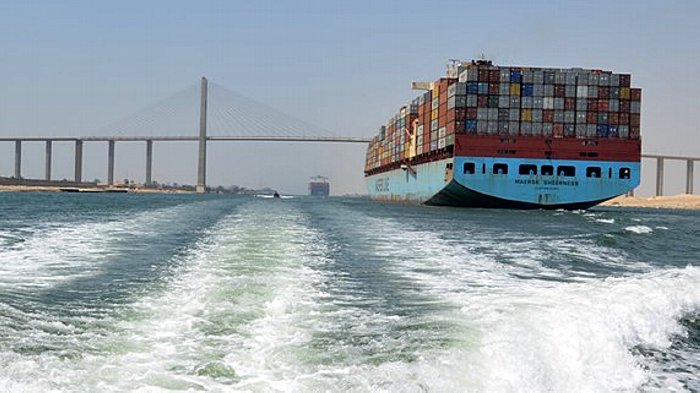








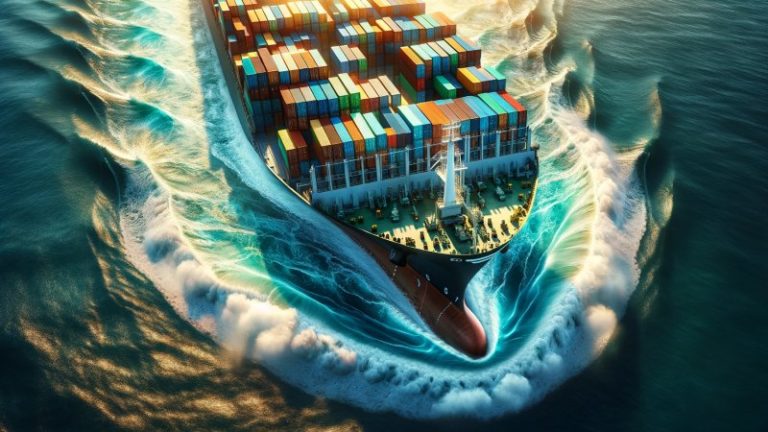
In response to the ongoing Red Sea crisis, which could extend for several months, shipping firms are considering different strategies to keep global transports efficient. The initial response to the Houthi attacks was to reroute container ships along the circumnavigation of Africa. However, this route may not be sustainable in the long term, especially if difficulties in the Bab-el-Mandeb Strait persist beyond the first quarter.
The ship leasing market is facing increasing pressure, with no quick way to add new capacity. Unlike in 2023, this year has seen a resurgence in ship demolition programs by shipping companies, aiming to dispose of not just the oldest units but the most polluting ones. This strategy could backfire for shipping firms, risking excessive leasing rates for underutilized ships, especially if slow steaming continues to be the norm.
Upply analyzed this situation, noting that one way to overcome these challenges is the implementation of "butterfly" services, which split a single long rotation into two to reduce sailing times. These services, still relatively rare, could ensure the restoration of long-term transport rates.
Upply presents this solution in several directions. The first is the African route, which involves shuttle services with short loops between Northern Europe and South Africa (the Cape or Durban) and between South Africa and Asia. This solution, not new, offers significant advantages according to Upply, such as reduced transit times between Asia and Europe and more regular departures and arrivals in Europe. However, there's a real risk of saturation and congestion at South African ports, especially for the Mediterranean and Black Sea ports, which have already felt the turbulence in the Red Sea.
The second direction pivots on the Middle East, activating a road bridge from Jebel Ali and Dubai to Jeddah in Saudi Arabia. Upply considers it an interesting alternative, though expensive and difficult to implement in the short term. A variant involves a road link from Jebel Ali to Haifa via Jordan, completely avoiding the Suez Canal, but this option is even less plausible due to the organizational complexity required.
The third possibility is the North-South International Transport Corridor (INSTC), aimed at connecting the Indian Ocean and the Persian Gulf to the Caspian Sea, and potentially, Northern Europe, through an intermodal network of maritime, road, and rail segments. Although the project has made little progress in the last two decades, the current geopolitical situation has reignited interest in this route as an alternative to the Suez Canal. However, its credibility is undermined by political obstacles.
The fourth and last possibility outlined by Upply is the Northern Sea Route, gaining interest as an alternative to the Suez Canal, becoming progressively more accessible. However, it faces significant ecological and political sensitivities, especially considering the war in Ukraine and subsequent sanctions.
Upply concludes that there is currently no immediate alternative to the Suez Canal for high-volume, competitive-cost transports, so shipping companies are likely to continue circumnavigating the Cape of Good Hope as long as the current geopolitical situation in the Middle East persists. This route is the least worst solution for high-volume FCL traffic, although it may not be as advantageous in the long term due to the low load factor per slot, which reduces financial profitability even with higher transport rates.