



Hybrid ferries for Stena Line
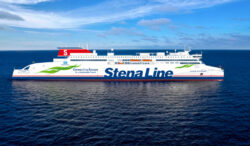
Stena Line has ordered two new hybrid E-flexer ferries for the Göteborg-Frederikshavn route, with entry into service scheduled for 2030. The ro-pax vessels will have capacity for 1,500 passengers and 2,750 lane metres of freight, spread across three vehicle decks, one for cars and two for freight. The ferries, measuring 214.5 metres long and 27.8 metres wide, will be designed for daytime services and will have 132 cabins for crew and passengers. Their hybrid propulsion systems will allow them to use both conventional fuels and electricity, with provision for future conversion to fully electric operation once the necessary charging infrastructure becomes available. The new vessels will increase freight capacity on the link between Sweden and Denmark and will also be suitable for deployment on other daytime routes in the network. The increase in cargo capacity is also linked to the planned transfer of operations to a new port area at Arendal, where a rail connection could support greater intermodality. The two ferries will gradually replace vessels with long operating histories: Stena Danica has served the route since 1984 and Stena Jutlandica since 1996. With this order, Stena Line's fleet will reach seven E-flexers, following the five vessels already operating in the Irish Sea and on links between Sweden and Poland. Construction will be carried out by China Merchants Industry Weihai Shipyard in China, which has already built 15 vessels in the same family.
Turkish Airlines orders 150 aircraft
Turkish Airlines has finalised the purchase of up to 150 Boeing 737 Max aircraft, turning the agreement announced in September 2025 into a firm order. The airline has signed a firm order for 100 aircraft, with deliveries scheduled between 2033 and 2037, together with options for a further 50. The agreement expands the fleet renewal programme already agreed with Boeing, which also includes 50 Boeing 787 Dreamliners and options for another 25 aircraft. Completion of the 737 Max order follows a prolonged period of negotiations. In November 2025, the then president of Turkish Airlines identified talks with engine manufacturer CFM International as one of the factors delaying formalisation of the purchase. The original agreement was announced after a meeting at the Casa Bianca (White House) between US President Donald Trump and Turkish President Recep Tayyip Erdogan. Purchases of Boeing aircraft have also played a role in US trade negotiations with China. An earlier meeting between Trump and Chinese President Xi Jinping had resulted in a preliminary agreement for Chinese airlines to purchase 200 Boeing aircraft. Boeing chief executive Kelly Ortberg, however, played down expectations of a possible large-scale agreement with China, pointing instead to the prospect of a more limited increase in orders. Following the Turkish Airlines announcement, Boeing shares rose by as much as 3.2%, before settling at a gain of 2%.
Zhejiang-Luxembourg cargo route
China Postal Airlines launched the first direct cargo service between Zhejiang and Luxembourg on 21 September 2026, linking Jiaxing Nanhu with Luxembourg Findel using a Boeing 777F. The inaugural flight carried around 84 tonnes of freight over a distance of approximately 9,200 kilometres, with a reported flight time of 12 hours. The cargo included cross-border e-commerce products, consumer goods, household items and electromechanical products originating in the Yangtze River Delta. The route is intended to serve a catchment area covering Zhejiang, Jiangsu, Anhui and Shanghai, reducing preliminary transfers to other airports. Findel, meanwhile, acts as a gateway for onward distribution to western Germany, France, Belgium and the Netherlands. The return leg is expected to carry mainly machinery and precision electronic components from Europe. For China Post, the service expands its directly operated intercontinental network to Europe and reduces dependence on capacity purchased from third-party carriers. For Jiaxing, it represents a further step in developing the airport as an alternative cargo hub for the Yangtze River Delta. Operational sustainability will also depend on the ability to balance Europe-China flows and maintain the planned service frequencies.
Trilateral Arctic alliance
Japan, the United States and South Korea are reportedly preparing a memorandum on economic and maritime co-operation in the Arctic. The agreement is expected to cover oceanographic and meteorological monitoring, incident response, technologies for icebreakers and navigation in ice, as well as dialogue on the sourcing and transport of oil, gas and other Arctic resources. It is also expected to establish a working group provisionally named the Arctic-Pacific Trilateral Partnership. From a logistics perspective, the three countries' interest is focused primarily on the Northern Sea Route, which recorded 103 full transits and around 3.2 million tonnes of international transit cargo in 2025. In the same year, there were 15 container transits, up from 11 in 2024, still modest figures compared with traffic on traditional routes. South Korea has increased its focus on the corridor following the voyage of PanStar Acro, which departed Busan on 22 August 2026 carrying around 837 TEU against a capacity of approximately 2,700 TEU and sailed through the Arctic until 6 September. The route can cut the distance by around 30% compared with the journey via Suez, but this theoretical advantage must be weighed against seasonality, changing ice conditions, the need for specialised vessels and the limited availability of ports, technical assistance and emergency infrastructure. Insurance, environmental and sanctions-related risks also remain significant, as authorisations, icebreaker services and much of the route's infrastructure depend on Russia. The Northern Sea Route handled a total of 37.02 million tonnes in 2025, while only 3.2 million tonnes involved international transit traffic, with the majority of volumes still linked to Russian exports of energy and raw materials. Any memorandum between Washington, Tokyo and Seoul would therefore primarily have value in terms of political, industrial and technological co-ordination and, in the short term, would neither alter the governance of the route nor turn the Arctic link into a structural alternative to the Suez corridor. It would, however, signal greater attention from the three countries to navigational safety, maritime technologies, energy supplies and logistics infrastructure in an area where co-operation between Russia and China is growing.
InPost expands Italian network
InPost Italia has installed its 6,000th locker in Naples, a 14-metre installation that is the largest the company has built in Italy to date. The new collection point forms part of the expansion of the national network, which has already exceeded 10,000 locations across lockers and InPost Points. Growth in Italy reflects the expansion of the group as a whole, which passed 100,000 collection points across its European markets in early September. In the first half of 2026, InPost recorded consolidated revenue of around €1.89 billion, up 24% year on year, while 380.9 million parcels were handled in the second quarter. The network expansion is being accompanied by new e-commerce services: the InPost Smart project, launched in March and aimed at SMEs, has attracted more than 570 sign-ups, while the new mobile app launched in June has exceeded 260,000 registrations. InPost has operated in Italy since 2015 and has been active as a courier since 2021, providing out-of-home delivery and collection services for individuals and businesses.
Fastned widens access to charging
Fastned is widening access to its ultra-fast electric charging network through Digital Charging Solutions platforms, having joined the Preferred Partner programme on 1 July 2026 across the nine European markets where it already operates, including Italy. The integration will give Fastned stations greater visibility in mobility applications and infotainment systems connected to DCS services. Digital Charging Solutions provides access to more than 1.2 million charging points in 31 markets across Europe and Japan through solutions for car manufacturers, fleet operators and service providers. The partnership also covers professional users and company vehicles, which will be able to access the Fastned network through DCS fleet management and mobility platforms under dedicated terms. Fastned operates more than 430 ultra-fast charging stations along motorways, major urban roads and other high-traffic locations, with a stated reliability rate of 99%. The network is currently present in the Netherlands, Germany, France, Belgium, the United Kingdom, Switzerland, Spain, Italy and Denmark, with operations in Austria due to begin at a later stage. The stations are powered exclusively by renewable energy, and many include additional facilities such as food outlets, shops, outdoor areas and toilets.