



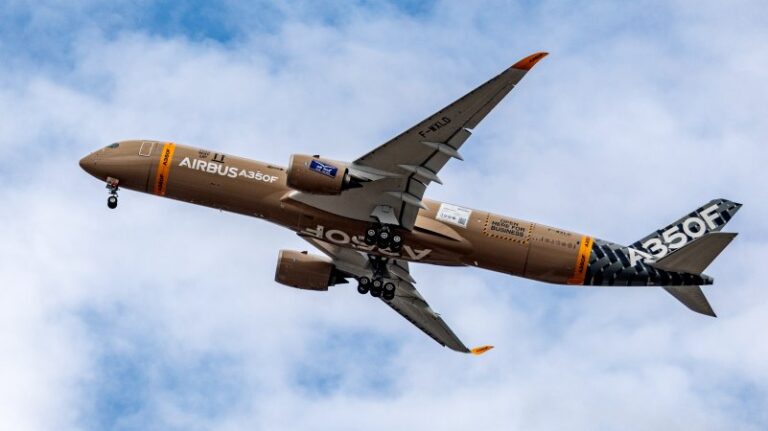
On 29 September 2026, the first prototype of the new Airbus A350F freighter, designated MSN700, made its maiden flight in Toulouse. The aircraft took off from Toulouse-Blagnac Airport at around 10.30 for an initial mission lasting about four hours, the first in a flight-test campaign that Airbus expects to total around 400 hours. The aircraft carries a cardboard-coloured livery reflecting its role in logistics, a special design created through an internal Airbus competition for the test aircraft. MSN700 will operate as a flying laboratory, recording thousands of parameters in real time while undergoing tests covering aerodynamics, structure, cargo systems, smoke detection and operational performance. The maiden flight marks the start of the validation phase, but does not amount to certification or commercial availability.
The A350F has been designed specifically as a freighter, although it is derived from the passenger A350-1000. It features extensive modifications to the fuselage and cargo systems and should therefore not be confused with a passenger A350 converted at a later stage. It offers a payload of 111 tonnes, with a stated range of 4,550 nautical miles at full payload and 4,700 nautical miles with 109 tonnes. The main-deck cargo door is 4.3 metres wide and the structure makes extensive use of composite materials. Airbus claims reductions of up to 40% in fuel consumption and CO2 emissions compared with freighters currently in service, while its 2025 annual report states that the programme has been designed to comply with the latest ICAO CO2 emissions requirements for freighter aircraft. Production is spread across four European countries: the composite wings come from Broughton in the UK and the cargo door from Getafe in Spain, while Bremen and Hamburg supply fuselage sections and cargo systems. Final integration and flight preparation take place in Toulouse.
The direct competitor to the Airbus A350F is Boeing’s 777-8 Freighter, which offers a structural payload of 118 tonnes and a range of 5,000 nautical miles with 110 tonnes. The figures are not directly comparable, as Airbus quotes range at maximum and near-maximum payload, while Boeing gives its figure at 110 tonnes. The overall picture is nevertheless clear: on paper, the 777-8F retains an advantage in capacity and range, while the A350F competes on fuel consumption, lower weight and the ability to load outsized cargo through its wider door.
In commercial terms, the A350F had around 115 firm orders on the day of its maiden flight. At the end of 2025 the figure stood at 81, with commitments from Air China Cargo, Cathay Cargo and Atlas Air added during 2026. Boeing said in July 2026 that orders for the 777-8F had exceeded 80 following its agreement with MSC Air Cargo, compared with the 68 it reported in March. Atlas Air’s decision carries particular weight in this context. The operator, one of the world’s largest in air cargo, wet leasing and charter services, has historically centred its fleet on Boeing 747F and 777F aircraft. Its choice of the A350F does not imply a near-term replacement of those aircraft, but it brings Airbus into a segment that Boeing has so far dominated.
Airbus positions the aircraft for both general cargo and express operations. The manufacturer estimates that by 2044 the global freighter fleet will grow by 45%, requiring an additional 2,605 aircraft, including 935 new purpose-built freighters. Airbus launched the A350F programme in 2021 and entry into service, originally expected in the middle of the decade, has already been postponed. The manufacturer is now targeting first deliveries in the second half of 2027, following certification expected during the year.
Anna Maria Boidi