







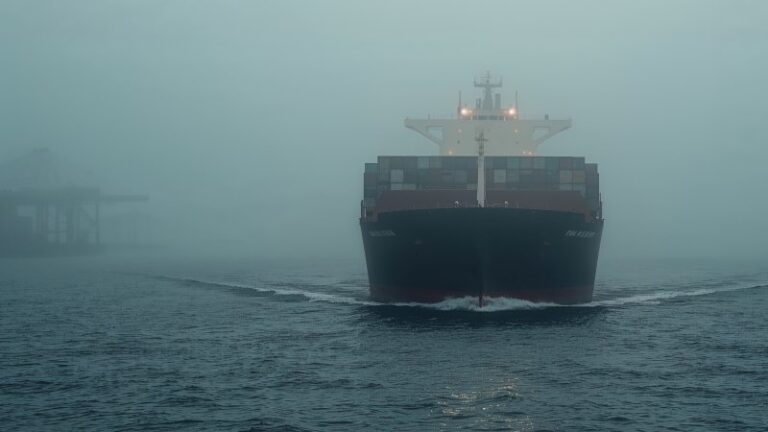
International conflicts and US tariff policies are reshaping the balance of global trade, according to the 27th edition of the Fedespedi Economic Outlook, the regular international freight transport observatory published by Federazione Nazionale Imprese di Spedizioni Internazionali (National Federation of International Freight Forwarding Companies). Tensions in the Middle East have caused a sharp fall in transits through the Strait of Hormuz, down 83% compared with pre-conflict levels, while tariffs introduced by the Trump administration are beginning to affect Italian exports to the United States, especially in the food and automotive sectors. Logistics costs are also weighing on companies, accounting on average for 9.9% of corporate revenues and rising above 11% for small and medium-sized enterprises.
“The geopolitical scenario continues to be the factor that most affects the international economy,” explains Alessandro Pitto, president of Fedespedi, who says the central issue today is not predicting the next crisis, but being prepared for it. Pitto points to the need for a “national project” that moves beyond the idea of an automatic return from Italy’s geographical position: recent crises, such as the almost 1,000 days of closure in the Red Sea, show that routes can change easily and trade continues along other paths. Logistics and freight forwarding, the president stresses, cannot be treated as a residual cost, but must be regarded as a strategic industry and a pillar of Made in Italy.
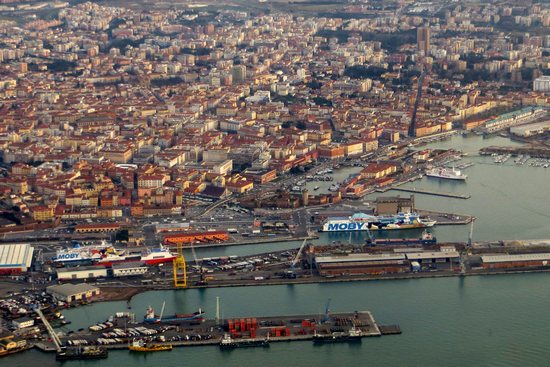
In the first quarter of 2026, global container traffic recorded estimated growth of 4.4%, driven by volumes from the Far East, up 8.8%, Sub-Saharan Africa, up 14.8%, and Latin America, up 4.4%. Italian ports, however, followed the opposite trend, with an overall 4.6% decline in TEU handled. The fall was led by Trieste, down 23.6% and affected by the reorganisation of shipping alliances, followed by Savona, down 14.1%, and Genoa, down 4.9%. Venice was the exception, with growth of 5.8%.
In air transport, Iata data for April 2026 show 4% growth in global cargo traffic, supported above all by Asia and trans-Pacific routes. Italy moved against the trend: in the first four months of 2026, national airports handled 385,100 tonnes of freight, a slight decline of 1%, affected by the slowdown at Milan Malpensa, the country’s main hub, where volumes fell 5% amid difficulties in the Middle East and government measures such as the €2 tax on small parcels from outside the EU. Pisa, down 19.3%, and Rome Ciampino, down 7.9%, also contributed to the decline. Despite this, Italy remains among Europe’s leaders for total, direct and indirect connectivity, ranking fourth on the continent, ahead of France.
In the United States, the economy recovered in the first quarter of 2026, with GDP up 1.6% compared with the same period in 2025, after modest growth of 0.5% in the final quarter of 2025. However, the Trump administration’s tariff policy and higher energy costs are pushing inflation back up after the decline seen in recent years. On the trade front, tariffs are showing their first significant effects: between January and April 2026, US exports rose by 11.3%, also supported by a weak dollar, while imports fell by 5.4%, cutting the US trade deficit by around half, from $435bn to $222bn.
For Italy, the United States remained its leading trading partner in the first quarter, with exports worth €18.79bn and growth of 1.3% year on year. The aggregate figure, however, masks major differences between sectors. Some 55.6% of Italian exports to the US are concentrated in four industrial areas, pharmaceuticals, mechanical engineering, transport equipment and food, but it is precisely among food products that the sharpest declines were recorded: oils and fats were down 33%, processed meat down 25%, bakery products down 18% and beverages down 24.2%. Motor vehicles fell by 21.8%.
International conflicts are having a direct impact on maritime dynamics. In the first quarter of 2026, transits through the Suez Canal fell by 47.2%, with the decline reaching 68% for container ships alone. The figure for the Strait of Hormuz is even sharper: according to data from the Strait of Hormuz website, the current average is just 10 ships a day, compared with 60 before the conflict, a fall of 83%. The slowdown in operations at ports inside the Gulf has been partly offset by the development of external ports along the coasts of the Arabian Peninsula, including Khor Fakkan, Salalah and Jeddah. To manage container traffic while avoiding transit through Hormuz, Gulf countries are developing new multimodal corridors, turning external ports into strategic gateways from which goods can be distributed by land across the Persian Gulf basin.
A.M.B.