







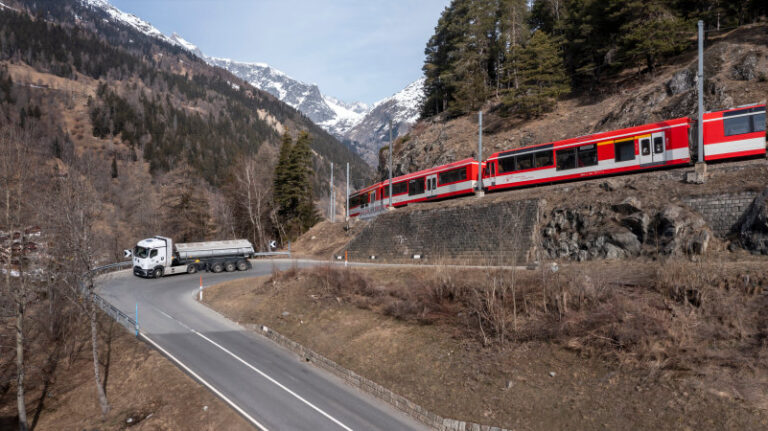
In the first half of 2026, freight transported by rail across the Swiss Alps reached 12.326 million tonnes, up 3.1% from the first half of 2025. This positive figure is offset by a decline in rail's share compared with road: over the same period, truck tonnage rose by 7.5% to 5.793 million tonnes. The figures were published on 10 September by the Swiss Federal Office of Transport and show that, out of total traffic of 18.119 million tonnes, up 4.4%, rail's share fell to 68%, 0.9 percentage points lower than a year earlier.
Looking more closely at transalpine rail freight, wagonload traffic reached 2.773 million tonnes, up 9.9%, while unaccompanied combined transport rose to 9.553 million tonnes, up 7.1%, or around 630,000 tonnes, accelerating from 4.8% growth in the first quarter to 9.5% in the second. The overall result was affected by the discontinuation of the Freiburg-Novara Rolling Highway in December 2025, which had carried 514,000 tonnes in the first half of 2025 compared with none in 2026. Excluding this item from the comparison base, the 12.326 million tonnes would represent growth of 7.7%. This assessment is also confirmed by an analysis of individual routes: 10.034 million tonnes crossed the Gotthard, up 8.4%, or around 780,000 tonnes, while the Lötschberg-Simplon route, linking the Basel area with Domodossola and Piedmont, handled 2.292 million tonnes, down 15.3%, or around 410,000 tonnes. Of the 514,000 tonnes carried by the RoLa service, 496,000 travelled on this route and, excluding that traffic, the Simplon would show growth of 3.8%. The Gotthard's share of transalpine rail freight increased from 77.4% to 81.4%, while the Simplon's fell to 18.6%. Despite the increase, rail volumes remain below the 14.1 million tonnes recorded in the first half of 2024 and well short of the 14.8 million-tonne peak reached in the first half of 2016.
The western corridor is also being affected by engineering works. The Lötschberg-Simplon line was completely closed from 29 May to 27 July 2026 for refurbishment of the spiral tunnel between Iselle and Varzo, with further closures totalling another 80 days over the course of the year. In addition, work on the eastern bore of the Simplon Tunnel between Brig and Domodossola is reducing available freight capacity. In the second quarter of 2026, which includes the start of the closure, combined transport on the Simplon fell by 12.5%. The FOT report identifies engineering works, particularly in Germany and Italy, as the cause of delays accumulated by trains, which can no longer be recovered before destination because of reduced operating margins on the north-south corridors.
For the growth in combined transport in 2026, the FOT identifies three factors based on information from the industry: fewer engineering works, particularly in Germany; measures introduced by operators that have reduced cancellations; and a slight improvement in the European and Swiss economies. Swiss Alpine traffic is largely linked to Italy, and the report directly associates it with the trend in Italian intra-EU trade, which has been recovering since 2025, while Swiss foreign trade volumes have been declining again since the fourth quarter of 2025. The economic forecasts cited by the FOT, despite geopolitical uncertainties, point to continued modest growth in the Alpine market.
Punctuality, however, remained virtually unchanged. In transalpine combined transport, 45.7% of trains arrived with delays of up to 30 minutes, compared with 45.5% in the first half of 2025. Delays of more than three hours fell from 33.4% to 30.6%, while delays of between one and three hours rose from 12.3% to 14.7%. In the second quarter, one southbound train in five, or 21%, accumulated a delay of at least 12 hours. The figures come from a survey of combined transport operators and measure the arrival of trains when ready for unloading rather than their entry into the station, while the FOT does not measure service quality for wagonload traffic. The theoretical number of freight train paths is 302 per day in both directions, 192 on the Gotthard and 110 on the Lötschberg-Simplon, with utilisation rates of 40.1% on the first route, compared with 37.4% in the first half of 2025, and 26.3% on the second, compared with 45.8% a year earlier. The report notes that train path availability is treated as constant even when engineering works, bad weather or accidents reduce actual capacity, and also reports lower capacity on the Gotthard since 28 August 2025 following an incident affecting the corridor.
Crossings by commercial vehicles over 3.5 tonnes reached 511,000, up 7.2%, or around 34,000 vehicles, with growth of 6.3% in the first quarter and 8% in the second. All road crossings recorded increases: Simplon +10.3%, Great St Bernard +9.3%, Gotthard +7.2% and San Bernardino +4.5%. By comparison, 1.258 million trucks and articulated vehicles crossed the Brenner route between Italy and Austria, up 3.6%, while Swiss crossings recorded 458,000 vehicles in the same category, up 7.6%. It should be noted that the Simplon Pass was closed several times in February because of avalanche risk. The FOT links the growth in road freight to economic conditions and considers it likely that rail capacity and quality problems are shifting time- and reliability-sensitive freight back onto roads. Some loads previously carried by RoLa may now also be moving by road, although the office says that firm conclusions will require analysis over the medium to long term. By the end of the year, the FOT estimates that Alpine crossings by commercial vehicles will once again exceed one million for the first time in many years.
As regards operators, SBB Cargo International remains the market leader with 44.1% of transalpine rail freight traffic, up 7.2 percentage points from 2025, followed by BLS Cargo with 20.6%, down 6.1 points, although it holds a 63.8% share on the Simplon. DB Cargo moves into third place with 16.4%, up 11.6 points, driven by the Gotthard, where its share reaches 19.7%, while SBB Cargo falls to fourth with 7.1%, down 10.2 points. TX Logistik stands at 5.5%, up 1.7 points, Railcare at 0.9%, up 0.1 points, and other operators at 4.6%, up 1.5 points. The decline in SBB Cargo's Alpine transit business should be distinguished from its performance in single-wagonload traffic, which serves the whole of Switzerland with domestic, import and export flows and, since 2026, also includes empty wagons and Swiss Split traffic previously classified as combined transport. In this segment, loaded wagons fell from around 185,000 to 180,000, down 3%, but excluding the impact of the new classification the actual decline was 8%, while tonne-kilometres fell by almost 5% to 584 million. Since the beginning of the year, the Confederation has supported the segment through a four-year agreement with SBB Cargo: the half-year loss fell to around CHF12 million from almost CHF40 million a year earlier, but this included CHF40 million in federal compensation, which is due to decline from CHF80 million a year in 2026 to CHF45 million in 2029. The cost per loaded wagon, which rose in the first quarter, returned to its 2025 level in the second, although over the full half-year it remained at CHF937 compared with CHF893.
For the coming years, the FOT warns that works announced for 2027-2029 on Germany's Rheintalbahn and the Lötschberg-Simplon corridor could put pressure on the recovery seen in 2026, with an improvement expected only from around 2030. Meanwhile, as part of the ongoing revision of the freight transport law, the Federal Council is planning additional financial resources for rail freight across the Alps.
Antonio Illariuzzi